


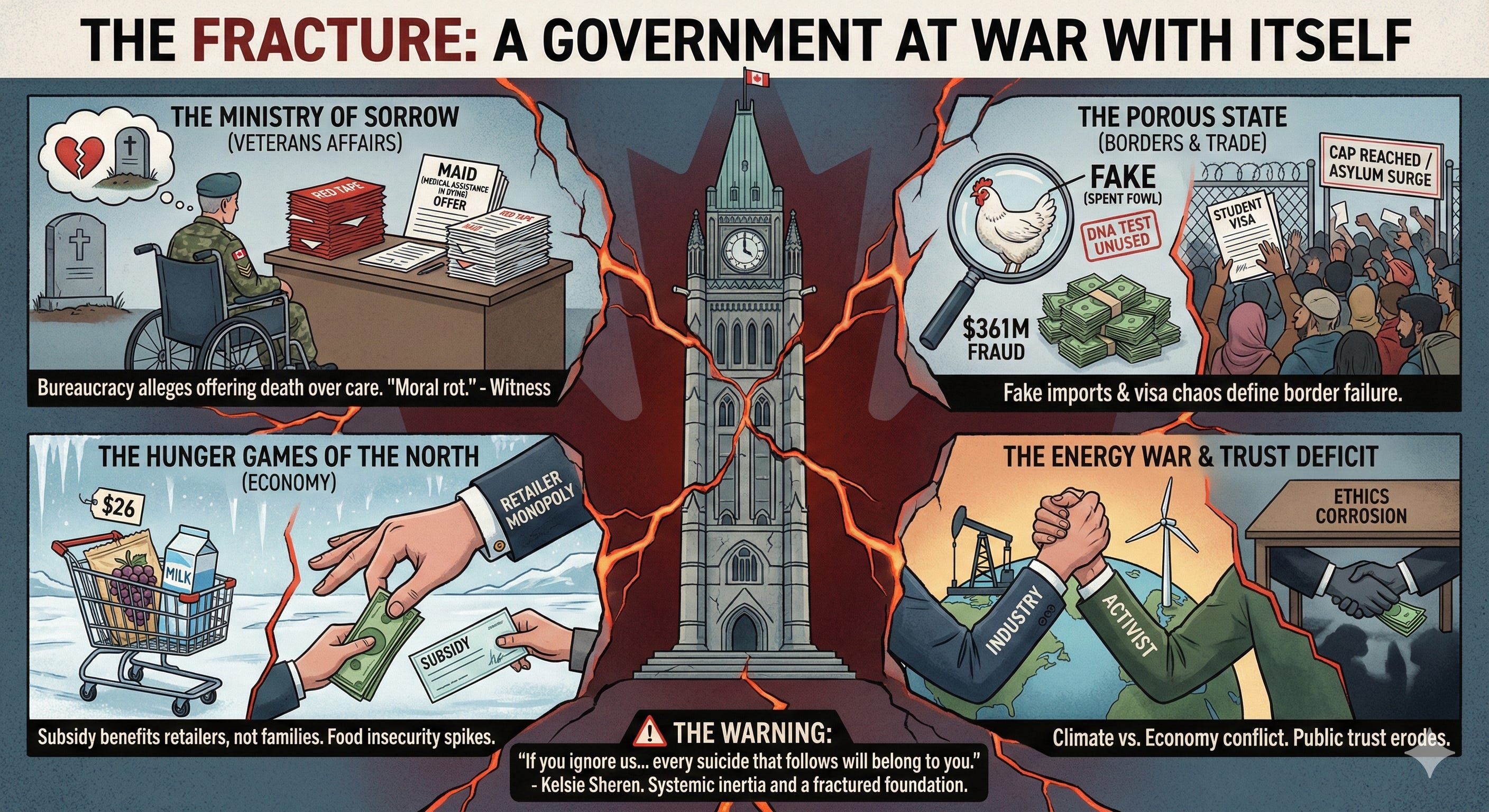
The silence in Room 035-B of the West Block was heavy, the kind that settles only after a truth so jagged has been spoken that it tears the parliamentary air itself. Kelsie Sheren, a veteran who deployed to Afghanistan at eighteen as an artillery gunner, sat before the Standing Committee on Veterans Affairs and did not blink.
She wasn’t there to discuss funding formulas or bureaucratic tweaks. She was there to talk about the government offering death as a cure for trauma.
“I know this because you send PIs to follow me around,” Sheren told the stunned MPs, her voice steady but laced with fury. “You threaten me in emails... Over 20 veterans have confirmed they’ve been offered MAID [Medical Assistance in Dying]. I have the proof.”
It was a week where the veneer of parliamentary procedure cracked, revealing the raw, human cost of systemic failure beneath. Across two dozen committee meetings, a picture emerged not just of policy disagreements, but of a sprawling state apparatus that has become simultaneously paralyzed by inertia and actively hostile to the citizens it is meant to serve. From the emotional devastation of veterans pleading for their lives to the surreal forensic hunt for fraudulent chicken imports, the proceedings painted a portrait of a nation struggling to maintain its moral obligations, its economic viability, and it’s very borders.
The Ministry of Sorrow
The testimony at the Veterans Affairs committee was visceral, a parade of those who had offered everything to the state, only to find the state had nothing left for them but paperwork and, allegedly, proposals for assisted suicide.
It wasn’t just Sheren. Retired Corporal Christine Gauthier, a paraplegic Olympian who served her country for a decade, brought the weight of a five-year battle just to get a wheelchair ramp installed in her home. But the bureaucracy didn’t just delay; it allegedly offered a final exit. Gauthier recounted a moment of desperation with a Veterans Affairs case manager. “If you really can’t deal with it anymore,” she recalled being told, “you know, you have the right to die.”
The disconnect was absolute. Shaun Fynes, whose son Stuart Langridge died by suicide after struggling with PTSD, described a system that bifurcates grief based on geography. “If they died overseas... they are honoured,” Fynes said, his voice carrying seventeen years of sorrow. “If they brought the war home and died later by suicide, they are discarded.”
While MPs debated the legal nuances of MAID, witnesses described a “moral rot.” They spoke of a bureaucracy so efficient at processing forms that it had forgotten how to process humanity. The committee heard that veterans must navigate a labyrinth of seven different agencies for health coverage, often managed by staff who do not understand military culture or, according to Sheren, sometimes don’t even speak the same language as the soldiers they serve.
This administrative cruelty was not isolated to Veterans Affairs. In the Health committee, witnesses warned of a broader healthcare system buckling under strain, facing a “human resources crisis” that leaves the most vulnerable waiting for basic care, creating a society where the sick are viewed as operational burdens rather than human beings in need.
The Hunger Games of the North
While veterans fought for their lives in Ottawa, Indigenous communities in the North were fighting for their daily bread. At the Standing Committee on Indigenous and Northern Affairs, the abstract concept of “affordability” dissolved into the brutal reality of survival. The subject was Nutrition North Canada, a federal subsidy intended to make food affordable in remote communities.
The reality on the ground is a $26 bag of grapes.
Witnesses described a subsidy that evaporates before it touches the shelves, absorbed by retailers holding monopoly power in isolated regions. “The subsidy is for the retailer, not for the people,” one witness stated bluntly to the committee. In communities where food insecurity is a daily gnawing hunger, the government’s flagship program was described as a corporate handout cloaked in humanitarian language.
The frustration was palpable. Billions in federal spending have not lowered the price of milk in Nunavut, leaving families to make impossible choices between heating their homes and feeding their children. The testimony revealed a profound dereliction of duty, where the government writes cheques but refuses to track whether the money actually feeds the hungry.
This theme of economic suffocation echoed in the Finance and Industry committees, where the wider national anxiety took centre stage. Small business owners testified they are being crushed by credit card transaction fees, while the average Canadian family sees their purchasing power eroded by relentless inflation. The Finance committee heard analysis suggesting government “affordability measures”—such as a tax cut saving the average worker roughly $200 a year—amount to less than the cost of a daily coffee, a drop in the bucket against the rising tide of housing and food costs.
The Porous State
If the social contract is fraying at home, the nation’s borders are facing an identity crisis, both agricultural and human. In a surreal turn at the Agriculture committee, the integrity of Canada’s trade infrastructure came down to a DNA test for poultry.
The Chicken Farmers of Canada testified to a massive, coordinated fraud. Millions of kilograms of prime broiler chicken are being illegally imported as “spent fowl”—old egg-laying hens—to bypass high tariffs. It is a scheme costing the Canadian economy an estimated $361 million and threatening the stability of the supply management system.
The tragedy is that the solution exists. A DNA test developed at Trent University can distinguish between the meat types. Yet, despite the technology being ready since 2014, the Canada Border Services Agency has failed to implement it. “This is illegal activity at our borders,” said Tim Klompmaker, chair of the Chicken Farmers. It is a symptom of a border agency overwhelmed, under-resourced, and unable to utilize basic science to enforce the law.
The chaos extended to the Citizenship and Immigration committee, where the fallout of the international student cap was laid bare. Witnesses described a system in freefall. The sudden imposition of caps has led to unintended consequences, including a surge in fraudulent asylum claims as pathways to residency close.
The Minister of Immigration faced intense questioning over a proposed power to conduct “mass cancellations” of visas—a blunt instrument for a delicate problem. The testimony revealed a government scrambling to close doors it had left wide open for too long, with the global reputation of Canada’s education system as collateral damage. Genuine students are caught in bureaucratic crossfire, while bad actors exploit gaping loopholes the government seems powerless to close.
The Energy War and the Trust Deficit
The systemic fractures ran deep into the debates over Canada’s economic future. In the Environment and Natural Resources committees, the tension over the proposed emissions cap for the oil and gas sector was explosive.
An eighteen-year-old climate activist stared down industry executives, demanding an immediate transition, while industry representatives warned that a hard cap would serve only to export jobs and revenue to countries with lower environmental standards, without reducing global emissions. It was a dialogue of the deaf, highlighting the impossible tightrope between economic imperative and existential climate threat.
Yet, the ability of Parliament to navigate these complex tradeoffs appeared fatally compromised by a fundamental lack of trust. In the Ethics committee, the focus turned to the “appearance” of conflict of interest and the awarding of government contracts. Witnesses argued that a subtle corrosion of ethical standards has occurred, where adherence to the letter of the law is used to mask violations of its spirit. Without a foundation of trust that decisions are being made in the public interest, the committee heard, the government lacks the legitimacy to tackle crises in healthcare, housing, or the environment.
The Warning
Across twenty-two committees, a singular, terrifying theme emerged. The systems designed to protect, serve, and regulate are buckling under the weight of modern complexity and bureaucratic inertia. It is a government that can debate AI regulation in the Heritage committee while failing to use basic DNA testing at the border; a government that speaks of reconciliation while overseeing starvation-level food prices in the North; a government that praises its veterans while its own machinery suggests they might be better off dead.
Back in the Veterans Affairs committee, the stakes were made crystal clear. As the meeting wound down, Kelsie Sheren looked the MPs in the eye and offered a final, chilling premonition.
“If you ignore us after today,” she warned, “every suicide that follows will belong to you.”
It was a week where the abstract machinery of the state collided violently with the concrete reality of the people it serves. The friction generated heat, light, and a terrifying glimpse of the fracture running through the foundation of Canada.
Source Documents
Standing Committee on Veterans Affairs. (2025, October 28). Evidence [PDF]. Parliament of Canada.
Standing Committee on Agriculture and Agri-Food. (2025, October 27). Evidence [PDF]. Parliament of Canada.
Standing Committee on Canadian Heritage. (2025, October 29). Evidence [PDF]. Parliament of Canada.
Standing Committee on Citizenship and Immigration. (2025, September 25). Evidence [PDF]. Parliament of Canada.
Standing Committee on Citizenship and Immigration. (2025, October 7). Evidence [PDF]. Parliament of Canada.
Standing Committee on Citizenship and Immigration. (2025, October 30). Evidence [PDF]. Parliament of Canada.
Standing Committee on Environment and Sustainable Development. (2025, October 30). Evidence [PDF]. Parliament of Canada.
Standing Committee on Access to Information, Privacy and Ethics. (2025, October 27). Evidence [PDF]. Parliament of Canada.
Standing Committee on Access to Information, Privacy and Ethics. (2025, October 29). Evidence [PDF]. Parliament of Canada.
Standing Committee on Foreign Affairs and International Development. (2025, October 30). Evidence [PDF]. Parliament of Canada.
Standing Committee on Finance. (2025, October 1). Evidence [PDF]. Parliament of Canada.
Standing Committee on Finance. (2025, October 29). Evidence [PDF]. Parliament of Canada.
Standing Committee on Fisheries and Oceans. (2025, October 30). Evidence [PDF]. Parliament of Canada.
Standing Committee on the Status of Women. (2025, October 29). Evidence [PDF]. Parliament of Canada.
Standing Committee on Health. (2025, October 30). Evidence [PDF]. Parliament of Canada.
Standing Committee on Indigenous and Northern Affairs. (2025, October 30). Evidence [PDF]. Parliament of Canada.
Standing Committee on Industry and Technology. (2025, October 30). Evidence [PDF]. Parliament of Canada.
Standing Committee on Justice and Human Rights. (2025, October 29). Evidence [PDF]. Parliament of Canada.
Standing Committee on National Defence. (2025, October 30). Evidence [PDF]. Parliament of Canada.
Standing Committee on Government Operations and Estimates. (2025, October 30). Evidence [PDF]. Parliament of Canada.
Standing Committee on Natural Resources. (2025, October 29). Evidence [PDF]. Parliament of Canada.
Standing Committee on Science and Research. (2025, October 30). Evidence [PDF]. Parliament of Canada.
Standing Committee on Transport, Infrastructure and Communities. (2025, October 30). Evidence [PDF]. Parliament of Canada.
Wow, this is awesome. Your work highlights things I want to know about how our government is working or not working for Canadians. Now these issues have been raised maybe solutions will be identified. We need a thorough updating of our government systems. Now is the time to do it, as we develop our nation to meet the challenges we face from outside our borders. We were too comfortable for too long, now it’s time to stretch.