


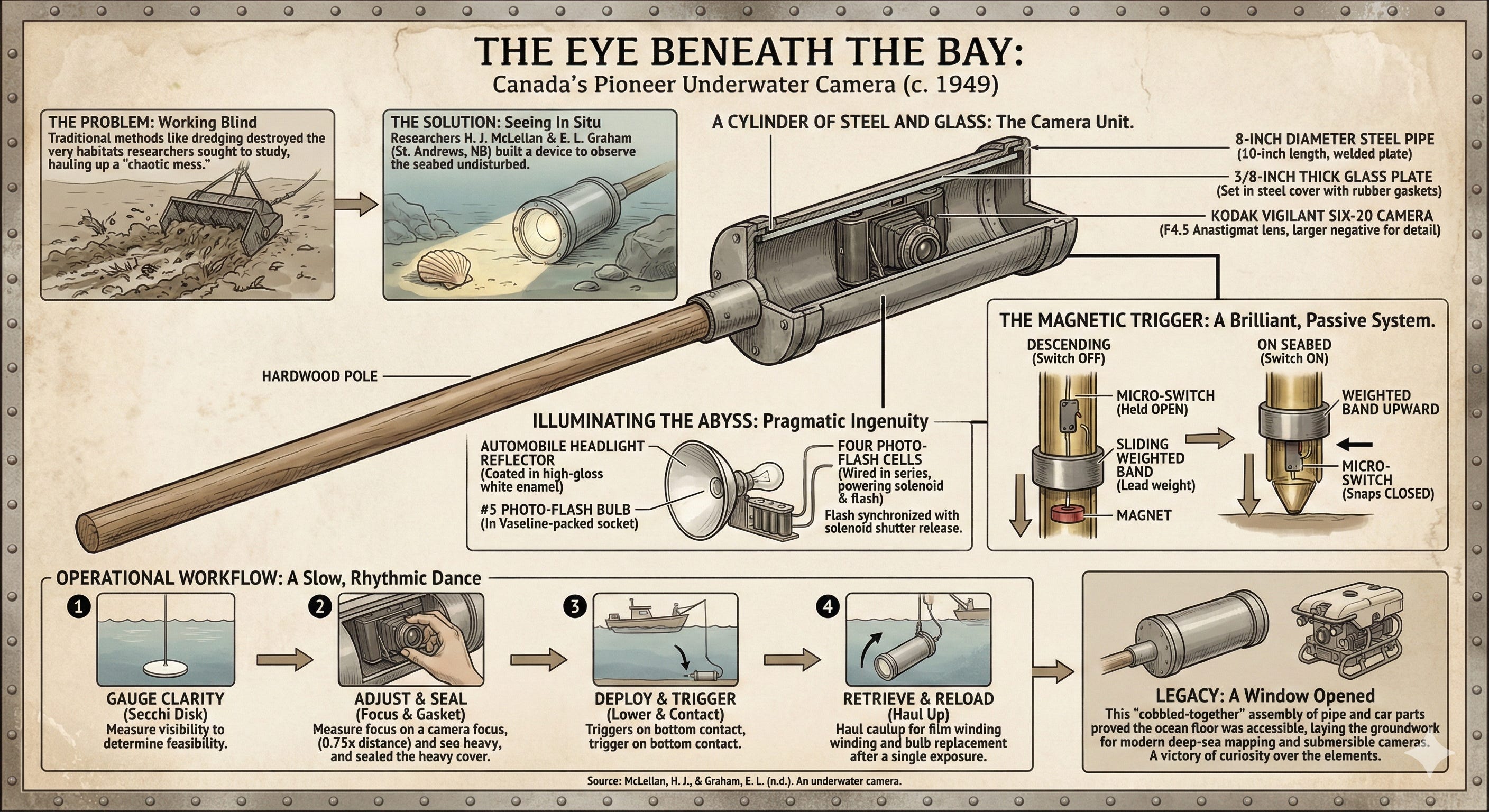
The ocean floor has always been a place of silence and profound darkness. For generations of marine researchers, the only way to understand what lay beneath the surface was to drag heavy nets or metal dredges across the bottom, hauling up a chaotic mess of mud, stone, and damaged biology. It was a method akin to studying a forest by bulldozing it and examining the debris. In the late 1940s, however, the scientists at the Atlantic Oceanographic Group in St. Andrews, New Brunswick, decided they were done working blind. They needed to see the seabed as it existed, undisturbed and in situ.
The result was not a sleek, mass-produced instrument of modern oceanography. It was a heavy, industrial beast born of necessity and ingenuity. H. J. McLellan and E. L. Graham, the architects of this vision, assembled a device that combined heavy-duty plumbing with consumer photography and automotive salvage. Their creation was a testament to the era of hands-on science, where the gap between a hypothesis and a breakthrough was often bridged by a welding torch and a tube of waterproofing grease.
A Cylinder of Steel and Glass
The environment of the North Atlantic is unforgiving. Saltwater corrodes metal in days, and the pressure at depth can crush standard housings like aluminum cans. McLellan and Graham began their construction with the only material rugged enough to survive: steel pipe. They utilized a ten-inch length of eight-inch diameter steel pipe, welding a heavy plate over one end to create a cup. This was the sanctuary for the delicate optics.
Inside this armored shell sat a Kodak Vigilant Six-20. It was a standard consumer camera of the time, folding and bellows-equipped, boasting an f4.5 Anastigmat lens. While 35mm cameras were becoming popular, the researchers opted for the larger Six-20 format. The larger negative offered a crucial advantage in the murky underwater world, allowing for granular examination of the images without the need for immediate enlargement.
The camera did not look straight down. It peered through a 3/8-inch thick glass plate set into a heavy steel cover, held fast by rubber gaskets and a retaining ring. The entire case was mounted on a fifteen-foot hardwood pole, angled specifically so the camera’s field of view would just miss the pole’s own foot. It was a design of geometric precision executed with heavy industrial materials. The researchers understood that once the device slipped beneath the waves, there were no second chances. Every seal had to hold. Every angle had to be true.
The Magnetic Trigger
The greatest engineering challenge was not keeping the water out but deciding when to let the light in. The camera needed to fire at the exact moment it reached the bottom, but it also had to remain dormant during the descent to prevent wasting the film or the flash on the empty water column. McLellan and Graham devised a triggering mechanism that relied on magnetism rather than mechanical springs, which could jam with sand or silt.
They constructed a switch sealed inside a brass pipe at the bottom of the pole. Inside, a micro-switch was held in the “open” or off position by the magnetic field of a magnet attached to a sliding external band. This band was weighted with lead. As long as the unit was suspended in the water column, the weight of the lead pulled the band down, keeping the magnets aligned and the circuit broken.
The moment the pole touched the seabed, the physical resistance of the earth pushed the weighted band upward. This movement separated the magnetic fields, allowing the internal switch to snap closed. In that instant, a solenoid attached to the camera shutter tripped, and a flashbulb exploded with light. It was a brilliant, passive system. The ocean floor itself took the picture.
Illuminating the Abyss
Photography is the manipulation of light, and at the bottom of the Bay of Fundy, light is a scarce commodity. To illuminate the gloom, the researchers salvaged a reflector from an old automobile headlight. They coated it with high-gloss white enamel to maximize diffusion and mounted it on the pole near the bottom.
The flash system was a study in pragmatic risk management. They used a single contact bayonet socket to hold a standard #5 photo-flash bulb. In a move that would terrify a modern electrical engineer, they provided no waterproofing for the socket itself. Instead, they packed it with Vaseline to retard corrosion. They calculated that the electrical resistance of the flash bulb was so low that the short-circuiting effect of the surrounding saltwater would be negligible during the split-second of ignition.
Powering this system were four photo-flash cells wired in series. The solenoid on the camera shutter was synchronized to open exactly as the bulb reached its peak brilliance. This synchronization was vital. The researchers were fighting against the scattering of light by suspended particles in the water—a phenomenon that creates a fog-like effect in photographs. By placing the light source close to the subject but away from the lens axis, they hoped to minimize the glare that often ruined underwater images.
Shadows in the Deep
The operational procedure was a slow, rhythmic dance on the deck of the station launch. The researchers would gauge the water clarity using a Secchi disk, a white plate lowered into the water until it disappeared from view. This crude measurement dictated their settings. If the disk vanished at ten feet, they knew the bottom would be a murky twilight.
They adjusted the camera’s focus not to the actual distance, but to 0.75 times the measured distance, a necessary correction to account for the index of refraction of water. Objects underwater appear closer than they are, and the lens had to be tricked to see clearly. With the focus set and the shutter cocked, the heavy steel cover was screwed down tight, the gasket greased to ensure a seal against the crushing deep.
During the summer of 1949, the unit was put to the test in the waters around Passamaquoddy Bay. The initial results were a mixture of triumph and frustration. In the clear, shallow waters of Chamcook Lake, the camera performed flawlessly, capturing sharp images of the bottom composition. But the open bay was a different beast.
The Fog of War
The team quickly discovered the limitations of photography in turbid waters. In areas where the Secchi disk reading was ten feet or less, the resulting negatives were often blank slates of grey, the light from the flash scattered back into the lens by millions of suspended particles. It was like trying to take a picture through a heavy snowstorm with high beams on.
However, when the water cleared, the results were revelatory. Photos taken at Head Harbour and the reefs at its mouth revealed a world of stark beauty and scientific value. The flash cut through the gloom to reveal scallop shells standing out like beacons against the dark substrate. The researchers found that while the printed photographs often looked muddy and low-contrast, the original negatives held a wealth of detail visible to the trained eye.
They experimented with yellow filters to cut through the blue-scattered light, refining their technique with every drop. They learned that the camera was more than just a recording device; it was a surveyor. By calculating the angle of view and the height of the pole, they could measure the size of the objects in the frame, turning the photographs into quantitative data sources.
A Window Opened
The camera unit designed by McLellan and Graham was not a perfect instrument. It required the unit to be hauled to the surface after every single exposure to wind the film and replace the flashbulb. It was heavy, slow, and dependent on the capricious clarity of the coastal waters. Yet, it represented a fundamental shift in how marine science was conducted in Canada.
For the first time, researchers at St. Andrews were not just guessing at the composition of the bottom based on what they scraped up. They were seeing it. They saw the arrangement of the rocks, the density of the weed, and the undisturbed habitats of the scallops. This cobbled-together assembly of steel pipe and car parts proved that the ocean floor was accessible. It laid the groundwork for the sophisticated remote-operated vehicles and submersible cameras that would eventually map the depths of the world’s oceans. It was a victory of curiosity over the elements, achieved one flashbulb at a time.
Source Documents
McLellan, H. J., & Graham, E. L. (n.d.). An underwater camera (Manuscript Report of the Biological Stations No. 384). Fisheries Research Board of Canada, Atlantic Oceanographic Group.