

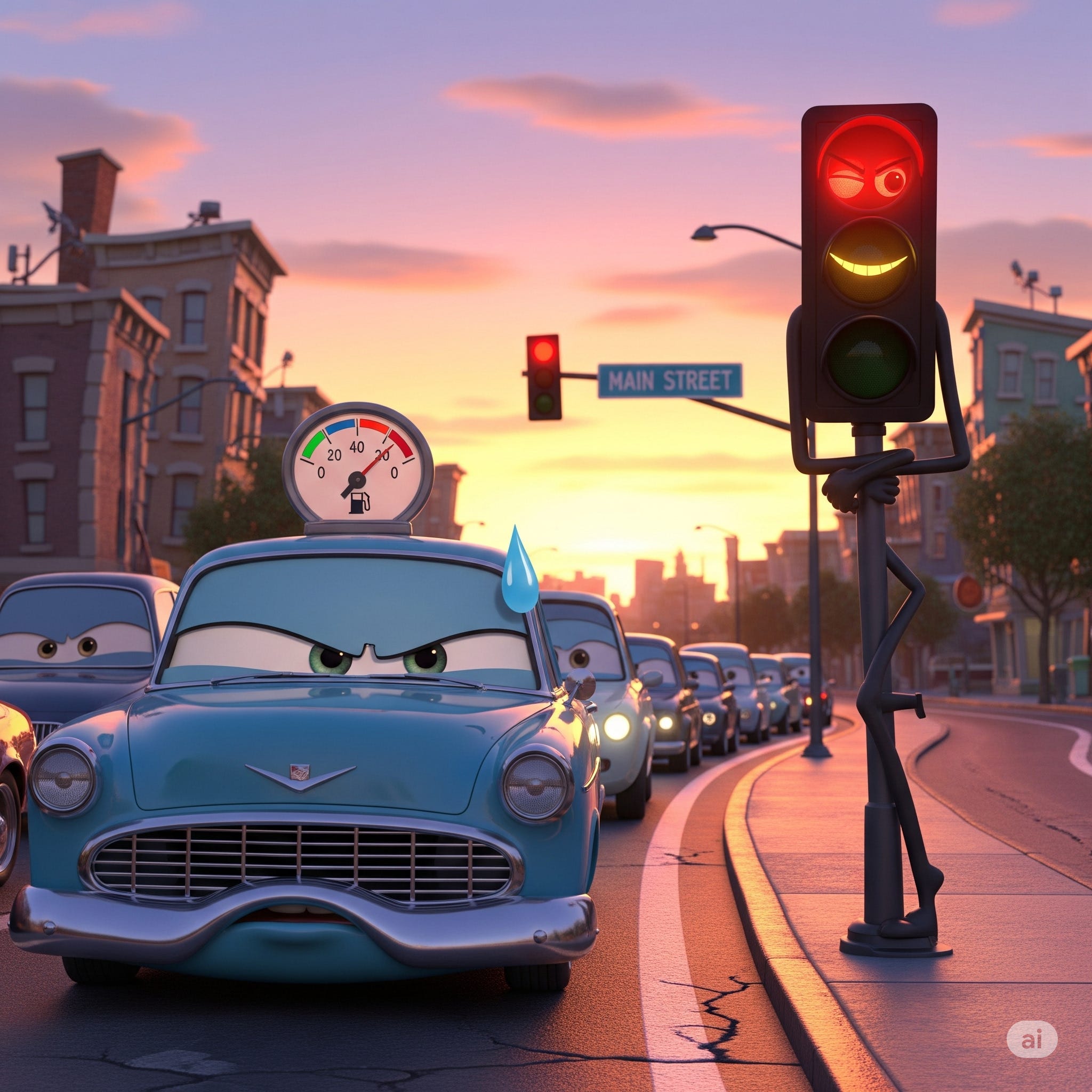
You’re sitting in traffic, watching the fuel gauge drop. Every red light feels like a personal attack on your wallet. The common wisdom is simple: the faster you get to your destination, the less fuel you'll use. It’s a logical assumption that has guided traffic management in our cities for decades. We ask our GPS for the "fastest route," and city planners optimize traffic signals to minimize travel time, believing they are saving us both time and money.
But what if this entire approach is wrong? What if the relentless focus on minimizing travel time is actually making our cars thirstier? It’s a frustrating paradox. We hurry up to wait at the next red light, burning gas with every stop and start, all in the name of speed. We've been trained to think that speed equals efficiency, but the physics of a two-ton metal box tells a very different story.
A fascinating, deep-dive study from 1978, conducted by the National Research Council of Canada and Metro Toronto's traffic department, put this assumption to the test. They instrumented a car, measured every drop of fuel, and recorded its exact velocity second-by-second to uncover the hidden relationship between traffic signals, speed, and fuel consumption. Their findings reveal a hidden system at play on our city streets, one that challenges the very foundation of how we manage traffic.
This article unpacks the core discovery of that experiment. By the end, you'll understand why the "fastest" route is often the least economical and how a different approach to traffic flow could save everyone a significant amount of fuel.
The System We Built: A Need for Speed
For decades, the primary goal of urban traffic control has been singular: minimize delay. Cities around the world, like the Toronto of the late 1970s, were early adopters of computerized traffic signals precisely for this reason. The objective was to get vehicles from Point A to Point B as quickly as possible. This created a system designed for "bursts" of speed. Traffic lights are timed to let large groups of cars accelerate quickly, travel at the speed limit, and then, more often than not, come to a complete stop at the next intersection.
This "speed-first" philosophy makes sense on the surface. A car sitting idle is getting zero miles per gallon. Therefore, reducing the time a car spends on its journey should, in theory, reduce the total fuel burned. It's an elegantly simple idea, and it’s the logic that still underpins most of our traffic networks today.
Decoding the Hidden Cost: The Physics of Stop-and-Go
The 1978 study revealed the flaw in this logic. While speed is a factor, the real enemy of fuel economy is inconsistency. The researchers simulated different traffic signal patterns on a stretch of Don Mills Road in Toronto and measured the results.
Here’s what they found:
A route with one stop resulted in fuel economy of 13.84 MPG.
The same route with two stops dropped fuel economy to 13.45 MPG.
A route with three stops plummeted fuel economy to 12.15 MPG.
The act of accelerating a vehicle from a standstill is the single most fuel-intensive part of urban driving. It requires immense energy to overcome inertia. Cruising at a steady speed, even a relatively high one, is far more efficient. The study concluded that a traffic control strategy based purely on minimizing travel time often creates more of these fuel-costly accelerations.
The Real Goal: Engineering for 'Flow'
The data points to a different, more efficient philosophy: managing traffic for optimal flow rather than maximum speed. This means creating a system where drivers can maintain a more consistent, albeit potentially lower, average speed with far fewer stops.
Think of it like this:
The "Speed" Model: Imagine sprinting 100 yards, then stopping completely. Then sprinting another 100 yards and stopping again. It's fast, but exhausting and inefficient. This is our current traffic system.
The "Flow" Model: Now, imagine jogging that same distance at a steady pace without ever stopping. It might take slightly longer, but you'll expend far less energy. This is the fuel-efficient model.
The study found that trade-offs between higher road speeds and additional accelerations are critical. Making two stops instead of one only slightly increased fuel consumption because the car spent more time at an efficient cruising speed. But adding a third stop was the breaking point, causing a significant penalty in both time and fuel. This suggests there is a sweet spot, a balance between travel time and the number of stops, that could be achieved with smarter traffic signal sequencing.
What This Means For Our Cities
The implications of this 40-year-old study are more relevant than ever. With urban automobile transportation accounting for a significant portion of petroleum consumption, optimizing this system could have a massive economic and environmental impact.
For City Planners: The focus could shift from "How fast can we move cars?" to "How smoothly can we move cars?" This might mean slightly longer green lights, synchronized corridors, and algorithms that prioritize minimizing stops over shaving a few seconds off travel time.
For Drivers: It's a reminder that aggressive, stop-and-start driving is incredibly wasteful. Maintaining a steady pace and anticipating light changes to avoid unnecessary braking and accelerating is the most powerful tool you have to save fuel.
The Takeaway
The most profound insights are often the ones that challenge our most basic assumptions. We believed speed was the key to efficiency, but the real key is consistency. This forgotten study proves that the smoothest journey is also the most economical one. By re-examining the hidden systems that govern our daily lives, we can find smarter ways to move, saving fuel, money, and frustration in the process.
What do you notice about the traffic flow in your city?
If you found this valuable, share it with a friend or colleague.
Follow OnHansard for more deep dives that make you smarter.
Source: Urban traffic signal control for fuel economy: project outline and system description (National Research Council of Canada, 1978)
What if cities were designed using wheel spoke and wheel concept: business center, community / recreation centers all threaded with efficient public transport and lots of green space where populations could enjoy forest-bathing. It's an idea that some brilliant urban planners could take further. I'll keep dreaming.
Thanks again - great essay.
I knew this. For many years I have tried to synchronize my travel to green lights. Not alelways successfully, but I tried. O