

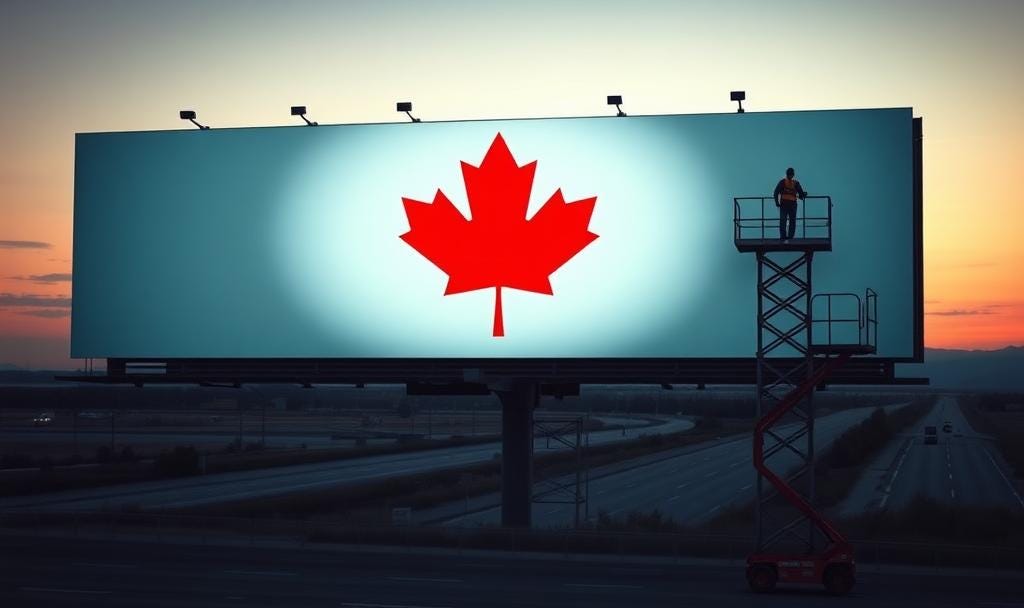
Imagine you’re driving down the highway or filling up your car, and you see a billboard. It’s not for a soft drink or a new truck. It’s an advertisement… about international trade policy. You’d probably have two questions: Who paid for this? And, more importantly, why?
We tend to think of geopolitics as an abstract chess match played by people in dark suits in faraway capital cities. We hear about trade disputes on the news, but they feel distant, like a problem for someone else to solve. The idea that a foreign government would buy ad space at your local gas station to talk to you about it seems bizarre.
But a recently released Canadian government document reveals that this is exactly what happened. In response to U.S. tariffs, the Canadian government didn't just issue press releases; it launched a quiet, data-driven, and highly personal advertising campaign on American soil.
This is the story of that campaign. It’s a story about how modern governments try to win arguments, not by shouting at each other, but by whispering in the ears of citizens. By the time we’re done, you’ll see those highway billboards a little differently.
A Trade Dispute Gets Personal
Our story begins with a policy decision: The United States imposed tariffs on some goods imported from Canada. From Canada's perspective, this was a problem that would hit Americans directly. They believed the tariffs risked "significant economic harm to Americans through higher prices on everyday items, disrupted supply chains, and reduced availability of certain products".
The Canadian government could have responded with retaliatory tariffs and left it at that. Instead, Global Affairs Canada (GAC) decided on a different strategy: a "factual advertising campaign in the United States".
The plan wasn't just to state its position. The core goal was to "educate the American public on the personal impact of these policies". GAC wanted to take the abstract concept of "tariffs" and connect it directly to the things ordinary people care about.
Winning Hearts, Minds, and Wallets
The ultimate objective of the campaign was twofold. First, to foster support for a strong U.S.-Canada partnership. Second, and more directly, to encourage Americans to "engage in informed discussions with their representatives and within their communities".
To do this, the government of Canada hired a marketing firm, Leger, for a contract worth $68,283.64. Their job was to build and measure a campaign that would make Americans more concerned about how tariffs could impact their:
Daily life
Personal finances
Family and community
The government wasn’t just buying ads; it was buying a strategy to make a political issue feel deeply personal.
The 'Red State' Test Kitchen
Before spending a dollar on billboards, the team needed to know if their message would work. In marketing, this is called concept testing. In geopolitics, it looks a lot like this project's "Creative Concept Testing" survey.
This is where the strategy gets really sharp.
They didn't survey a random sample of Americans. The research team specifically targeted 506 residents living in "red states" and Republican-leaning states.
Think of it like a comedian testing new material on the toughest crowd they can find. If you can craft a message about the economic downsides of tariffs that resonates in states that might be ideologically supportive of those same tariffs, you know your argument is powerful. They assessed if the ads were credible, memorable, and—most importantly—if they had the potential to motivate the audience to take action.
The 'Purple District' Play
Once Leger and GAC had honed their message in the "red state" test kitchen, it was time to launch the full campaign. The post-campaign survey, known as the Advertising Campaign Evaluation Tool (ACET), was deployed across twelve states and the District of Columbia.
Here again, the targeting was surgically precise. The campaign focused on 2,003 Americans living in "strategic" swing states, with a focus on "purple districts"—areas that represent a mix of Democratic and Republican voters. These were the places where public opinion was most fluid and, therefore, most valuable.
The ads were placed in specific locations identified by ZIP code, appearing as:
Digital and highway billboards
Signage in and around gas stations
Displays in shopping malls and grocery stores
An international trade debate was now happening in the places where Americans live and shop.
The Takeaway: A New Kind of Diplomacy
This 36-page report tells the story of a fascinating and thoroughly modern political campaign. A friendly foreign government, facing a trade dispute, chose not to escalate but to educate.
It bypassed traditional diplomatic channels to speak directly to the American people about their personal finances and their families. It used the tools of a data-driven marketing firm—A/B testing messages, targeting specific demographics, and buying local ad space—to achieve a geopolitical goal.
This is what modern influence can look like. It's not always a shadowy plot. Sometimes, it’s a transparent, factual, and highly strategic campaign to win an argument, one billboard at a time.