


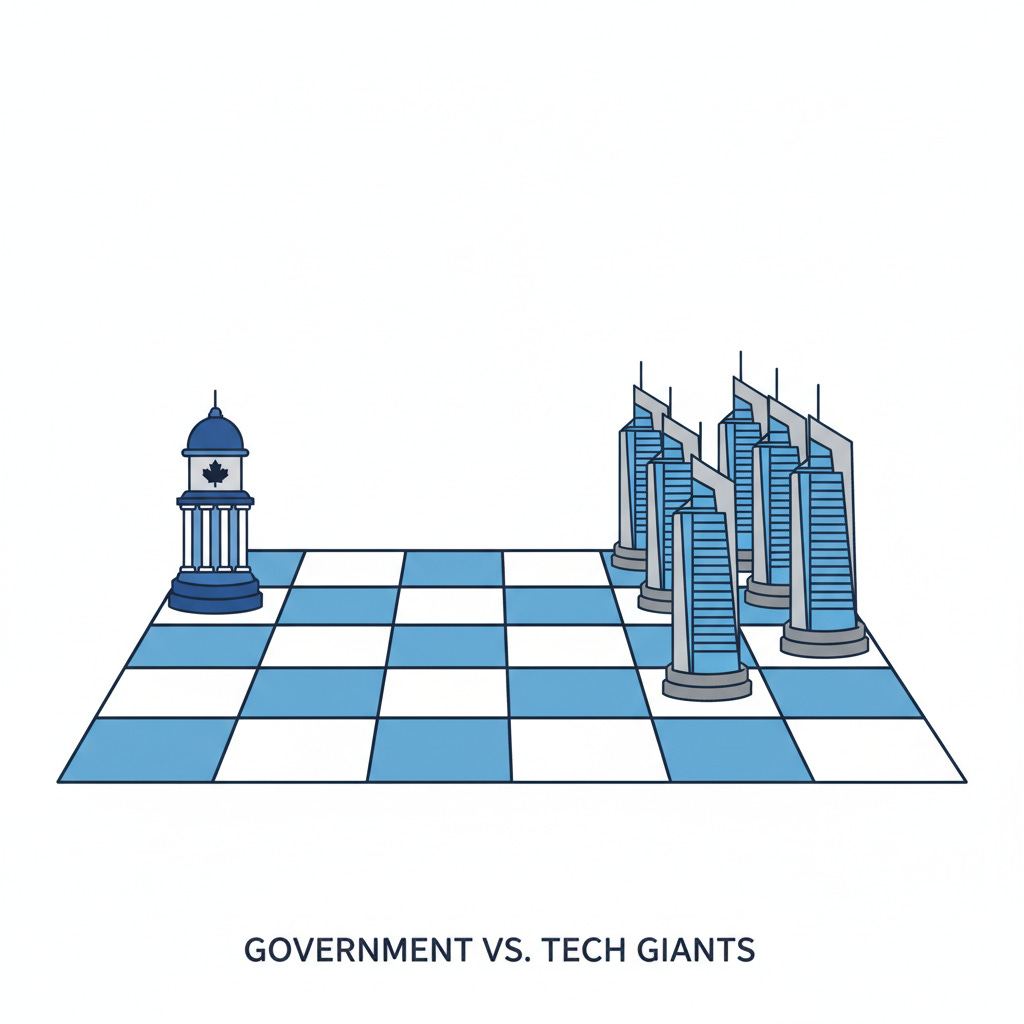
The relationship between a democratic government and a multinational corporation is supposed to be clear: one creates the rules, the other operates within them. A November 2024 report from the House of Commons Standing Committee on Canadian Heritage, titled Tech Giants’ Intimidation and Subversion Tactics to Evade Regulation, suggests this relationship is no longer so straightforward. The report, prompted by the actions of Google and Meta in response to Bill C-18 (the Online News Act), provides a detailed accounting of a confrontation between Parliament and two of the world’s most influential companies. This was not a simple policy disagreement. It was a case study in how corporate power is applied to influence, and at times subvert, the democratic process itself.
The conflict began with a clear problem. For years, Canadian media outlets have seen their advertising revenues decline as those same dollars migrated to digital giants like Google and Facebook. Bill C-18 was Parliament’s proposed solution: a framework to force digital news intermediaries to negotiate fair compensation with news organizations for using their content. The response from the tech companies was immediate and decisive. Google ran “tests” blocking news access for a percentage of Canadian users, while Meta threatened to, and ultimately did, remove all news content from its platforms in Canada. These actions, which many Canadians experienced directly, were the most visible part of a much deeper, more methodical strategy to resist regulation.
The Digital Tobacco Playbook
Here’s the detail I find most revealing. During testimony, one witness, Georg Riekeles from the European Policy Centre, directly compared the tech industry’s strategy to that of the tobacco industry. This points to a critical question: Are the tactics used by tech giants unique to the digital age, or are they a modern application of a well-worn corporate playbook for resisting government oversight? The committee’s report provides extensive evidence for the latter. The strategy appears to be a multi-front campaign designed to control the narrative, the research, and the political environment.
This campaign is what we might call the Digital Tobacco Playbook. It is a systematic approach to shaping public and political opinion to protect a business model from regulation.
First, Control the Narrative
The first element of the playbook involves an overwhelming effort to shape the public and political conversation through lobbying and public relations. Witnesses described how tech companies deploy “massive funding” to build extensive networks of lobby groups, think tanks, and academic partnerships, creating a “gigantic lobbying echo chamber that constantly plays a variation of the same tune: Regulation will damage the economy, damage innovation and be bad for small and medium enterprises.” This goes beyond direct lobbying into a practice known as “astroturfing,” where companies fund organizations that appear to be independent, grassroots movements. One witness described how a coalition in Brussels arguing against copyright reform, the Coalition for Creativity, turned out to be financed indirectly by Google and other platforms.
The most direct tool for narrative control is, of course, the platforms themselves. The committee heard that tech giants use their dominant gateways to “propagandize against regulation they oppose, distorting public perception and debate.” Jason Kint, CEO of Digital Context Next, testified:
[Companies] intimidate consumers in order to drive outrage, including by using their dominant gateways of YouTube, search and messaging to [claim] that regulations will destroy innovation or end the free and open internet. Facebook often takes it a step further by suggesting it will have to charge for services or kill thousands of small businesses and millions of jobs.
This tactic turns a company’s user base into an unwitting political force, pressuring legislators by framing regulation as a direct threat to the services they use daily.
Second, Control the Knowledge
The second part of the playbook focuses on influencing the evidence available to policymakers and the public. This involves both promoting favorable research and suppressing independent inquiry. The committee report points to a 2021 academic paper which found that 52% of tenure-track computer science professors in top-tier schools with known funding sources were directly funded by Big Tech. One witness, Dr. Joan Donovan, offered a personal account of this dynamic, explaining how her research project at Harvard was terminated after a “well-known Facebook fixer became enraged in a donor meeting” over her work with a whistleblower’s documents.
Simultaneously, platforms make it difficult for outside researchers to study their operations. Witnesses explained that a lack of access to platform data gives the companies a “very dangerous hold on our ability to understand our information ecosystem.” Nora Benavidez of Free Press told the committee that one of the platforms’ tactics is “cutting off researcher and [application programming interface (API)] access to platform data,” sometimes by placing a “high price tag” on it or by implementing an approval process that allows them to “approve or reject research access if they don’t like how the ultimate product will be used.” This creates an information asymmetry where the companies under scrutiny are the primary gatekeepers of the data needed to scrutinize them.
Third, Exert Direct Pressure
When narrative and knowledge control are insufficient, the playbook calls for direct economic and political pressure. In Canada, this manifested as Google running tests to block news content and Meta making the business decision to withdraw news entirely. These were not abstract threats. They were tangible demonstrations of the companies’ willingness to degrade their services to avoid compliance with Canadian law. The result was a choice presented to Canadians and their government: accept our terms, or lose access to a fundamental part of the digital commons. This strategy culminated in the government reaching a deal with Google for a $100 million annual contribution, while Meta’s news block remains in place, harming many digital-first news innovators who relied on its platforms to reach their audience.
Sovereignty in the Digital Public Square
The events surrounding Bill C-18 were more than a dispute over compensating news outlets. They exposed a fundamental tension over who governs our digital spaces. The committee report documents a clear, methodical playbook used by corporate actors to counter the will of a democratically elected Parliament. The core principle at stake is one of national sovereignty. A government’s ability to create laws for the public good and to regulate markets within its borders is a basic function of a democratic state. The Digital Tobacco Playbook is a direct challenge to that function. The final outcome in our digital world depends on who we believe should write the rules: our elected representatives or corporate strategists.
In Other News...
Beyond this deep dive, you can find more analysis and commentary on the On Hansard site.


Sources:
House of Commons Standing Committee on Canadian Heritage. (2024, November). Tech Giants’ Intimidation and Subversion Tactics to Evade Regulation in Canada and Globally. 44th Parliament, 1st Session.