


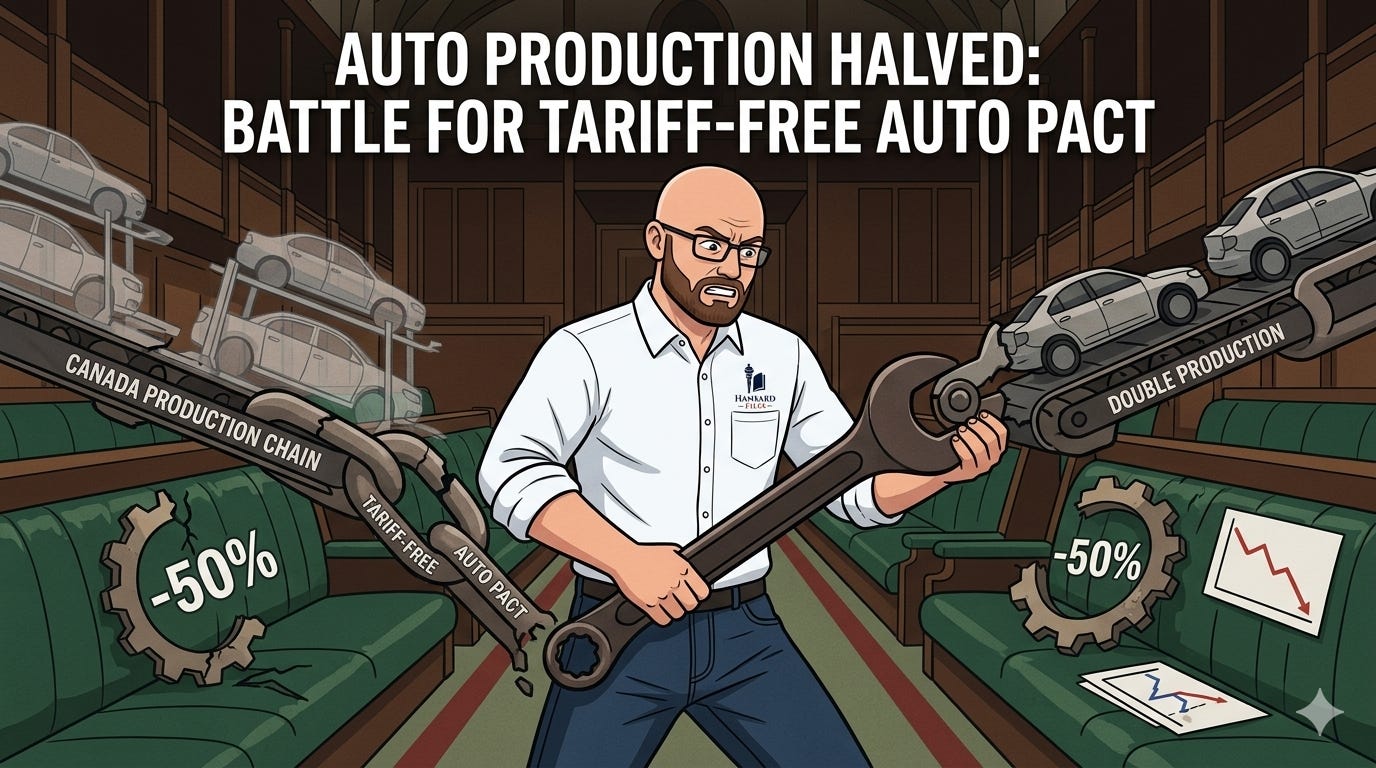
In the House of Commons on March 24, 2026, the chamber filled with the raw urgency of a sector fighting for survival. Conservative MP Kyle Seeback rose to move the opposition motion on the tariff-free auto pact, his words cutting through the tension like a factory whistle at shift change. Auto production in Canada had halved since the Liberals took office in 2015. From two million vehicles a year under the last Conservative government, output had fallen to 1.2 million in 2024. More than 5,000 jobs had vanished since the current Prime Minister took office. Exports of passenger cars and light trucks had dropped more than 53 percent.
The numbers carried the weight of communities across the country. Direct auto manufacturing contributed $17 billion to Canada’s GDP. Including parts, tools, and die-making, the ecosystem reached $94 billion. Advanced manufacturing tied to the sector underpinned defence production and technological edge. Yet the Liberals had no plan to persuade Americans to remove tariffs on Canadian goods. The US bought 90 percent of Canadian-made automobiles. A permanent rupture with that market was a dangerous illusion.
Seeback’s motion called on the government to back the Conservative plan to double automotive production through a tariff-free auto pact. The five-point blueprint mirrored the spirit of the 1965 Canada-US Auto Pact while addressing today’s realities:
make it easier to build and buy Canadian by removing the GST on all Canadian-made vehicles, ending counterproductive Liberal EV mandates and rebates, and harmonizing tailpipe emissions reductions with North American partners;
bring home production through performance by implementing a rule where, for every car produced in Canada, the same manufacturer would get to sell a car in Canada, duty-free, from a CUSMA partner on a dollar-for-dollar basis;
protect North American supply chains by maintaining the minimum 75 percent North American content and existing CUSMA rules of origin;
develop automotive security and technology by creating a harmonized North American cybersecurity and data standard while banning vehicles using software connected to China or Russia; and
stand firm against unfair trade by aligning with North American partners on Chinese tariffs if they accept this plan, for maximum leverage in CUSMA renegotiations.
Seeback split his time with the member for Oshawa. He stressed that the auto sector was not just assembly lines but thousands of jobs across supply chains. Without it, Canada would lose critical advanced manufacturing vital for sovereignty and resilience.
Decade of Decline: How Canada’s Auto Industry Reached the Breaking Point
The debate unfolded like a high-stakes boardroom showdown, with speakers from every corner of the country rising to lay their cards on the table. Conservative MPs painted vivid portraits of communities hollowed out. In Brampton, 3,000 workers laid off. In Sainte-Thérèse, 475 Paccar jobs gone. Tony Baldinelli (Niagara Falls—Niagara-on-the-Lake) described families who built cars for generations now facing uncertainty. Chris Lewis (Essex) spoke of hard-working auto workers in his riding who deserved protection. Amarjeet Gill (Brampton West) warned that the crisis touched every province, from Ontario’s heartland to supply chains nationwide.
Seeback drove the point home: “We have witnessed over the last decade of Liberal governance… the decimation of the Canadian auto industry. There is no other word that appropriately describes the decline.” He reminded the House that under the last Conservative government, Canadian auto companies manufactured two million vehicles per year. “Fast-forward to the last year on record, which is 2024, and that number has declined by almost 50%.”
Liberals countered that nostalgia was not a strategy. They defended years of collaboration with provinces, police, and industry experts. One speaker noted the 1965 pact predated modern realities such as electric vehicles and global supply chains. Unifor had questioned whether the plan could achieve its goals. Others highlighted existing investments in EV plants and clean-energy transitions, arguing the Conservative proposal risked putting Quebec at a disadvantage by ending EV rebates and focused too narrowly on Ontario.
Bloc Québécois voices expressed deep concern. The plan, they said, overlooked Quebec’s unique position. One member urged ambition beyond subsidies and called for regulatory harmony across North America. The debate stretched into the afternoon, questions flying across the floor. Would the pact truly double production? Had the Liberals consulted auto workers before rejecting the idea? Seeback repeatedly pressed that Canadians wanted tariff-free access, not surrender.
Voices from the Floor: MPs Channel the Human Cost
The chamber echoed with personal stakes. Baldinelli rose again: “This bold new policy offers a fresh take on a similar policy, embodied by the old auto pact rules.” Gill spoke directly to the layoffs in Brampton: “We stand in solidarity with them.” Lewis declared: “Essex-Windsor auto workers are among the best in the world and their jobs deserve to be protected.”
On the government side, speakers stressed that one in four cars sold globally was now electric. Canada’s future lay in innovation, not 1960s models. Yet all sides agreed on one point: tariff-free access to the US market was critical. The industry could not absorb losses from even a 15 percent tariff. At 5 percent, the hit would still reach $800 million a year.
Seeback pushed back on claims the plan ignored parts manufacturing: “Canada has been leading in auto parts.” He warned that without action, jobs would keep disappearing to the United States.
Quebec’s Stake and the Bloc’s Warning
Bloc members made their position clear. Conversations about the auto industry were “a bit triggering in Quebec.” One speaker reminded the House of past protectionism that favoured Ontario while leaving Quebec behind. Rejecting CUSMA-style integration risked repeating history. They called on Liberals to be “much more ambitious” and stop listening solely to Ontario’s auto lobby or the oil industry.
The motion, Bloc speakers argued, did nothing for Quebec while potentially harming its competitive position. Yet they acknowledged the shared crisis: production down nearly half, jobs slipping away.
Liberal Counter: Innovation Over Nostalgia
Government benches framed the Conservative plan as denialism. “We cannot go back to 1965, to a tariff-free auto pact,” one member stated. The sector had changed; North American integration had underpinned it for over 60 years. Diversification was not an option overnight. Experts from the Canadian Vehicle Manufacturers’ Association had warned against it.
Liberals pointed to $30 billion in subsidies for modernization, mostly in Ontario, and argued the future lay in electric vehicles and plug-in hybrids. They cited global trends: the auto industry was electrifying. One in four cars sold worldwide was now electric. Canada understood this shift and supported the industry through targeted investments.
Still, the absence of a concrete Liberal counter-plan drew sharp criticism. Seeback asked repeatedly: “What is the Liberal plan?” The response often circled back to ongoing CUSMA talks and existing supports.
Closing the Debate: Sovereignty on the Line
By late afternoon, the House had heard passionate arguments from both sides. Conservatives insisted the tariff-free auto pact was about more than economics. It was sovereignty: strategic self-reliance in energy and resources, faster procurement, digital security. Banning foreign-linked software protected sensitive environments. Maintaining 75 percent North American content kept supply chains integrated. Aligning on Chinese tariffs gave leverage in CUSMA talks.
The motion framed the pact as a return to North American partnership that had built the industry. Geographic realities made diversification impossible overnight. The performance-based rule would reward production here with duty-free market access there. Removing the GST on Canadian-made vehicles would make them more affordable at home. Ending EV mandates would let the market decide.
As the supply day drew to a close, the debate captured a nation’s anxiety over blue-collar paycheques, community foundations, and the promise of opportunity for the next generation of skilled trades workers. Production had been halved. Jobs had disappeared. The threat of unjustified American tariffs hung over every assembly line.
The opposition motion on the tariff-free auto pact offered one vision: double output, protect supply chains, secure sovereignty. Whether that vision would prevail remained for Parliament to decide. But the human cost, laid bare in Hansard, left no doubt: Canada’s auto industry stood at a crossroads.
Hansard Files digs through dense parliamentary archives to surface these high-stakes stories. Subscribe to support independent investigation into the debates shaping Canada.
Source Documents
House of Commons. (2026, March 23). *House of Commons Debates* (Vol. 152, No. 097).
House of Commons. (2026, March 24). *House of Commons Debates* (Vol. 152, No. 098).
House of Commons. (2026, March 25). *House of Commons Debates* (Vol. 152, No. 099).
House of Commons. (2026, March 26). *House of Commons Debates* (Vol. 152, No. 100).
Conservatives always want to give away the house. The reason auto manufacturing in Canada has declined so much is 'Buy America'. While it generally refers to governmental buying for infrastructure, it also affects manufacturers through the Inflation Reduction Act (?). Donald Trump has made it even more specific by imposing tariffs intended to re-shore manufacturing. There are NO Canadian auto manufacturers, just Canadian auto plants. If a company doesn't make some of 'em here, we here, shouldn't buy any of 'em.
Great to have this summary, thank-you