


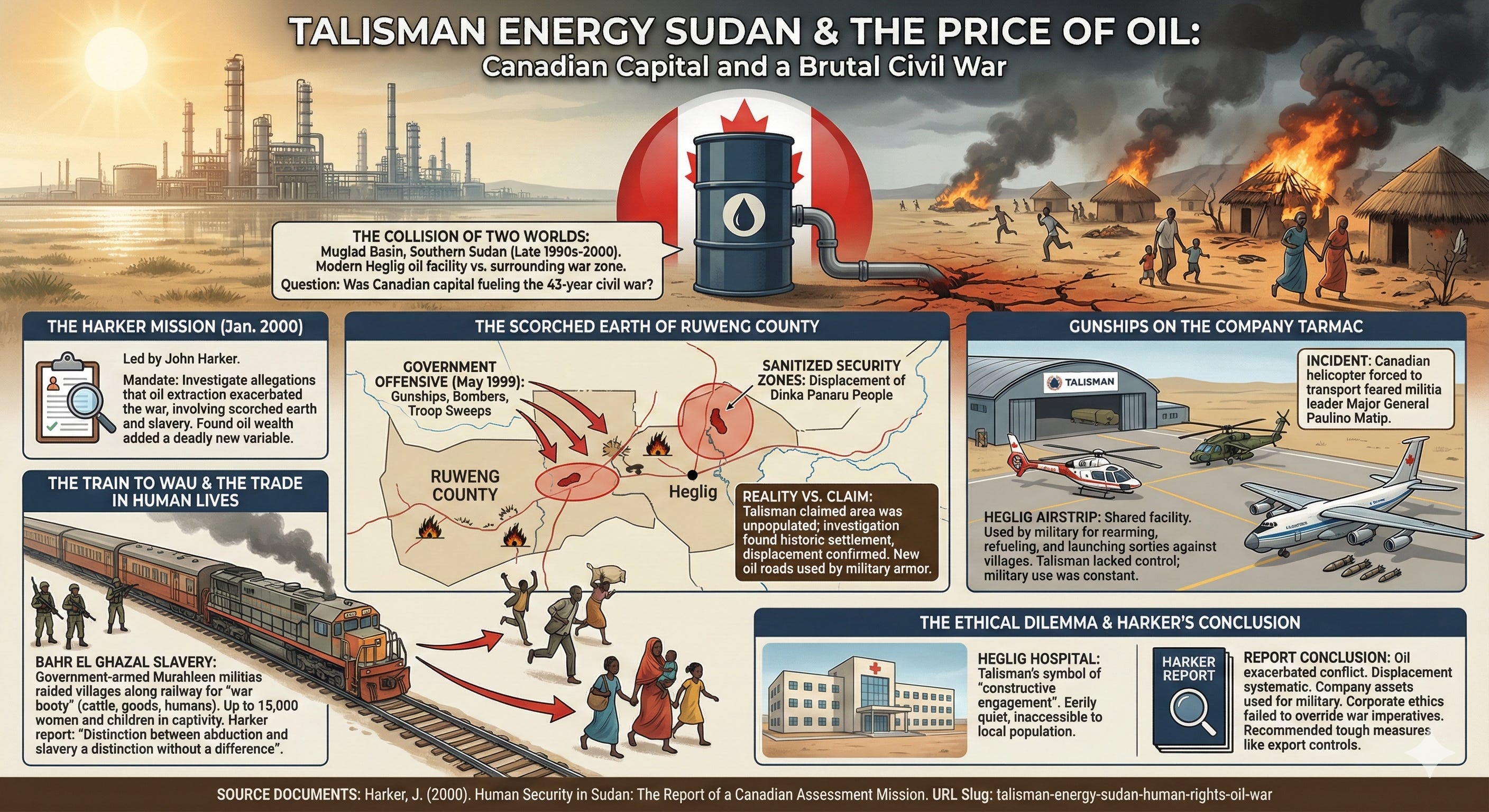
The heat in the Muglad Basin is relentless, a physical weight that presses down on the swampy flatlands of Southern Sudan. In the late 1990s and into the year 2000, this heat shimmered over two distinct and colliding worlds. One was the world of the Heglig oil facility, a modern fortress of steel piping, air-conditioned compounds, and advanced technology. The other was the world immediately outside the perimeter, a landscape of burnt thatch huts, fleeing civilians, and the terrifying drone of Antonov bombers. At the center of this collision stood a major Canadian corporation, Talisman Energy Sudan operations, and a question that had traveled all the way to the terrified halls of government in Ottawa: Was Canadian capital fueling a civil war?
In January 2000, John Harker led a Canadian Assessment Mission into this volatile region. His mandate from the Minister of Foreign Affairs was specific and heavy. He was to investigate allegations that oil extraction was not merely happening alongside the war but was actively exacerbating it. The allegations were gruesome. Human rights groups claimed that the government in Khartoum was clearing the land around the oil fields through a policy of scorched earth, displacing thousands to secure the pumps. Even darker were the whispers of slavery, of militias raiding villages for human booty, emboldened by the chaos of the conflict.
The mission arrived in a country paralyzed by a forty-three-year civil war, a conflict often simplified as the Muslim North against the Christian and Animist South. But Harker and his team found a reality far more complex, where the extraction of wealth had added a deadly new variable to an old equation. The oil flowed north through pipelines guarded by the very forces accused of decimating the local population.
The Scorched Earth of Ruweng County
To understand the impact of Talisman Energy Sudan and its partners in the Greater Nile Petroleum Operating Company, the investigators had to look beyond the corporate spreadsheets and into the villages of Ruweng County. Talisman executives had maintained a defense that the area of their operations was largely unpopulated, a flood plain with minimal permanent settlement. This claim of an empty landscape suggested that there were few people to displace in the first place.
The investigators found a different history written in the ash of burnt tukuls. Using maps dating back to 1954, they confirmed that Ruweng County and the areas east of Heglig had long been home to the Dinka Panaru people. These were cattle-rearing communities that had lived there for generations. The silence in the area was not natural. It was man-made.
Witnesses described a terrifying offensive in May 1999. Government of Sudan troops, supported by helicopter gunships and high-altitude Antonov bombers, swept through the villages. The objective appeared to be the creation of a sanitized security zone around the oil fields. Civilians told the mission that the attacks were indiscriminate. Gunships flew low enough to kill individuals running for cover. Food stocks were burned. In the village of Biem, the destruction was nearly total.
The report noted a chilling correlation between the infrastructure of oil and the efficiency of war. The new roads built by the oil consortium to service rigs and pipelines had a dual use. They allowed heavy government armor and troop carriers to reach deep into the swamps, accessing areas that had previously been safe havens for the Dinka populations. The isolation that had once protected these communities was paved over.
Leonardo Franco, a UN Special Rapporteur, had previously reported that a swath of scorched earth was being created around the oil fields. Talisman’s CEO, Jim Buckee, had disputed this, suggesting the reports were based on hearsay. But when the Canadian mission flew over the area and spoke to the survivors, the conclusion was inescapable. The displacement was real. It was violent. And it was inextricably linked to the need to secure the ground for oil extraction.
Gunships on the Company Tarmac
Perhaps the most damning evidence of the entanglement between the oil consortium and the war effort was found on the tarmac of the Heglig airstrip. This facility, adjacent to the oil workers’ compound and operated by the consortium, was intended for logistics and personnel transport. It became a launchpad for war.
Credible reports and eyewitness testimony confirmed that helicopter gunships and Antonov bombers used the Heglig airstrip to rearm and refuel. From this corporate facility, these machines of war launched sorties against villages south of the river. The juxtaposition was jarring. Canadian-chartered aircraft, ferrying oil workers and supplies, shared the tarmac with the very weapons systems destroying the surrounding communities.
Talisman executives admitted to the mission that they were aware of “defensive” uses of the airstrip but insisted they had lodged protests with the Sudanese government. They claimed the offending military aircraft were removed after these complaints. However, the mission received reports that the military use of the airstrip was constant, interrupted only by the arrival of VIPs or international observers.
One particularly disturbing incident involved a Canadian helicopter chartered by Talisman. The mission learned that this aircraft was used to transport Major General Paulino Matip, a feared militia leader allied with the government. Matip reportedly demanded the pilot fly him to Khartoum. When the pilot initially refused, a Talisman employee was summoned and, fearing for the safety of the crew, authorized the flight.
This incident underscored the lack of control the oil company had over its own partners. The consortium’s security was provided by the Sudanese government, meaning the very soldiers protecting the oil infrastructure were the ones prosecuting the war against the local population. The mission concluded that the oil operations were being used, directly and indirectly, to support military objectives. The airstrip, the roads, and the fuel were all assets in a war that targeted civilians.
The Train to Wau and the Trade in Human Lives
While the oil war raged in Western Upper Nile, a different but equally horrific tragedy was unfolding in Bahr El Ghazal. This was the issue of slavery. The Government of Sudan vehemently denied the existence of slavery, preferring the term “abduction” and attributing it to tribal warfare between the Baggara Arabs and the Dinka.
The investigation peeled back the layers of this semantic defense. The core of the issue lay with the Murahleen, Arab militias armed by the government to fight the southern rebels. These militias were often used to guard the supply trains running from Babanusa to Wau. The government, unable or unwilling to pay these militias in cash, effectively allowed them to take their payment in war booty. That booty included cattle, goods, and human beings.
The train to Wau became a symbol of terror. As it moved south, the militia guards would fan out, raiding Dinka villages along the railway corridor. They would kill the men and capture women and children. These captives were then taken north, where they were forced into domestic servitude or agricultural labor. They were owned. They were stripped of their identity.
The government argued that these were merely abductions resulting from traditional tribal conflicts. They pointed to the Committee for the Eradication of Abduction of Women and Children (CEAWC) as proof of their commitment to solving the problem. The mission, however, saw through the deflection. While tribal raiding had a long history, the scale and nature of these attacks had changed when the government began arming the Murahleen with automatic weapons and using them as a proxy force.
The investigators met with Dinka leaders and human rights workers who estimated that as many as fifteen thousand women and children remained in captivity. They visited a safe house in Khartoum where escaped children were being hidden. They heard stories of brutality and forced conversion. The distinction between “abduction” and “slavery” was, in the eyes of the mission, a distinction without a difference. The state was sponsoring a war strategy that relied on the enslavement of its own citizens.
Talisman Energy Sudan and the Ethical Dilemma
Throughout the investigation, Talisman Energy maintained that its presence was a force for good. They argued that their investment brought development, roads, and hospitals to a region that had known only neglect. They spoke of “constructive engagement,” the idea that a Western corporate presence would moderate the behavior of the Sudanese regime.
The mission tested this theory at the Heglig hospital. Talisman pointed to this facility as a prime example of their benevolence. It was a modern, well-equipped medical center, boasting more incubators than could be found in the entire country of Ethiopia. But when the investigators visited, something was wrong. The hospital was eerily quiet. There were almost as many machines as people.
Talisman claimed the lack of patients was due to the timing of the visit, occurring late in the day during Ramadan. Yet, a flyover the next morning revealed the same emptiness. Suspicions arose that the local Dinka and Nuer populations were effectively barred from the facility, or too terrified to approach the government-controlled garrison town. The hospital stood as a potent symbol of the mission’s findings: a gleaming, modern structure that offered little succor to the people dying in the bush just miles away.
The investigators concluded that Talisman Energy Sudan had failed to be a neutral actor. By generating revenues for a government that spent heavily on weaponry, and by building infrastructure used by the military, the company had become part of the war machine. The belief that corporate ethics could override the imperatives of a desperate regime proved to be an illusion. The oil did not bring peace. It raised the stakes of the war, making the control of the territory an existential necessity for the government in Khartoum.
The report delivered by Harker was unambiguous. Oil was exacerbating the conflict. The displacement of civilians was systematic. The use of company assets for military purposes was documented. The silence of the oil fields was the silence of a graveyard, achieved through the forced removal of the people who lived there. The mission recommended tough measures, including export controls and rigorous monitoring, effectively shattering the narrative that business could continue as usual in the shadow of a dirty war.
Source Documents
Harker, J. (2000, January). Human Security in Sudan: The Report of a Canadian Assessment Mission. Department of Foreign Affairs and International Trade.
Very disturbing read. I can’t say I am surprised. Expecting otherwise than fully complicit behaviour from a private sector profit motivated actor? Not remotely possible. Appreciative that you chose to shed light on (yet another) oil and greed story. The full shift to green energy can’t come soon enough.