


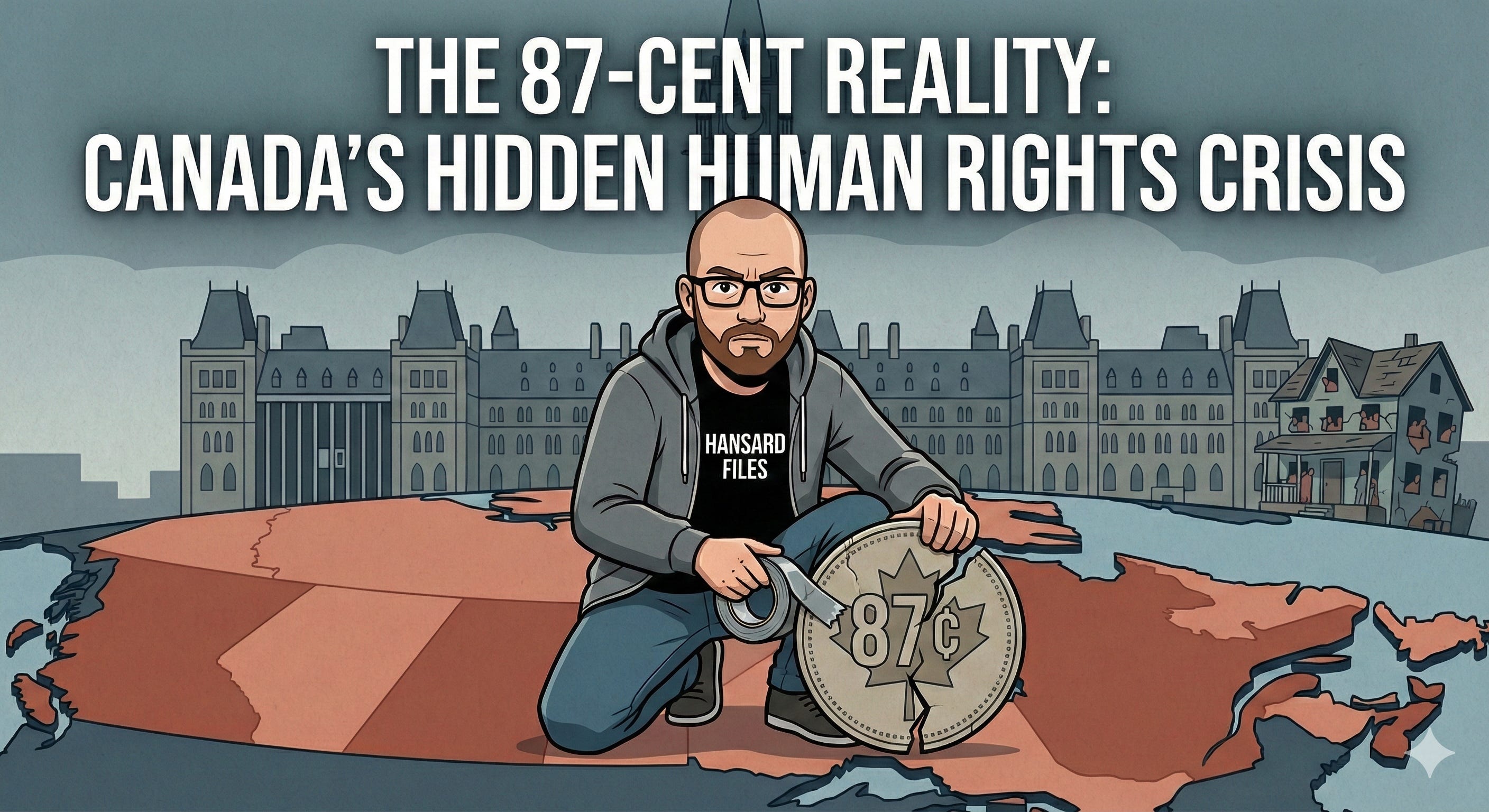
While Canada frequently positions itself on the global stage as a leader on equality, a submission filed in September 2024 by the Canadian Human Rights Commission (CHRC) to the United Nations tells a different story. Prepared for the Committee on the Elimination of Discrimination against Women (CEDAW) on the occasion of Canada’s 10th Periodic Review, this report records systemic discrimination in housing, pay and incarceration.
At the heart of this submission is a stark economic reality that defies the country’s reputation for equity. In 2023, for every dollar a man earned in Canada, a woman earned 87 cents. This figure is not merely a statistic; it is a barometer of a society where the machinery of equality has stalled. The Commission’s findings describe a country where Indigenous women are incarcerated at alarming rates, where the financialization of housing forces women into “hidden homelessness,” and where the legislative frameworks intended to protect the vulnerable are often riddled with exclusionary gaps.
The Architecture of Housing Inequality
The crisis of shelter in Canada is often framed as a supply issue, but the CHRC report reframes it as a failure of human rights. The 2019 National Housing Strategy Act was meant to enshrine housing as a human right, yet the Commission argues that the strategy is failing the very demographic it aims to protect. The report identifies a disturbing trend: the financialization of housing (where homes are treated as investment vehicles rather than shelter)is exacerbating affordability and security of tenure, specifically harming women.
The consequences of this market pressure are gendered and severe. Women and gender-diverse people are statistically more likely to live in unaffordable housing and face “core housing need”. When the system fails, it does not always result in visible homelessness. Instead, women experience “hidden homelessness,” a phenomenon where they are forced to stay in abusive situations or temporarily with friends because they have nowhere else to go. The Commission notes that municipal homeless counts frequently miss this demographic entirely, rendering their suffering invisible to policymakers.
Even when women seek emergency help, the infrastructure is often absent. A review by the Federal Housing Advocate revealed that women may reside in dangerous homeless encampments simply because there are no gender-specific shelters in their communities. The underinvestment is chronic. Co-ed shelters, which are often the only option available, have become sites of harassment and violence, particularly for trans women who face acute discrimination.
The Persistence of the Pay Gap
While the “87 cents” figure captures the headline, the CHRC submission examines the nuanced machinery of economic exclusion. The Pay Equity Act came into force in 2021 to ensure equal pay for work of equal value in federally regulated sectors. However, the Commission highlights a critical flaw in the legislation’s design: it relies on a binary comparison of “male” and “female” job classes. This approach effectively erases non-binary people from the equation, failing to capture their economic reality or the specific discrimination they face.
The economic disparity is not uniform; it is compounded by race and ability. The gender pay gap widens significantly for Indigenous women, racialized women, and women with disabilities. The Commission also points out a jurisdictional void: the Pay Equity Act does not apply to territorial governments in the Northwest Territories, Yukon, and Nunavut, nor does it cover Indigenous governing bodies. This leaves vast swathes of the country’s workforce without the same proactive protections afforded to federal employees.
Incarceration as a Colonial Legacy
A later section of the submission concerns the treatment of women deprived of their liberty. The Commission identifies Indigenous women as the fastest-growing population in Canadian prisons. They are vastly over-represented in the federal correctional system, particularly in maximum-security populations. The CHRC draws a direct line between this incarceration crisis and the “intergenerational effects of trauma and genocide,” including the legacy of the residential school system.
Inside these institutions, the conditions are grim. The Office of the Correctional Investigator has reported that coordinated mental health support for Indigenous individuals is “non-existent”. Community-run Healing Lodges, which are legally intended to provide traditional healing paths under the Corrections and Conditional Release Act, remain grossly under-resourced and are largely unavailable to Indigenous women outside the Prairies.
The report also breaks the silence on a pervasive internal threat: sexual coercion and violence within federal prisons. The Commission describes a “culture of silence” that prevents incidents from being reported. While the Correctional Service of Canada announced a zero-tolerance policy in 2022, the CHRC argues that this policy fails to address the root barriers to disclosure, such as the fear of retaliation.
The Shadow of the Indian Act
The submission makes it clear that discrimination against Indigenous women is not just a matter of practice but of law. The Indian Act continues to cast a long shadow over the rights of Indigenous women and their descendants. Specifically, the report targets the sexist registration provisions that prevent Indigenous women from reaffiliating with their natal bands if a male relative chose to “enfranchise”, a historical legal process that stripped them of status.
Although Bill C-38 was introduced in 2022 to address these inequities, the legislation remains stalled. This delay perpetuates a lineage of exclusion that the CHRC argues must be dismantled immediately.
Furthermore, the Commission raises the alarming issue of coerced sterilization. Historically performed under the guise of public health, this practice disproportionately targeted Indigenous women labeled as “feeble-minded”. The report indicates that survivors continue to suffer, avoiding healthcare services due to a profound mistrust of the system. The CHRC calls for the implementation of recommendations to end this practice and provide redress to survivors.
The Intersection of Race, Religion, and Employment
The CHRC’s submission extends its gaze to the province of Quebec, specifically regarding the Act respecting the laicity of the State, commonly known as Bill 21. This law bans public sector workers in positions of authority (including teachers and police officers)from wearing religious symbols. The Commission argues that this law has a disproportionate adverse impact on racialized Muslim women who wear the hijab.
This restriction effectively amounts to “government-imposed workplace discrimination”. At a time when religious intolerance is rising across Canada, the CHRC warns that such legislation forces women to choose between their faith and their employment, further marginalizing a group that already faces intersectional barriers in the workforce.
A Call for Accountability
Throughout the document, the Canadian Human Rights Commission adopts a tone of urgent advocacy. It highlights that the mechanisms designed to protect human rights (from the National Housing Strategy to the Employment Equity Act)are often failing those who exist at the intersections of gender, race, and disability.
The submission concludes with a series of recommendations that read as a roadmap for structural repair. From demanding the ratification of the Optional Protocol to the Convention against Torture (OPCAT) to allow for independent oversight of detention centers , to calling for the recognition of trans and non-binary rights in healthcare, the message is clear. Canada’s reputation as a human rights leader is being tested, not by its promises, but by the reality of the women who are falling through the cracks of its democracy.
Hansard Files digs through hundreds of pages of government submissions, transcripts, and reports to bring you the stories that shape our nation’s legal and moral landscape. The archive stays free. A paid membership funds the hours to work the next file.
Source Documents
Canadian Human Rights Commission. (2025). Submission to the Committee on the Elimination of Discrimination against Women on the occasion of Canada’s 10th Periodic Review.
Office of the Federal Housing Advocate. (2023). Interim report of the Advocate’s review of homeless encampments.
Statistics Canada. (2023). Employee wages by occupation, annual.
Native Women’s Association of Canada. (2024). Final Report: Adequate housing for Indigenous Two-Spirit, transgender, non-binary, and gender-diverse people.
The CHRC ignores the variability of hours worked between men and women. A study of the Ontario Pay Equity Act about a decade after its implementation reduced the pay gap to 2-3% once hours worked were standardized.
This is another instance of our Human Rights Tribunals taking actions outside their jurisdiction and competance. The complaint about no data for non-binary occupations fails because the Canadian Pay Equity Act reporting gathers data based on its definitions of female-dominant and male-dominant occupations. Those are the comparisons that required pay equity adjustments to female-dominant occupations in the '90s.
I see this as another instance of bureaucratic capture by "progressive" beliefs, previously termed "woke" (apparently now out of favour among progressives). The CHRC has responsibilities to adjudicate workplace complaints of discrimination. Anything else is "progressive" make work.
"At the heart of this submission is a stark economic reality that defies the country’s reputation for equity. In 2023, for every dollar a man earned in Canada, a woman earned 87 cents. This figure is not merely a statistic; it is a barometer of a society where the machinery of equality has stalled." With the women the clear majority in nearly all categories of post secondary education; with younger men in the clear majority with gambling addictions and gaming; with women marrying 'down', to a man having less education and making less money; with more and more men involved with family child care; I find it challenging to discern a context for this very real stat.