


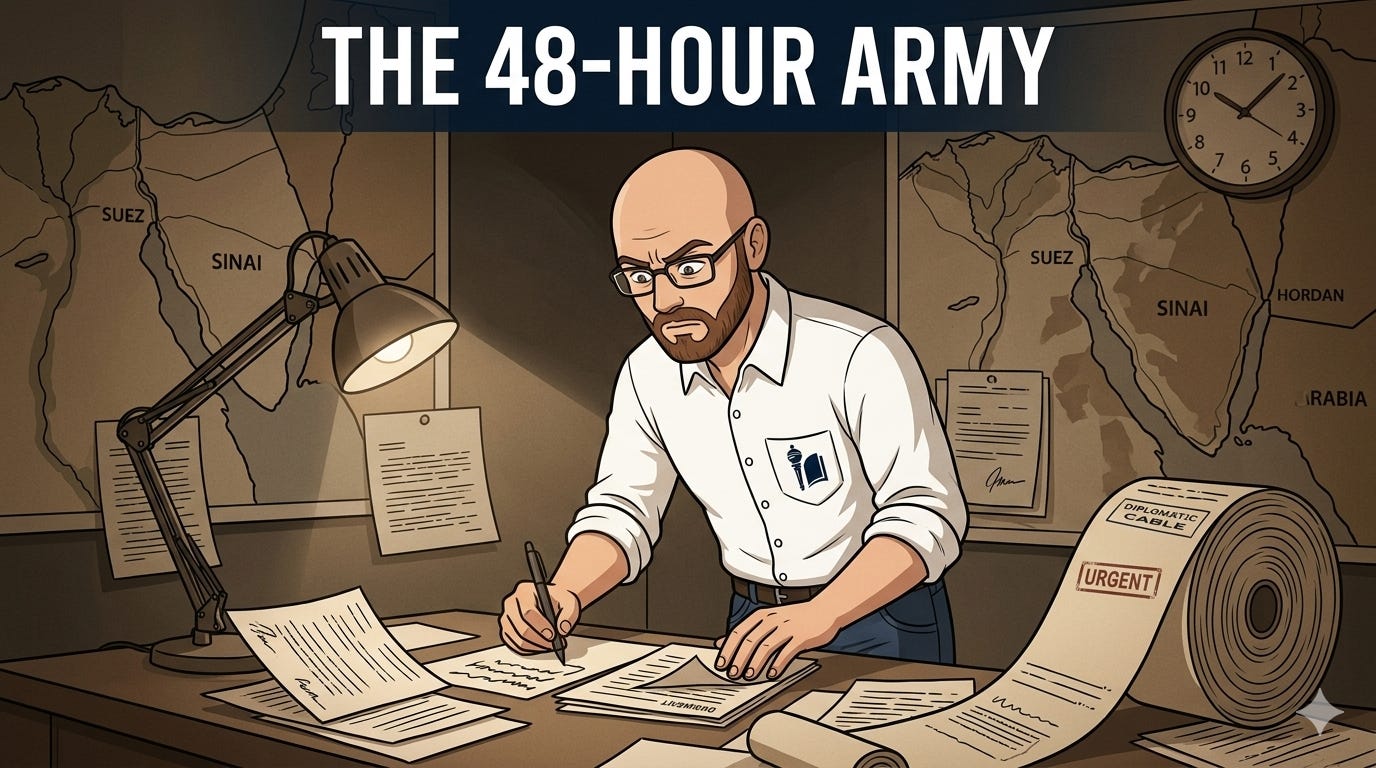
The world ended—or nearly did—in the final days of October 1956. While the globe’s attention was fixed on Soviet tanks crushing a rebellion in Hungary, a second fuse was lit in the Middle East. On October 29, Israeli forces surged across the Egyptian border, cutting deep into the Sinai. Within days, British and French bombers were darkening the skies over Cairo, ostensibly to “separate the combatants” but in reality to seize back the nationalized Suez Canal. This was the Suez Crisis, a moment of geopolitical madness that threatened to drag the United States and the Soviet Union into a nuclear confrontation.
In New York, the United Nations was paralyzed. Vetoes flew like shrapnel in the Security Council, rendering the body useless. It was in this vacuum of power that a Canadian diplomat, Lester B. Pearson, and a Canadian General, E.L.M. Burns, would attempt the impossible: to build an army from scratch in 48 hours, not to fight a war, but to end one.
The Background of the Suez Crisis
To understand the sheer improvisation of what followed, one must understand the panic of the moment. The crisis did not begin with the invasion; it began with a national humiliation. In July 1956, Egyptian President Gamal Abdel Nasser nationalized the Suez Canal Company, stripping Britain and France of a colonial jewel. The reaction in London and Paris was not diplomatic; it was martial.
Secretly, Britain, France, and Israel concocted a plan. Israel would attack; the European powers would issue an ultimatum demanding both sides withdraw from the Canal Zone; and when Egypt inevitably refused, the Europeans would invade to “protect” the waterway. The plan worked militarily, but it was a diplomatic catastrophe. As Israeli paratroopers dropped into the Sinai, the world reacted with horror. The United States, kept in the dark by its allies, was furious. The Soviets threatened to rain rockets on London and Paris.
In Ottawa, the Canadian government watched the “tragic and violent events” with deep alarm. Canada was in a uniquely agonizing position: a loyal member of the British Commonwealth, yet a neighbor and close ally of the United States. If the conflict escalated, Canada would be torn apart.
The “Pearson Plan”
On November 2, amidst the wreckage of failed resolutions, Lester B. Pearson rose in the General Assembly. He proposed something radical: a “United Nations Emergency Force” (UNEF). This would not be a combat force in the traditional sense, but a shield—a multinational body large enough to keep the belligerents apart while a political settlement was hammered out.
The idea was desperate, but it was the only one on the table. The General Assembly seized it. On November 4, they passed a resolution asking the Secretary-General to submit a plan within 48 hours for setting up the force.
The clock started ticking. There was no blueprint. There were no troops. There was only an idea.
The 48-Hour Scramble
The task of turning rhetoric into reality fell to Major-General E.L.M. Burns, a Canadian who was already in the region as the Chief of Staff of the UN Truce Supervision Organization. He was immediately appointed Commander of the new UNEF.
The logistical challenges were nightmarish. This was not a standard military deployment where a nation moves its own troops with its own ships. this was a diplomatic potluck. The force had to be “unique,” composed of nations that were not permanent members of the Security Council—meaning no Americans, Russians, British, or French.
In Ottawa, the lights burned late at National Defence Headquarters. The Canadian Army was tasked with planning a contribution to a force that didn’t essentially exist yet. They dubbed it “Operation Rapid Step.” The initial plan was robust: Canada would send an infantry battalion, the 1st Battalion of the Queen’s Own Rifles of Canada.
Trains began moving. Equipment was crated. In Calgary, the Queen’s Own Rifles prepared to ship out to Halifax, believing they were about to be the vanguard of a new world order.
The Humiliation of the Queen’s Own
Then, the politics of the crisis crashed into the military planning. As the Canadian troops prepared to embark on the aircraft carrier HMCS Magnificent, a diplomatic cable arrived that stunned the government.
President Nasser of Egypt objected to the Canadian infantry. The reason was as petty as it was serious: the “Queen’s Own Rifles” sounded too British. Their uniforms were nearly identical to the British soldiers who were currently bombing Egyptian airfields. Nasser argued that the Egyptian population, inflamed by the invasion, would not be able to distinguish a Canadian “Queen’s Own” soldier from a British enemy. He feared riots, or worse, that the Canadians would be shot on sight.
It was a crushing blow. The soldiers were ready; the ships were loading. But Pearson and Burns realized that insisting on the infantry would kill the mission before it began. They had to pivot.
The Logistics Nightmare
General Burns, struggling to organize a chaotic mix of Colombian, Indian, Danish, and Swedish troops, realized he had a different problem. Everyone wanted to send infantry—the “glamour” troops—but nobody was sending the unsexy, essential support units needed to keep an army alive. He needed engineers, signalmen, supply clerks, and transport drivers.
Canada swallowed its pride and changed the mission. Instead of the Queen’s Own Rifles, they would send the administrative and logistical backbone of the UNEF. It was a less glorious role, but a critical one. Without Canada’s signallers and engineers, the multinational force would be a mob, not an army.
The “Swissair” solution was another improvisation. The United States Air Force had the lift capacity to move the troops, but their planes were politically radioactive in Egypt. Swissair, a neutral civilian carrier, had to be chartered to fly the advance parties into the staging areas in Italy and then on to Egypt.
Arrival
On November 24, less than a month after the first shots were fired, the first Canadian troops landed in Egypt. They were not the stormtroopers of a new empire, but the mechanics of peace. They set up the supply lines that allowed the Indians and Scandinavians to patrol the buffer zones.
The gamble worked. The British and French, humiliated by American financial pressure and world opinion, withdrew. The Israelis pulled back. The UNEF took up positions in the Sinai, a “plate-glass window” that, if shattered, would trigger an international response.
The 48-hour army held the line for ten years. It did not bring permanent peace—war would return to the Sinai in 1967—but it bought a decade of quiet in the most volatile region on earth. In doing so, it established the model for every UN peacekeeping mission that followed. For his efforts, Lester B. Pearson would win the Nobel Peace Prize, and Canada would find a new national identity—not as a junior partner in empire, but as the world’s peacekeeper.
Hansard Files digs through declassified military reports and forgotten parliamentary archives to bring you the stories that shaped our world. If you value this kind of deep-dive investigation, please consider subscribing.
Source Documents
Army Headquarters, Historical Section. (1961). Report No. 94: Canadian Participation in the United Nations Emergency Force. Department of National Defence.
Canadian War Museum. (n.d.). Canada and Peacekeeping Operations.
The Queen’s Own Rifles of Canada Regimental Museum. (n.d.). Suez Crisis 1956.
In tears. Thanks Mike. I remember this, vaguely of course. I was 13, and my mind was not on global affairs. But my heart felt the tension. There might seem to be big differences between Carney and Pearson; but they share quick thinking, good sense and the capacity to see the big picture. Oh, and intelligence. Lots of intelligence.
Yes, arguably Canada’s best diplomat and a reasonable prime minister. Thank you for refreshing my memory of the blessings and curses of the middle powers.