


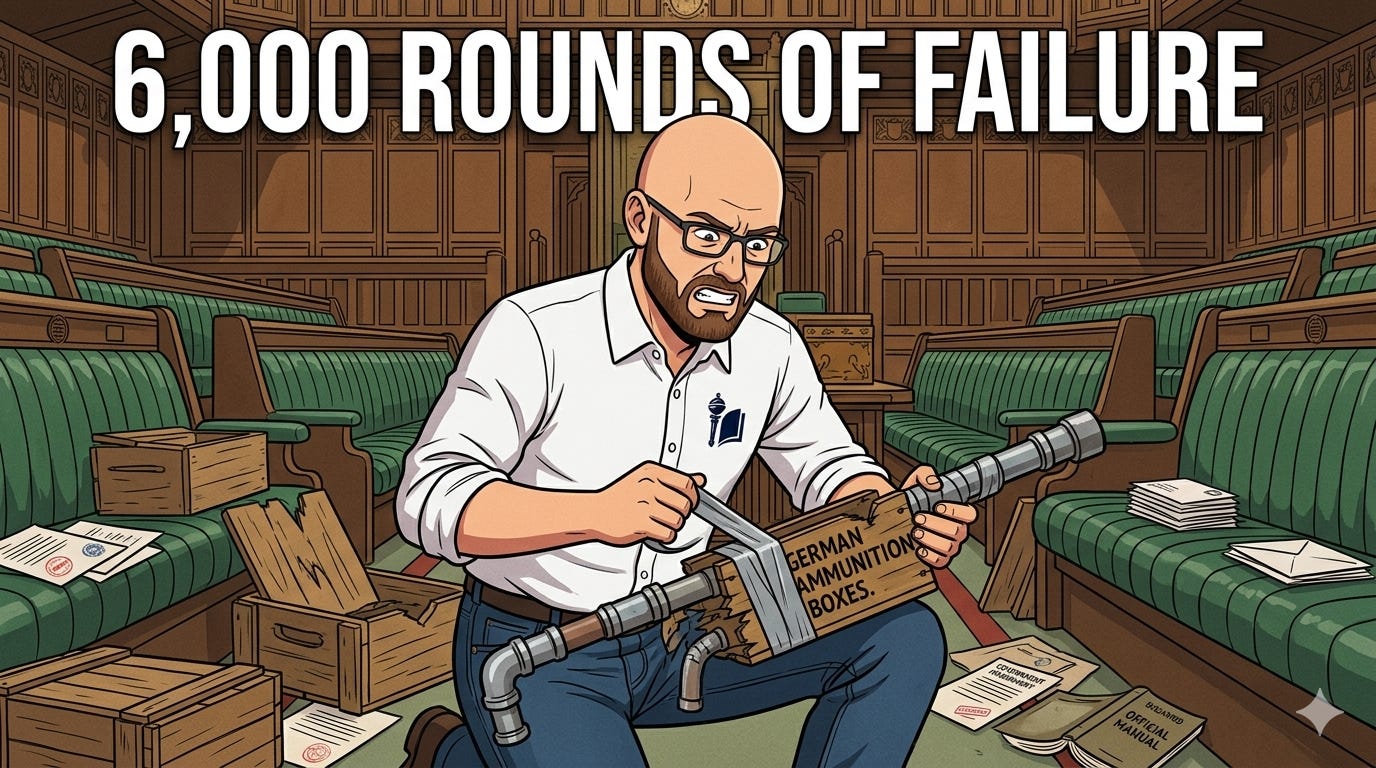
The test was as simple as it was damning. In a quiet sector of the European theatre, a group of Canadian officers walked into a clearing, placed a series of standard German ammunition boxes on the ground, and drew their sidearms.
For years, the British War Office had insisted that the .38 calibre revolver was the gentleman’s weapon of choice: reliable, steady, traditional. The soldiers on the ground, however, had been pleading for the captured German 9mm Browning automatics, or the American Colts. To settle the argument, the Historical Section of Canadian Military Headquarters later noted, the officers lined up and opened fire.
The results were humiliating. The heavy, slow .38 rounds struck the wooden German boxes and frequently bounced off, leaving the wood splintered but intact. The 9mm rounds, fired from the “unauthorized” automatics, punched clean through.
It was a small moment in a global war, but it perfectly encapsulated a much larger, darker reality recorded in Report No. 141, a once-classified document titled “Progress in Equipment.” While the Allied invasion of Normandy is remembered as a triumph of logistics and industrial might, this internal file reveals a parallel history of jamming submachine guns, bureaucratic absurdities, and a “crisis of confidence” that forced Canadian soldiers to scavenge, improvise, and invent their own killing machines to survive.
The Plumber’s Nightmare
If the .38 revolver was a disappointment, the Sten machine carbine was a scandal. Cheap, stamped out of metal for a fraction of the cost of a Thompson, the Sten was the mass-produced answer to the Wehrmacht’s firepower. But by 1944, the Canadian Army was awash in reports that the weapon was a death trap—often for the man holding it.
The report details a “loss of confidence” so severe that it became an operational liability. The Historical Section began collecting “Battle Experience Questionnaires” from officers hospitalized in the United Kingdom. Their feedback was vitriolic. The primary issue was the magazine. The feed lips were made of soft metal that bent easily; a single drop on a hard surface could render the magazine useless. Even when the magazine was intact, the spring often failed, causing the bolt to ride over the round without chambering it.
Worse was the “accidental discharge.” The Sten was notorious for firing when dropped, or even when jolted. The report notes that unless the gun was cocked—a dangerous state for a weapon with a sensitive sear—it was effectively a safety hazard. One complaint described the weapon as “not safe unless cocked,” a paradox that left soldiers choosing between a slow reaction time and the risk of shooting their own platoon mates.
The hatred for the weapon was not universal—one Saskatchewan regiment claimed to have “killed more Jerries with Stens than with any other weapon”—but the psychological damage was done. When a soldier believes his weapon will jam in a firefight, he hesitates. And in the hedgerows of Normandy, hesitation was fatal.
The 20-Millimeter Boondoggle
While the infantry struggled with their small arms, the artillery procurement officers were fighting a war against their own paperwork. Report No. 141 chronicles the farcical saga of the 20mm anti-aircraft gun, a weapon that the Canadian Army spent countless man-hours acquiring, only to realize they couldn’t actually use.
The plan seemed sound: equip light anti-aircraft regiments with 20mm cannons to fend off the Luftwaffe’s low-level strafing attacks. Orders were placed, shipping space was allocated, and the guns began to arrive. Then, the orders were abruptly cancelled. Then, reinstated.
The punchline came when the guns were finally ready for deployment. The bureaucracy realized that the only ammunition available in the theatre was “non-self-destroying.” In anti-aircraft warfare, a shell that misses its target must detonate in the air to avoid falling back to earth and killing friendly troops or civilians. Without self-destroying fuses, the 20mm guns were effectively useless for their intended role. The entire program had been a massive expenditure of energy to deliver a weapon that could not be fired into the sky.
The Frankenstein Weapons
Faced with “official” equipment that bounced off ammo boxes or jammed in the mud, Canadian soldiers did what soldiers always do: they improvised.
The most terrifying example of this ingenuity was the “Wasp.” The British Army had developed a flamethrower variant of the Universal Carrier, a small, tracked armoured vehicle. But the British design placed the fuel tanks inside the hull, taking up valuable crew space and limiting the vehicle’s utility.
Canadian engineers looked at the design and decided they could do better. They mounted the fuel tank on the outside rear of the vehicle. It was a suicidal trade-off—placing a tank of jellied gasoline on the exterior of a lightly armoured carrier—but it allowed for a third crewman to operate a Bren gun or a PIAT anti-tank projector. These “Canadian Wasps” became trench-clearing nightmares, capable of sliding up to a German bunker and unleashing a jet of fire while suppressing the enemy with machine-gun fire. They were vulnerable, dangerous to their crews, and utterly effective.
But the crown jewel of Canadian improvisation was the “Land Mattress.”
The Screaming Ghost
By late 1944, the Canadian Army wanted a rocket artillery system to rival the German Nebelwerfer or the Soviet Katyusha. The British War Office was slow to develop one. Lieutenant Colonel Eric Harris, a Canadian artillery officer, decided not to wait.
Harris and his team scavenged parts from across the military inventory. They took British naval rocket launchers—designed for suppressing beachheads from landing craft—and mounted them on towed trailers. They utilized 3-inch aircraft rocket motors, originally intended for Typhoon fighter-bombers, and fitted them with naval warheads.
The result was a “Frankenstein” weapon: the Land Mattress. It looked absurd—a honeycomb of tubes on a trailer—but its performance was terrifying. During the crossing of the Scheldt, the Canadians unleashed the weapon. It fired a ripple of up to 30 rockets in under eight seconds, creating a “screaming” noise that shattered German morale before the warheads even impacted.
The Land Mattress was never a standard issue weapon in the traditional sense. It was a solution born of necessity, cobbled together by officers who realized that if they waited for the perfect weapon to arrive from the factories, the war might already be over.
The Verdict of History
Report No. 141 was written in July 1945, months after the victory in Europe. Its tone is clinical, filled with tables of “deficiencies” and “surpluses.” It lists shortages of 9mm Browning pistols (deficiency: 11,887) and surpluses of obsolete anti-tank guns.
But reading between the lines of the equipment tables and the sanitized summaries of “questionnaires,” the document tells a more human story. It is a story of an army that outgrew its colonial leash. When the British-issue revolvers failed, they stole German automatics. When the mass-produced submachine guns jammed, they relied on captured MP40s or trusted their bolt-action Lee-Enfields. And when the bureaucracy failed to provide a rocket launcher, they built their own out of spare airplane parts and naval junk.
The “crisis of confidence” mentioned in the secret files was real, but it wasn’t fatal. The soldiers simply stopped trusting the bureaucracy and started trusting their own ability to improvise. In the end, it wasn’t the equipment that won the war—it was the willingness to abandon it.
Hansard Files digs into the archives to find the stories that official histories overlook. If you want to support independent investigative journalism that reads between the redacted lines, please subscribe today.
Source Documents
Historical Section (G.S.), Army Headquarters. (1945, July 18). Report No. 141: Situation of the Canadian Military Forces Overseas, Progress in Equipment (January - December 1944). Department of National Defence.
Canadian War Museum. (n.d.). Land Mattress.
Knight, D. (2003). The Land Mattress in Canadian Service. Service Publications.
Canadian Soldiers. (n.d.). Wasp.
"The result was a “Frankenstein” weapon: the Land Mattress. It looked absurd—a honeycomb of tubes on a trailer—but its performance was terrifying. During the crossing of the Scheldt, the Canadians unleashed the weapon. It fired a ripple of up to 30 rockets in under eight seconds, creating a “screaming” noise that shattered German morale before the warheads even impacted." Subjective response: My dad was killed Oct. 9, '44 at Hoofdplaat, south shore of the Scheldt, in this costly campaign to liberate the port of Antwerp.
Not the first time the Canadian Army has abandoned a weapon. In WWI, the infantry abandoned the Ross Rifle for the Lee-Enfield with great enthusiasm, Among many other failures, you could strip it for cleaning and accidentally reassemble it incorrectly which would allow you to fire it and then the bolt, instead of being locked in place, would fly back (equal and opposite reaction) and strike you in your face, possibly fatally.
https://en.wikipedia.org/wiki/Ross_rifle