


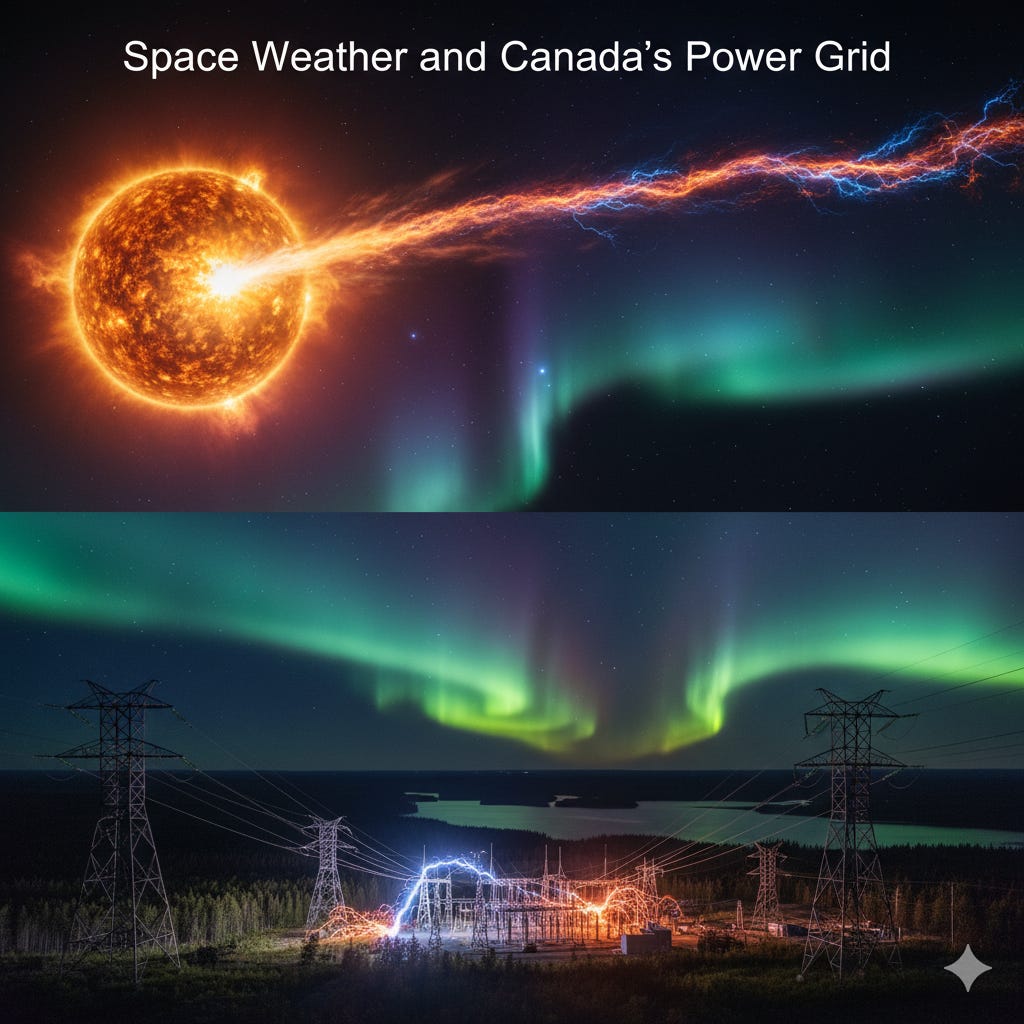
We rarely think about the sun as a direct threat. We depend on our electrical grid for nearly every aspect of modern life, assuming it will function quietly in the background. But what if an event millions of kilometres away could disrupt that system? A 2021 report from the Geological Survey of Canada, titled Review of space weather events in solar cycle 23 (1998-2005), provides a detailed account of just how vulnerable our infrastructure can be. The report is not a forecast of future doom, but a sober, scientific look at past events and their very real impacts on Canadian systems. It offers a clear-eyed reminder that some of the biggest threats to our national infrastructure are not earthbound.
What Is Space Weather?
To understand the risk, you first need to understand the phenomenon. What is space weather, and how does it reach us? The report explains that the sun operates in cycles, and during active periods, it can produce powerful events that travel through space.
The key drivers are solar flares, which are intense bursts of radiation, and Coronal Mass Ejections (CMEs), which are massive eruptions of plasma and magnetic fields from the sun’s corona. When a CME is aimed at Earth, it travels through space as a disturbance in the solar wind, the stream of charged particles constantly flowing from the sun.
When this disturbance reaches Earth, its magnetic field can interact with our planet’s own magnetic field, the magnetosphere. The report shows that when the interplanetary magnetic field (IMF) turns southward, it can effectively open a door, allowing energy from the solar wind to pour into our atmosphere. This interaction is what drives geomagnetic storms, the earthly consequence of space weather. These storms are not just responsible for the brilliant aurora borealis, they can also induce powerful electrical currents in the ground.
The Impact on Canadian Infrastructure
This is where the risk becomes tangible. How does a geomagnetic storm affect a power line in, for example, Nova Scotia? The report documents several instances where this exact scenario played out. These ground-induced currents (GICs) can flow into power grids through grounding points, potentially overloading transformers and disrupting the entire system.
The review of Solar Cycle 23 provides a clear record of this threat to Canada:
May 4, 1998: A geomagnetic storm caused GICs in the Nova Scotia power system to reach approximately 70 amperes. While no operational impacts were reported, it demonstrated the grid’s direct connection to space weather.
July 15, 2000: The “Bastille Day event,” a major storm, produced GICs of up to 100 amperes in Nova Scotia substations. Another event in April of that year caused GICs of 10 amperes in Ontario.
October 29-31, 2003: The famous “Halloween Storms” produced “exceptionally large” magnetic disturbances across all of Canada, from the polar region to the subauroral zone. The report notes that power systems in North America experienced “very strong” induced currents. While no outages occurred in North America, a short-duration outage was reported in Sweden, highlighting the severity of the event.
November 7-10, 2004: A complex event triggered by a series of CMEs resulted in GICs reaching 116 amperes in North American power systems. This storm was so intense that the aurora was visible across southern Canada, leading to widespread media coverage in cities like Ottawa.
These are not theoretical models, but documented measurements. The data shows a direct cause-and-effect relationship: a solar eruption leads to a geomagnetic storm, which in turn induces currents in Canadian power grids. The risk is not evenly distributed, with the report showing that disturbances vary significantly across Canada’s polar, auroral, and subauroral zones depending on the specific characteristics of each storm.
The Data Brief
The key takeaway from the report is that space weather poses a recurring and significant threat to Canada’s critical infrastructure. The review of the 1998-2005 solar cycle, a period of high solar activity, serves as a crucial case study. The data shows that major solar events, particularly CMEs, have repeatedly induced powerful electrical currents in Canadian power grids in Ontario, Quebec, and Nova Scotia. Storms like the 2003 Halloween event and the November 2004 storm pushed infrastructure to its limits, demonstrating that our modern, technology-dependent society is directly exposed to the sun’s volatile behaviour.
The Final Analysis
The Geological Survey’s report is a reminder that our complex systems are built on a foundation of stability we often take for granted. We have engineered incredible networks to power our lives, but they remain subject to forces of nature that operate on a scale far beyond our control. This is not about fear, but about foresight. Understanding the documented impacts of past solar storms gives us the intellectual ammunition to plan for a more resilient future, ensuring that when the next great storm arrives from the sun, the lights on Earth stay on.
Source Documents
Trichtchenko, L. (2021). Review of space weather events in solar cycle 23 (1998-2005) (Geological Survey of Canada, Open File 8765).