


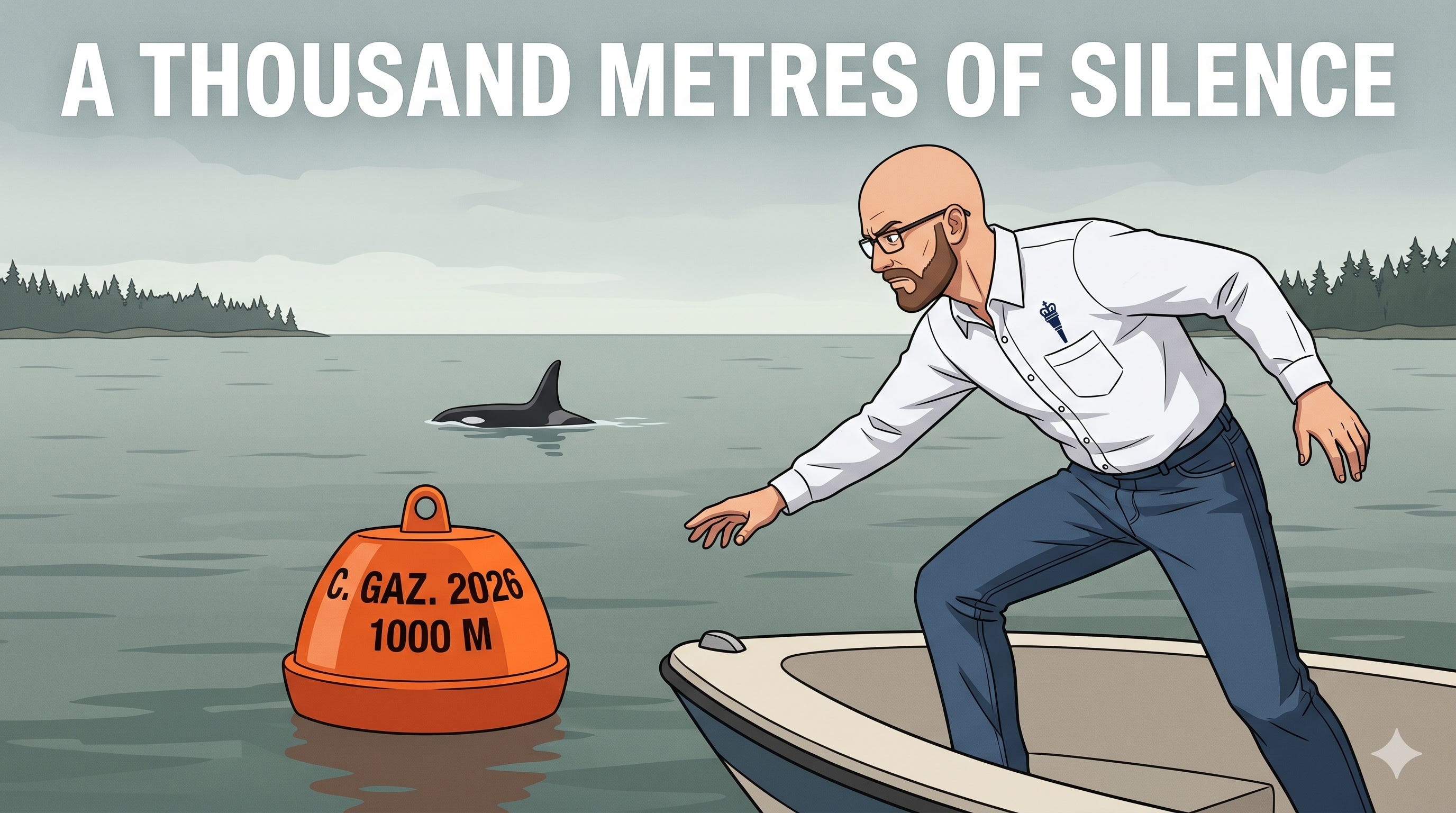
On a summer morning somewhere between Saturna Island and the open Pacific, a boater who once ran a familiar route at cruising speed now has a legal obligation they might not know exists yet. If a Southern Resident killer whale surfaces within a kilometre, they are already in violation of a federal interim order. The fine isn’t specified in the order. The whale doesn’t know the boundary exists. But as of June 1, 2026, the boundary is law.
That’s the quiet reality buried in the June 6 edition of the Canada Gazette, Part I, Vol. 160, No. 23: the Minister of Transport has issued the Interim Order for the Protection of the Southern Resident Killer Whale (Orcinus orca) in the Waters of Southern British Columbia, 2026, a set of binding rules that reshape how vessels move through some of the most trafficked marine waters in the country.
A Species, a Distance, a Deadline
The core of the order is specific. No vessel, no person aboard one, may approach within 1,000 metres of a Southern Resident killer whale in the waters identified in Schedule 1 of the order. That is ten times the previous general federal requirement for all whales under the Marine Mammal Regulations, and five times what had applied to orcas specifically. The order makes no exception for commercial operators, for whale watchers who have built businesses in the area, or for recreational boaters who simply didn’t see the animal coming.
Speed is the other lever. In the waters set out in Schedule 3, the order caps vessel speed at 10 knots over ground. Two areas are named specifically: the mouth of the Nitinat River and Swiftsure Bank, both known foraging grounds where whales surface unpredictably and vessels travelling at speed have limited time to react.
The order doesn’t linger on the science behind those numbers. It doesn’t explain the noise modelling or the strike-risk calculations. It simply sets the distance, sets the speed, and sets the date: June 1, 2026, when both provisions came into force.
The expiry date is November 30, 2026. If nothing else is said or done by then, the rules go with it.
Restricted Zones Off the Gulf Islands
Beyond the general 1,000-metre rule and the speed limits, the order carves out specific vessel restricted zones around two of the Gulf Islands. The waters near Saturna Island and Pender Island now carry additional restrictions, layered on top of the general prohibition. The Gazette does not describe what additional restrictions those zones contain; it signals they exist in the attached schedule. What they represent is a tiered system: certain places in the range of the Southern Resident pods are treated as more sensitive than others, and access to those places is controlled accordingly.
Saturna and Pender are familiar names to anyone who knows the Southern Gulf Islands. They sit in the corridor the Southern Residents travel regularly, and they attract recreational boaters throughout the summer season. The collision of those two facts is precisely why the zones exist.
False Creek Goes Dark
Simultaneously, the Minister issued a second interim order that has nothing to do with whales and everything to do with a specific stretch of urban water.
The Interim Order Respecting the False Creek Exclusion Zone came into force on the same day, June 1, and it does something unusually blunt: it bars pleasure craft and passenger-carrying vessels from navigating, anchoring, mooring, or berthing in the area of False Creek east of the Cambie Bridge. The order names its own expiry date as July 8, 2026. Whatever prompted the exclusion zone, the Gazette treats it as temporary.
The permitted exceptions are narrow. Vessels in distress may enter. Government personnel carrying out their duties may enter. Everyone else is out.
False Creek east of Cambie is not a remote anchorage. It is the inner waterway of one of the most densely populated urban cores in Canada, running through the former Expo 86 lands, past the Science Centre, past rowing clubs and residential towers that back onto the water. Closing it to pleasure craft for more than five weeks, with no detailed explanation in the Gazette text itself, is a significant operational fact.
The order was issued May 25. It came into force June 1. It ends July 8, unless something changes.
Tankers, Pilots, and the Crude Oil Rule
The same May 22 cluster of interim orders that produced the whale protection rules also updated the compulsory pilotage requirements in three separate maritime areas, each targeting a different category of risk.
In Area 2 of the Pacific Pilotage Authority Region, the new rule applies specifically to laden crude oil tankers. The threshold is a summer deadweight tonnage of 40,000 or more. Only vessels meeting that definition are now subject to compulsory pilotage within that area. The phrasing in the Gazette is deliberate: “only laden crude oil tankers with a summer deadweight tonnage of 40,000 or more.” Smaller vessels, or tankers carrying other cargo, are not captured by that particular rule.
On the East Coast, the Sheet Harbour Compulsory Pilotage Area received its own update. Ships of 170 metres or more in length, tankers of any kind, and liquid natural gas carriers are all now subject to compulsory pilotage there. The size threshold and the vessel-type list are different from the Pacific rule, reflecting different risk profiles in different waters.
The Belledune Compulsory Pilotage Area, also on the East Coast, saw changes to sea-experience requirements for pilots holding certificates for that zone.
Three separate waterways, three separate rules, all published in the same Gazette and all carrying the same May 22 issuance date. The cluster suggests a coordinated review across multiple pilotage zones, tightening the conditions under which certain high-risk vessels are required to take on a licensed pilot.
What Else the Gazette Carried
Beyond the marine orders, this Gazette issue moved through several other regulatory actions.
The Canada Border Services Agency reached two decisions on trade measures against China. On May 25, it issued preliminary determinations of dumping and subsidizing against forged grinding media, with provisional duties applied to goods released from that date forward. On May 28, it reached final decisions on thermoformed molded fibre tableware, the disposable plates and bowls that had been under investigation since late 2025.
A Texas-based company, Exsocert LLC, applied to the Canada Energy Regulator on May 12 to export up to 200,000 megawatt-hours of combined firm and interruptible energy annually to the United States, for a period of 10 years. The application sits with the regulator.
The Canadian International Trade Tribunal opened procurement inquiries into three separate complaints: from Origin Studios Inc. over exhibition services, from The Government Travel Group Inc. over hotel and lodging facilities, and from MTE Instruments Inc. over a torsion meter system. Each is an allegation from a company that believes a federal procurement process was conducted improperly.
And the CRTC published a correction to its Regulations Amending the Telecommunications Fees Regulations, 2010, confirming that the contribution-eligible revenue threshold applies to any provider or related group that “had at least $25 million in Canadian telecommunications services revenues for its fiscal year ending in the preceding calendar year.” Those amended regulations are scheduled to come into force January 1, 2027.
Five public servants received formal permission from the Public Service Commission to seek nomination and run as candidates in 2026 municipal elections. Ottawa, Cap-Acadie, Fundy Albert, and Mississippi Mills are the communities involved, with Ontario’s municipal election day falling October 26.
The Temporary Nature of Permanent-Feeling Rules
Interim orders are a specific tool in the federal regulatory toolkit. They allow a minister to act faster than the standard regulation-making process permits, but they come with a clock. The whale protection order expires November 30. The False Creek exclusion zone expires July 8. The pilotage amendments are framed as interim orders as well, meaning permanent regulations, if they come at all, will follow through a separate process.
The Gazette is the official record, but it is also a snapshot. It captures what the government decided to do on a particular date and for how long. Whether the Southern Resident killer whale protection measures become permanent, whether the exclusion zone in False Creek reflects a situation that gets resolved by early July, whether the pilotage tightening becomes the standing rule: none of that is answered here.
What is answered is simpler. On June 1, 2026, a boater approaching within a kilometre of a Southern Resident killer whale in southern B.C. coastal waters was in violation of federal law. The whale swam on.
Hansard Files goes to the primary record so you don’t have to. If this kind of accountability journalism matters to you, consider subscribing to keep the work independent.
Source Documents
Canada Gazette. (2026, June 6). Canada Gazette, Part I, Vol. 160, No. 23. Government of Canada.
The False Creek closure is related to the world cup as I saw reported on the news I saw tonight. Vancouver is pretty locked down as the event gets closer.
And now... the rest of the story...
The Southern Resident killer whales are an anomaly in that that pod ceased to breed with other killer whale pods. As a result, they are suffering a significant health issues due to inbreeding; reduced size, lowered fertility & early mortality. So much so that have genetically diverged enough to be considered separate species.