


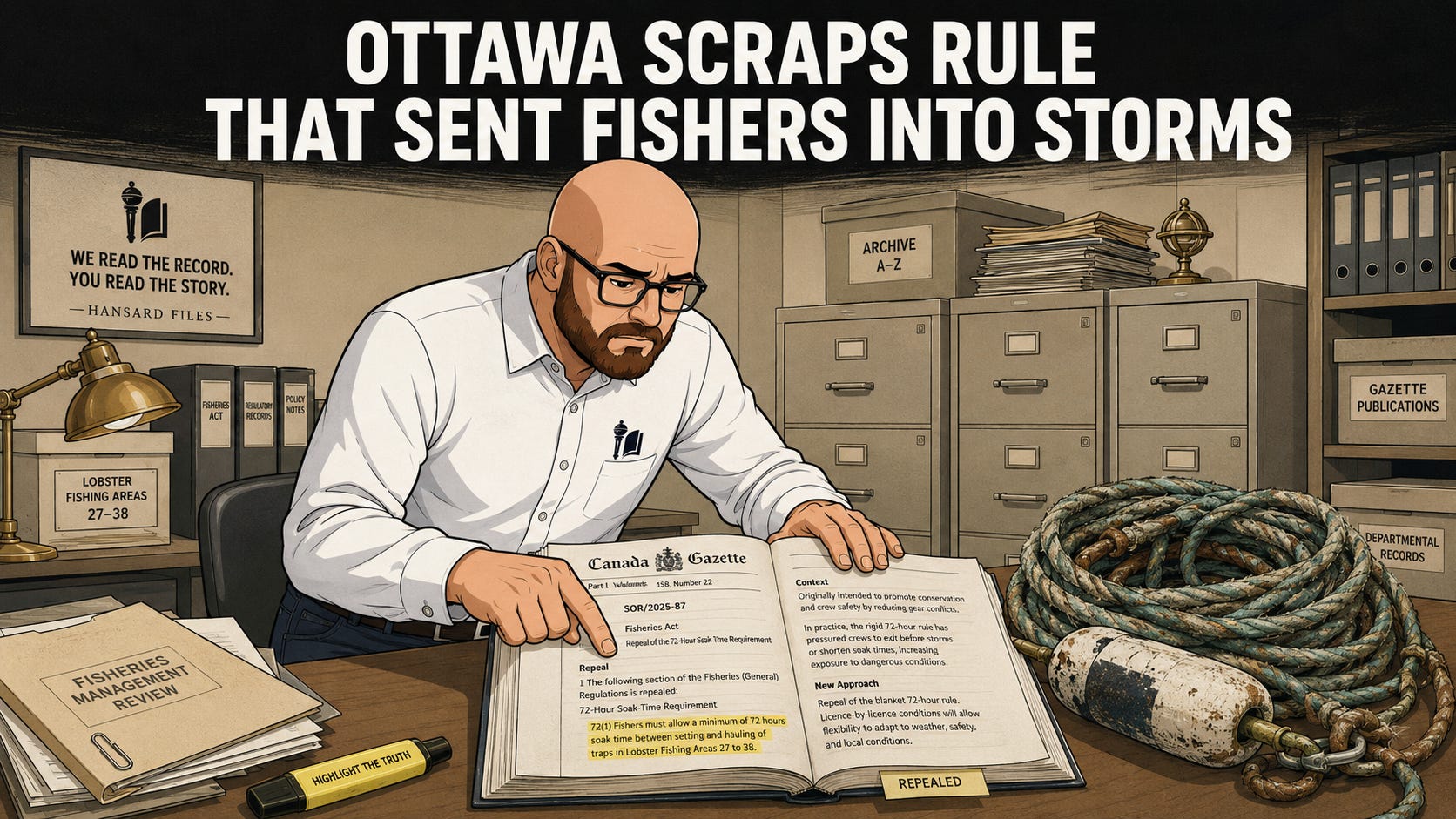
Federal fisheries regulations currently give a lobster or crab harvester on the Atlantic coast exactly 72 consecutive hours to check a string of traps before the law says the gear counts as abandoned. In Newfoundland and Labrador waters, the window is three days, not counting the day the gear went in. Miss it, and a harvester risks a $500 fine under the Contraventions Regulations. The rule sounds like a minor bit of bookkeeping. In practice, Fisheries and Oceans Canada says it has been quietly pushing crews out onto the water in weather they would otherwise sit out, just to keep the clock from running out on a trap line.
That’s the problem the department laid out in a Regulations Amending Certain Regulations Made Under the Fisheries Act (Unattended Fishing Gear), published in the July 4 Canada Gazette. The fix is almost bureaucratic in its simplicity: strip the fixed soak time limits out of three separate regulations and let DFO set them instead through conditions of licence, the same legally binding paperwork that already governs trip limits and gear allocations for a given season.
A rule built for a different fleet
The soak time requirement was never really about safety when it was written. The Atlantic Fishery Regulations, 1985, the Maritime Provinces Fishery Regulations and the Newfoundland and Labrador Fishery Regulations all impose the same flat tending window on every fixed gear fishery in their territory, whether that’s a small inshore trap fishery close to a harbour or an offshore fleet running gillnets and longlines far past sight of land. According to the regulatory impact analysis published alongside the amendment, the underlying goal was to limit spoiled catch, incidental catch, entanglement of marine mammals, turtles and sea birds, gear conflict and gear loss. Those are reasonable things to want. The trouble, DFO says, is that a single number applied to every fishery in the region “isn’t practical or economical” for offshore fleets that hold large trap allocations and face trip restrictions of their own, and can end up pressuring crews into hauling gear in conditions they’d rather avoid.
DFO didn’t need Parliament to fix this. Under the Fishery (General) Regulations, the department can already set soak times through conditions of licence, the same mechanism it uses for nearly everything else that has to flex with the season. The department has, in fact, been doing exactly that on the Pacific coast since 1999, when the soak time provisions in the Pacific Fishery Regulations, 1993 were repealed. This amendment brings the Atlantic and Newfoundland and Labrador fisheries into line with a system the west coast has run for a quarter century.
What the soak time repeal actually changes
The mechanics are narrow but specific. Section 115.2 of the Atlantic Fishery Regulations, section 27 of the Maritime Provinces Fishery Regulations and section 8 of the Newfoundland and Labrador Fishery Regulations are all repealed outright. In their place, DFO will prescribe soak times fishery by fishery, or fleet by fleet, through licence conditions, the same tool fisheries managers already use to set trap allocations and season dates. Because the old soak time rules also applied to licences issued under the Aboriginal Communal Fishing Licences Regulations, those licences move to the new system too.
There’s a wrinkle worth noting. A licence condition is not a lighter obligation than a regulation. Breaking one carries a $750 set fine, compared with $500 for the current soak time contraventions under the Newfoundland and Labrador and Atlantic regulations, or $250 under the Maritime Provinces regulations. DFO’s own cost-benefit analysis calls this change cost-neutral for harvesters, on the theory that compliance costs don’t shift just because the rule moved from one legal instrument to another. Whether a harvester agrees likely depends on how the new, more flexible limits get set fishery by fishery once the regulation takes effect on registration.
What the industry told DFO
DFO ran its consultation between January and February 2026, sending letters to commercial licence holders, industry representatives and environmental groups, and presenting the proposal at two regional advisory meetings, the Eastern Arctic Groundfish Stakeholders Advisory Committee and the Scotia Fundy Roundtable. The online survey drew 133 responses. Support was lopsided: 119 respondents backed repealing the fixed soak times, and the regulatory impact analysis says many of them cited safety, not economics, as the main benefit of the change.
Not everyone agreed. Twelve respondents, including environmental non-governmental organizations and inshore licence holders, worried that longer or more variable soak times could raise the risk to marine mammals, particularly in net fisheries, or that pulling the limit out of regulation altogether could invite neglect from harvesters who simply leave gear in the water longer than they should. DFO’s response, laid out in the same document, was that most harvesters have no incentive to leave gear unattended for long stretches in the first place, since it raises their own costs and risk, and that the department will keep soak time requirements consistent across overlapping or similar fisheries unless there’s a clear reason to diverge.
Indigenous consultation ran on a separate track. DFO wrote to coastal and inland First Nations and Indigenous organizations, and received 11 survey responses from Indigenous licence holders along with one written response from a consultation body. No meetings were requested. Every response DFO logged from Indigenous stakeholders supported the amendments, with safety, and not having to be at sea in bad weather, coming up repeatedly as the reason. An assessment conducted under the Cabinet Directive on the Federal Approach to Modern Treaty Implementation found a low risk that the change would affect the rights, interests or self-government provisions of Canada’s modern treaty partners, since the restrictions never applied to Indigenous harvesters fishing under communal licences to begin with.
Who’s watching for the fine print
Nothing about how DFO enforces the water changes here. Fishery officers will still lean on patrols, gear inspections, logbooks and vessel activity data, the same tools they use now, and DFO says it will publish operational guidance to keep soak time conditions consistent from region to region once licence conditions take over. What does change is who gets to move the number, and how fast. A regulation takes a formal amendment process to adjust. A licence condition can be updated at the start of a season, or mid-season if the science or the weather calls for it, which is precisely the flexibility DFO says the old system never had.
The amendment applies to fixed gear fisheries in the tidal waters of the Atlantic provinces and Quebec, coastal and offshore marine fisheries in Nunavut, Canadian fishery waters off Nova Scotia, New Brunswick and Prince Edward Island, and the waters of Newfoundland and Labrador. Interested parties have 30 days from July 4 to file comments with DFO before the regulation is finalized.
Hansard Files spends weeks in the archives so you don’t have to. If stories like this matter to you, subscribe to keep this work independent.
Source Documents
Government of Canada. (2026, July 4). Canada Gazette, Part I (Vol. 160, No. 27), Regulations Amending Certain Regulations Made Under the Fisheries Act (Unattended Fishing Gear), pp. 1904–1912.
I had not realized that there were regulations on how often capture devices needed to be visited, but now that I have read this I recognize the need. As long as the license conditions recognize that bad weather can impact safety and takes that into account, this sounds like a good thing. There are already enough dangers for people who go down to the sea in ships.
My brother-in-law is a commercial fisherman, spring season lobster on PEI. When he started telling me about the number of intrusive conditions being forced in by DFO, I was shocked.
For example, he is required to use an app to report when he heads out in the morning to check his trap and how many people he has on the boat. As he comes back in, he is required to estimate his catch, same app. While I hold my brother-in-law in high regard, he has zero interest in technology so he ends up depending on his hired hand for the smart phone app. When I asked what the purpose of the reporting was, he shrugged.
As a result, I'm tempted to send this article to my brother-in-law except I know he wouldn't read it.
Contrast that to when my father was fishing (1960s to 2000s), the fishermen were self-policing. They voluntarily restricted the number of traps before DFO conceived of the notion. Why? To avoid over-fishing. They voluntarily held to territorial restrictions; each small harbour had it's "zone" and didn't cross into the next harbour's zone. Why? To avoid over-fishing.
Then along comes the DFO to issue "tags" for traps (restricting the number per licence) and then using the Charter to dismiss the territorial zones, resulting in fishermen travelling hours "chasing" the areas with more lobsters. Fishermen from New Brunswick sailing across to Strait to set traps close to PEI. Results? Over-fishing!! The underwater version of the "paradox of the commons" proved accurate again.