


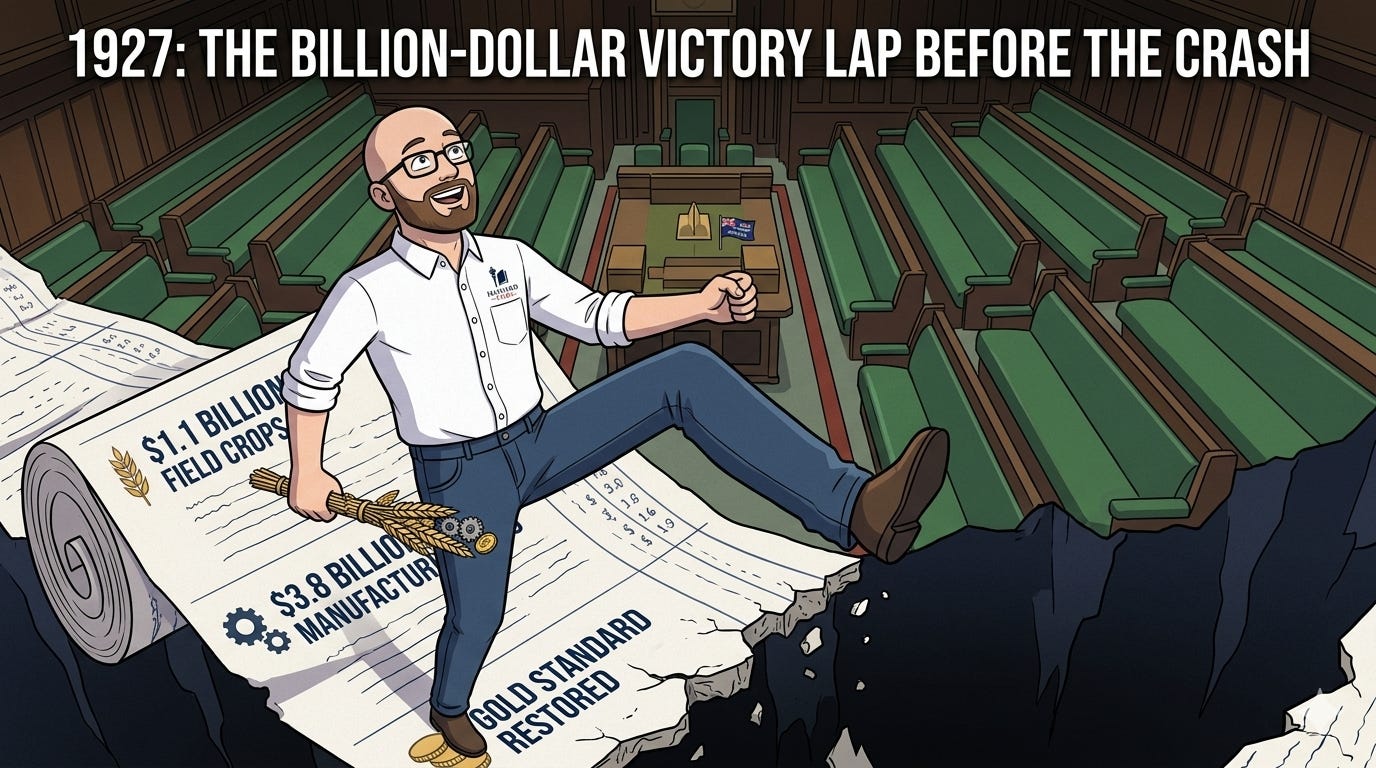
On July 1, 1927, the Dominion of Canada was in a mood for self-congratulation. It was the Diamond Jubilee of Confederation. From the granite bluffs of Halifax to the temperate rainforests of Vancouver, church bells rang out for a country that, by all rights, shouldn’t have worked. The speeches were grand, filled with references to “spirit,” “unity,” and “imperial destiny.” But in Ottawa, the Department of Trade and Commerce released a document that skipped the poetry in favor of the cold, hard ledger.
Titled Sixty Years of Canadian Progress, 1867–1927, this report is one of the most fascinating time capsules in Canadian history. Prepared by Minister James Malcolm, it serves as the ultimate “State of the Union” for a Canada that had survived its infancy and adolescence to become a global industrial power. It captures the nation at a precise, fleeting moment of supreme optimism: the economy was roaring, the factories were humming, and the gold standard had just been restored.
Yet, reading it today offers a chilling sense of dramatic irony. The statisticians who compiled these tables saw a trajectory of endless ascent. They could not see that the global financial system was overheating, or that the “billion-dollar wheat crop” they celebrated would soon rot in the fields during the Dust Bowl. This report is the final inventory of the “Old Prosperity” before the world broke in 1929.
The Conquest of the “Empty” West
To understand the magnitude of the shift documented in these pages, one must first look at the map—or rather, the blank spaces on it. The report reminds the reader that in 1867, the Dominion was effectively a ribbon of humanity clinging to the St. Lawrence River and the Atlantic coast.
The document notes starkly: “There was no Calgary, Edmonton or Vancouver in 1867; Winnipeg was a collection of huts”. The vast territory labeled “Rupert’s Land” was the private fiefdom of the Hudson’s Bay Company, inhabited by Indigenous nations and fur traders, but statistically invisible to the Ottawa bureaucrat.
By 1927, the rail lines had stitched these void spaces into the national fabric, and the demographic explosion was staggering. In 1871, the first census after Confederation, the population stood at a mere 3.4 million. By 1927, it had surged to nearly 9.5 million.
But the raw numbers hide the true revolution: the geography of power had shifted. Manitoba, which had a population of barely 25,000 at its organization, had exploded to over 647,000. Saskatchewan and Alberta, nonexistent as political entities in 1867, were now home to over 1.4 million people combined. The “Empty West” had been conquered, subdivided, and monetized.
The Billion-Dollar Granary
If the people provided the labor, the soil provided the capital. The report details the relentless industrialization of the Canadian landscape, transforming it from a subsistence economy to the “Granary of the Empire.”
In 1870, the total value of Canada’s field crops was estimated at $111 million—a figure representing a society growing food largely to survive the winter. By 1926, that figure had skyrocketed to over $1.1 billion. This ten-fold increase was an engineered miracle, driven by the breeding of new, early-ripening grain varieties like “Garnet wheat” which pushed the agricultural frontier north of the 60th parallel.
However, the data also reveals the terrifying volatility of this new economy. The report shows that crop values hit a staggering peak of $1.53 billion in 1919, driven by wartime demand and inflated prices, before crashing to $899 million in 1923. By 1927, the recovery was in full swing, creating a sense of stability that the data suggests was far more fragile than the government admitted. The report proudly displays photos of “miles of stooked wheat,” unaware that this monoculture dependence would leave the West devastatingly vulnerable to the drought and price collapses of the 1930s.
The Death of the Artisan
Perhaps the most striking sociological revelation in Sixty Years of Canadian Progress is the death of the artisan economy. The report describes the Canada of 1867 as a “primitive society” where manufacturing was “carried on within the household for the needs of the household”.
In those early days, the industrial census tracked trades that sound almost medieval to the modern ear. The report lists “spinning wheel factories, carving and gilding establishments, bellows manufacturers and manufacturers of paper collars” as significant industries of the 1870s. These were small, local operations; a shirt was made by a mother, a plow by the village blacksmith.
By 1927, the “Industrial Revolution” had brutally and efficiently reorganized Canadian life. The statistical leap is almost difficult to comprehend. In 1870, the gross value of manufactured products was $221 million. By 1925, that number had reached nearly $3 billion. The capital invested in factories had grown from a modest $78 million to a staggering $3.8 billion.
The Great War had been the great accelerator. The demand for munitions and supplies between 1914 and 1918 had forced Canadian industry to modernize overnight. The report notes that the war left a “permanent imprint upon the variety and efficiency of Canadian plants.” Entirely new behemoths had risen to replace the bellows-makers. Pulp and paper, practically non-existent in 1867, had become a giant, with Canada surpassing the United States as the world’s leading producer of newsprint. The automobile, a curiosity at the turn of the century, had spawned a manufacturing sector producing over $110 million in value annually.
The Financial Nervous System
A nation cannot grow from a colony to a power without a sophisticated financial nervous system, and the report tracks the explosion of Canadian banking with particular pride.
In 1867, Canadian banks were modest institutions with local reach. By 1926, they had become global players, with 195 branches in foreign countries, including outposts in London, Paris, and the West Indies. The “Dominion Note”—the paper currency of the federal government—tells the story of inflation and commerce. In 1870, the average circulation was $7.2 million. By 1920, fueled by the exigencies of war and the suspension of the gold standard, that figure had ballooned.
The report notes, with a palpable sense of relief and rectitude, that gold payments were resumed on July 1, 1926. To the economists of 1927, this was the ultimate signal that the chaos of the war years was over and that the Canadian dollar was once again “as good as gold.” They could not foresee that the gold standard would become a straightjacket during the Depression, exacerbating deflation and misery just a few years later.
Even the way Canadians protected themselves had changed. In 1875, the insurance market was dominated by foreign entities. By 1925, the volume of life insurance in force had grown exponentially, a safety net for a population that was increasingly dependent on wages rather than the land. The report lists “tornado and livestock insurance” alongside “burglary and forgery,” a catalogue of the anxieties of a modern, wealthy state.
The Ghosts in the Machine
While the tone of the 1927 report is relentlessly positive, a modern reading reveals the ghosts in the machine—the people and things left behind by “progress.”
The section on education notes that in 1871, 20 percent of the population over the age of 20 was “illiterate”. While this had improved to the point where the 1927 writer could boast of “great advances,” it reminds us that the industrial machine was built on the backs of a workforce that was often uneducated and raw.
There is also a poignant note regarding the “Fathers of Confederation” themselves. The frontispiece of the document is a reproduction of a charcoal drawing by Robert Harris. The original massive painting, which had hung in the Railway Committee Room of the House of Commons—the icon of the nation’s birth—was destroyed in the Great Fire of 1916. The image, like the men it depicted, had passed into history, leaving behind a nation that was richer, faster, and more complex than they could have ever devised.
Sixty Years of Canadian Progress is a victory lap run on the edge of a precipice. The authors of 1927 saw a trajectory of endless ascent—more wheat, more steel, more people. They calculated their wealth in billions, unaware that the ledger was about to turn red. But for that one moment, on the Diamond Jubilee, the numbers added up to a perfect success story.
The “Hansard Files” digs through dusty archives to find the narratives that shaped our world. Subscribe today to support independent investigative journalism that values depth over clicks.
Source Documents
Dominion Bureau of Statistics. (1927). Sixty Years of Canadian Progress, 1867–1927.
My grandfather used to tell a story of the first time he saw an automobile. Born and raised on a remote rural farm before roads were paved, plowing of fields involved horses and backbreaking labour behind a plow. The horse he was riding was spooked by the car and bolted across the field with my grandfather holding on for dear life.
Wow, the Canadian Archives. My tax dollars at work. :)
My grandfather moved to Alberta with his family from Ontario in about 1910. I just now realized that the excitement about "Canada's new province", joined Confederation in 1905, must have been huge.