


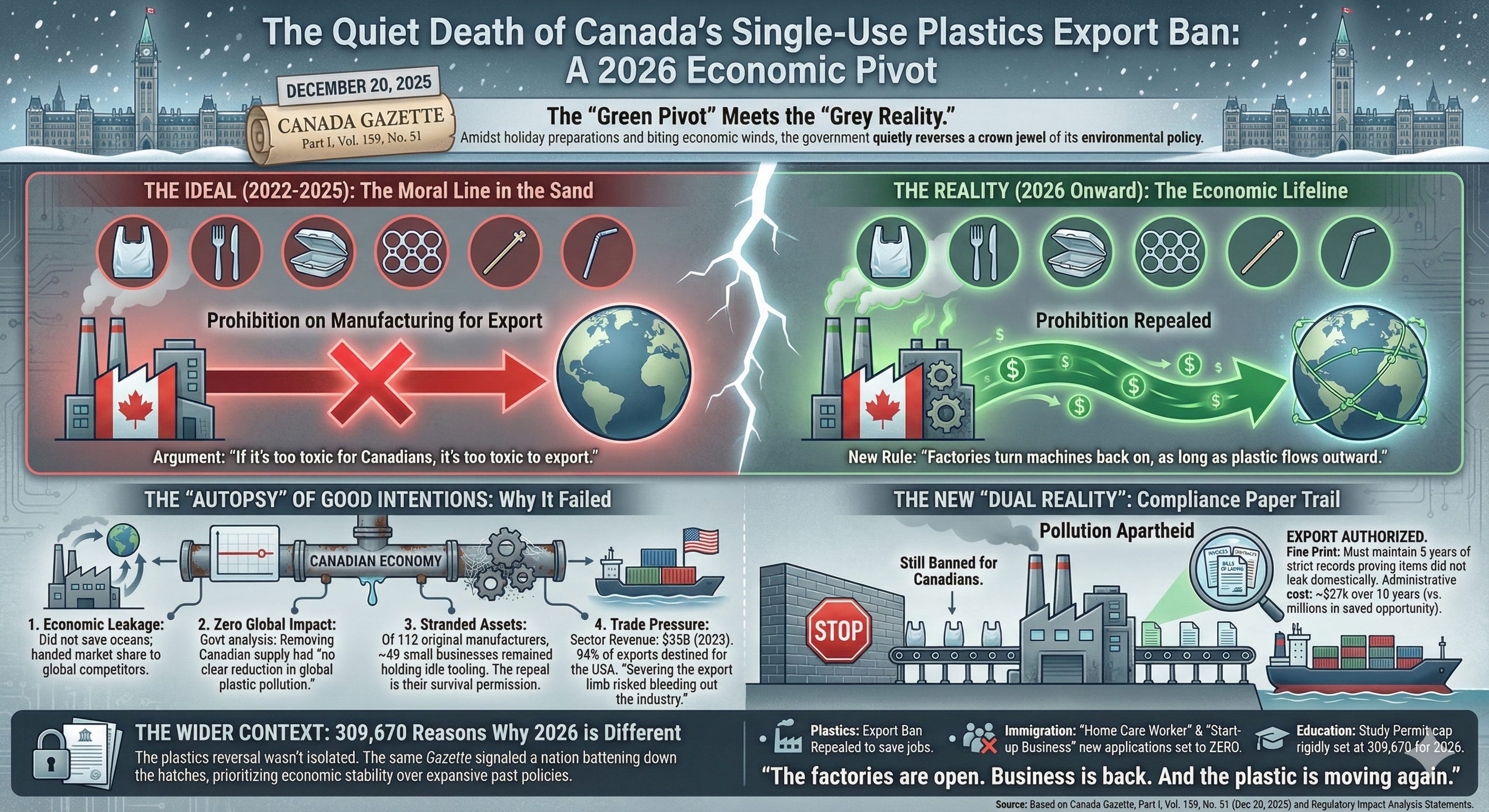
On the snowy morning of December 20, 2025, amidst the typical flurry of holiday preparations in Ottawa, the government of Canada quietly released a document that signaled a profound shift in the nation’s economic and environmental soul. Buried within the dense, bilingual columns of the Canada Gazette, Part I, Vol. 159, No. 51, was a admission of defeat—or perhaps, a cold calculation of survival. The Single-use Plastics Export Ban, once the crown jewel of Canada’s zero-plastic-waste ambition, was effectively dead.
Ideally, the ban was supposed to be a moral line in the sand. Canada had already prohibited the manufacture and sale of six categories of single-use plastics (SUPs)—checkout bags, cutlery, difficult-to-recycle foodservice ware, ring carriers, stir sticks, and straws—for its own citizens. The logical next step, argued proponents in 2022, was to stop exporting these “harmful substances” to the rest of the world. It was a matter of consistency; if it was too toxic for Canadians, it should be too toxic to sell to anyone else. But as the winter of 2025 set in, bringing with it the biting winds of global trade wars and “significant pressure on the domestic economy,” that moral line was erased. The government’s new proposal was stark: repeal the prohibition on manufacturing for export. The factories could turn the machines back on, as long as the plastic flowed outward, away from Canadian shores.
The Economic Reality Check
The reversal did not happen in a vacuum. It was the result of a brutal collision between ideology and the hard edges of a 2025 economy battered by tariffs and supply chain fractures. The Regulatory Impact Analysis Statement accompanying the amendments reads like a sombre autopsy of good intentions gone wrong. It explicitly notes that the prohibition on export came into force at a time when “tariffs and global supply chain challenges are creating significant pressure on the domestic economy.”
The government’s own analysis revealed a painful truth: stopping Canadian companies from selling plastic forks and bags abroad did not save the oceans. It simply handed market share to foreign competitors. The global demand for these cheap, disposable conveniences remained voracious, and where Canada stepped back, other nations stepped in. The regulatory text makes the admission bluntly, stating that the ban would displace domestic producers “in favour of other competitors in the global marketplace” without inducing any clear reduction in global plastic pollution. It was a classic case of economic leakage—Canada was exporting jobs, not environmentalism.
For the 112 unique businesses identified back in 2021 as manufacturers of these items, the writing had been on the wall. By November 2025, nearly half had already abandoned these product lines, diversifying into paper or fibre alternatives. But a stubborn core remained—49 businesses, the vast majority of them small enterprises with fewer than 100 employees, were still holding on, sitting on “stranded assets” and idle tooling. For them, the repeal wasn’t a policy debate; it was a lifeline.
The Machinery of Reversal
The mechanism of this policy U-turn is outlined in the proposed “Regulations Amending the Single-use Plastics Prohibition Regulations.” The amendment is deceptively simple: it adds a subsection regarding “Export” that effectively nullifies the previous restrictions for any goods manufactured, imported, or sold for the purpose of export.
The shift is justified through a lens of economic pragmatism that would have seemed heretical just three years prior. The government’s analysis highlights the intense “trade exposure” of the Canadian plastic product manufacturing sector—a sector that generated $35 billion in revenue in 2023. These are not isolated workshops; they are deeply integrated into North American supply chains, with 94% of exports destined for the United States. To sever the export limb was to risk bleeding out the entire organism.
There is a palpable sense of urgency in the text. The prohibition on manufacture for export was set to bite fully on December 20, 2025. The repeal, therefore, comes at the eleventh hour, a desperate attempt to prevent the final shuttering of production lines that employ thousands of workers. The government admits that for at least one company, the rescue came too late—they were already winding down operations. But for others, this regulatory amendment represents permission to survive. It re-establishes “access to economic opportunities” and allows Canadian firms to fight for their slice of the global single-use market, environmental optics be damned.
The Illusion of Global Influence
What makes this regulatory pivot so narratively compelling is the frankness with which the government assesses its own lack of leverage. In 2022, the argument was that Canada would lead by example. By 2025, the argument had shifted to one of insignificance.
The analysis provided in the Gazette posits that because the market for items like plastic straws and cutlery is “global, relatively non-differentiated and highly competitive,” removing Canadian supply has zero impact on global consumption. If a buyer in Texas or Tokyo wants a plastic stir stick, they will get one. The only variable is whether the profit from that stir stick lands in a Canadian bank account or a foreign one.
This realization strikes at the heart of modern environmental policy. It exposes the tension between symbolic domestic actions and the ruthless efficiency of international trade. The government concluded that the prohibition would not fulfill an environmental objective “commensurate to its economic impact.” In other words, the pain inflicted on Canadian workers and businesses was real and measurable, while the environmental benefit was theoretical and, ultimately, non-existent.
The proposed amendments do not just allow for the export of finished goods; they also address the complex web of “final goods” production. Consider the Canadian juice box manufacturer who imports plastic straws to attach to their cartons before exporting the whole package. Under the strict interpretation of the previous ban, this activity was imperiled. The prohibition on importing SUPs for the purpose of export threatened to disrupt established supply chains, forcing Canadian producers to source inferior substitutes or lose contracts to competitors unburdened by such scruples. The amendments sweep these restrictions away, prioritizing the smooth operation of trade over the rigid enforcement of plastic reduction.
A Fractured Consensus
The reaction to this pivot, as detailed in the consultation summary, paints a picture of a divided nation. When the Minister of the Environment first hinted at this reversal in October 2025, citing the “current policy landscape,” the relief from industry was audible. Associations representing manufacturers, chemists, and retailers backed the move, seeing it as a necessary correction to regulatory overreach.
However, the environmental non-governmental organizations (ENGOs) that had championed the ban saw it differently. To them, this was not a pragmatic adjustment but a retreat. They argued that repealing the ban signaled that “Canada is stepping away from its ambitions.” They pushed for a delay rather than a full repeal, hoping to keep the principle alive even if the practice was suspended. But the government, staring down the barrel of economic uncertainty, chose the permanent fix. The proposal to repeal was retained.
The implications of this choice extend beyond the factory floor. It represents a subtle but significant shift in the social contract regarding climate action. It suggests that in the hierarchy of needs for a mid-2020s G7 nation, economic stability has climbed back to the top rung, displacing purely aspirational environmentalism. The “non-regression” principle—the idea that environmental protections should only ever strengthen, never weaken—was analyzed and dismissed in this context. The government concluded that because the global pollution levels wouldn’t change, there was no regression. It is a technical truth, perhaps, but a symbolic defeat.
The Paper Trail of Compliance
Despite the reopening of the export floodgates, the government is not abandoning oversight entirely. The proposed amendments maintain strict record-keeping requirements. Any business that manufactures or imports these plastics for export must keep a paper trail for five years—invoices, bills of lading, contracts—proving that these forbidden items did not leak into the Canadian domestic market.
This creates a curious dual reality within Canada’s borders. A factory in Ontario might churn out millions of plastic ring carriers, but they must all vanish across the border. A Canadian citizen cannot buy the product made in their own town, even as that product is shipped by the container-load to a jurisdiction with looser rules. It creates a “pollution apartheid,” where Canadian soil is kept pristine by regulations that explicitly authorize the fouling of other nations’ ecosystems—provided the cheque clears.
The administrative burden of this compliance is calculated down to the dollar in the Gazette. It will cost the industry roughly $27,303 over ten years to maintain these records—a trivial sum compared to the millions in “forgone profit opportunity” that the ban would have cost them. The government estimates that re-opening exports could save the industry tens of millions of dollars, a figure that likely underestimates the true value of keeping these supply chains alive in a protectionist global economy.
A Cold Winter for Idealism
As the year 2025 draws to a close, the Canada Gazette Part I, Vol. 159, No. 51, stands as a testament to the complexities of governing in a turbulent world. It contains not just the plastics reversal, but other indicators of a nation battening down the hatches.
In the same document, buried under “Government Notices,” are new Ministerial Instructions regarding immigration that set the number of new applications for the “Home Care Worker” and “Start-up Business” classes to zero. The “Study Permit” cap is set at a rigid 309,670 for 2026. Everywhere one looks in this document, limits are being imposed, doors are being closed, and economic realities are asserting their dominance over expansive policies of the past.
The repeal of the Single-use Plastics Export Ban is the most vivid symbol of this new pragmatism. It is a recognition that Canada cannot unilaterally disarm in a trade war, even if the weapon is a plastic fork. The “Green Pivot” has met the “Grey Reality” of 2025.
For the workers in the plastics sector, this is a victory. Their jobs, for now, are safe. The machines will keep running. The trucks will keep rolling across the border, laden with the single-use conveniences that the world apparently cannot give up. But for those who believed that 2022 marked the end of Canada’s contribution to the global plastic crisis, the Gazette offers a sobering correction. The factories are open. business is back. And the plastic is moving again.
Source Documents
Department of the Environment & Department of Health. (2025, December 20). Regulations Amending the Single-use Plastics Prohibition Regulations. Canada Gazette, Part I, Vol. 159, No. 51.
Department of Citizenship and Immigration. (2025, December 20). Ministerial Instructions with respect to the processing of certain applications for a study permit made by a foreign national as a member of the student class. Canada Gazette, Part I, Vol. 159, No. 51.
Department of Citizenship and Immigration. (2025, December 20). New Ministerial Instructions regarding the processing of applications under the Home Care Worker Immigration Pilot (Child Care) and Home Care Worker Immigration Pilot (Home Support). Canada Gazette, Part I, Vol. 159, No. 51.
Department of Citizenship and Immigration. (2025, December 20). New Ministerial Instructions regarding the processing of applications under the Start-up Business Class and the Self-employed Persons Class. Canada Gazette, Part I, Vol. 159, No. 51.