


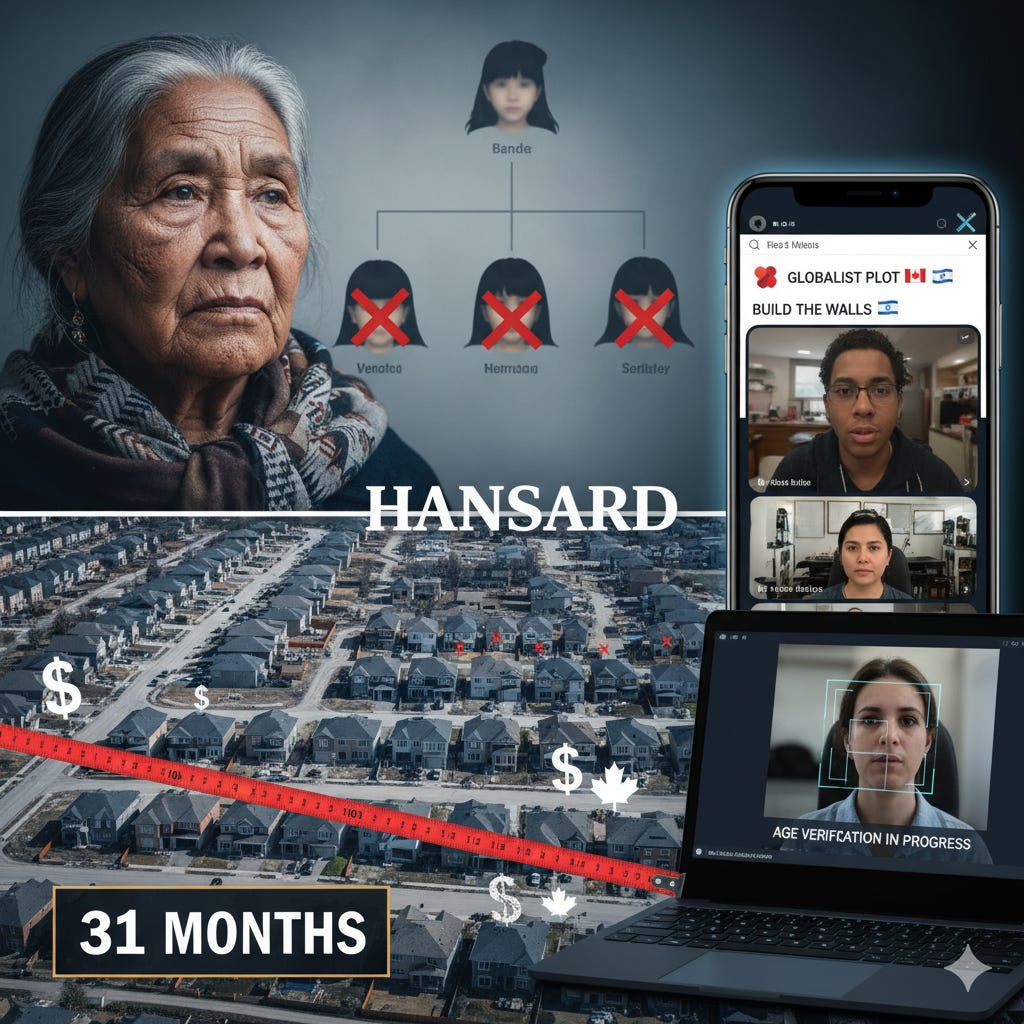
The past week in the Canadian Senate was not about incremental policy tweaks. It was a dense, often striking, review of the foundational crises facing the country. In committee rooms, senators grappled with fundamental questions of identity (who is a citizen?), infrastructure (where will they live?), and information (how do we protect them from harm?).
Testimony was not abstract. It was concrete, personal, and urgent. Witnesses delivered stark warnings on topics ranging from the “legislated extinction” embedded in the Indian Act to the “perverse platform design” fueling online hate, and the “broken” funding model stalling housing construction.
While the topics were disparate, the throughline was clear: core systems are failing to meet the needs of the present, and Parliament is struggling to find the tools to fix them.
What follows is a more granular synthesis of the key evidence presented, designed to provide deeper clarity on the complex challenges senators are attempting to navigate.
A ‘Legislated Extinction’
At the Standing Senate Committee on Indigenous Peoples, testimony centered on Bill S-2, a law intended to correct historical, sex-based discrimination in the Indian Act. The message from First Nations leaders and experts was unified and clear: the bill, as written, is a failure that continues, rather than ends, a policy of assimilation.
The “Second-Generation Cut-off”
Witnesses argued that while the bill addresses the specific Nicholas v. Canada court case, it deliberately ignores the larger, systemic discrimination that continues to this day: the “second-generation cut-off.”
What is this? It is the mechanism in section 6(2) of the Act. In simple terms, a person with 6(1) status can pass status to their child, but that child will have 6(2) status if the other parent is non-status. That 6(2) person cannot then pass their status to their own child if their partner is also 6(2) or non-status.
Lynda Price, former Chief of the Ulkatcho First Nation, presented a gut-wrenching family chart showing the “identical genealogy” paradox. She and her brother both have status. Her brother married a non-status person before 1985; his grandchildren received status. She married non-status after 1985; her grandchildren (Liv, Millie, and Lincoln) were denied status.
As Cora McGuire-Cyrette of the Ontario Native Women’s Association (ONWA) put it, “This is not an abstract policy. This is the government telling an Anishinaabe mother she cannot pass her identity to her child... It is legislated extinction.”
A “Colonial Delay Tactic”
Jeremy Matson, a successful UN litigant, was blunt. His own son is 6(2), meaning his bloodline is “extinct at his generation.” He argued that Canada’s Species at Risk Act gives “more legal protections” to fish and grass than the Indian Act gives his descendants.
When senators pressed on the government’s stated plan for “more consultation” on the cut-off, the response was one of deep frustration. “No more consultations are needed,” Matson stated, a sentiment echoed by all.
Chief Darcy Bear of the Whitecap Dakota Nation and Grand Chief Rémy Vincent of the Wendat Nation both described further consultation as a “delay tactic.” McGuire-Cyrette was more direct, calling it a “colonial tactic” used to avoid fixing a problem the government has been “studying” for 40 years. The demand from all witnesses was to amend Bill S-2 now to remove the second-generation cut-off and the existing bars on compensation for past harms.
The Housing Crisis: A Broken Funding Model
While one committee debated who belongs in Canada, two others—National Finance and Banking—tackled the question of where they will live. Testimony from economists, developers, and non-profit builders revealed a strong consensus: the system for funding new housing is broken, and municipalities are at the center of the problem.
The Problem with Development Charges (DCs)
The core of the problem, according to testimony, is a structural misalignment. Municipalities, reluctant to raise property taxes on existing residents, use Development Charges to force new home buyers to pay 100% of the cost of new “hard infrastructure” (water, sewer, roads, transit) upfront.
David Wilkes of the Building Industry and Land Development Association (BILD) noted that government fees and taxes account for 25% of a new home’s cost in the GTA. He stated that DCs in Toronto for a single-family home have risen 885% since 2011, from $14,000 to $138,000. These charges, he argued, are “pricing out an entire generation.”
The proposed solution? A fundamental shift. Witnesses Robert Howe and Daryl Keleher argued that this infrastructure, which makes up about 50% of DC costs, should be funded through a long-term utility model.
How would this look in practice? Municipalities (or new service corporations) would finance the infrastructure through 40-year bonds. They would then pay for it over decades via user fees from all residents in the service area who benefit, not just the new buyer. This spreads the cost over the asset’s lifespan and removes the crushing upfront barrier.
The “Layers of Regulation”
The second major barrier identified was not just the time for approvals, but the redundancy. Economist Peter Norman (Altus Group) provided data showing approval timelines in Hamilton (31 months) and Toronto (25 months) are among the worst in the developed world, compared to two months in Saskatoon.
Robert Howe, a municipal lawyer, gave a stark example. He told the committee he has a client file in the GTA that he opened in 2010. “It’s 2025,” he said, “and we don’t have shovels in the ground yet because we have literally been fighting with the municipality for the last 15 years” over competing, and often redundant, demands from different city departments and conservation authorities.
The PBO vs. CMHC Gap
Finally, the committee heard a crucial clarification on the “housing gap.” Jason Jacques, the Interim Parliamentary Budget Officer (PBO), stated his office’s calculation (a gap of 690,000 units) is based on returning to the historical vacancy rate.
In contrast, CMHC’s much larger number (which has been cited as 3.2 or 5.3 million) is based on returning to 2019 affordability levels. Jacques noted that for CMHC’s affordability goal to be met, the vacancy rate would have to “more than double the historical rate,” a situation he described as “strange” and one that would have its own disruptive economic impacts.
The Digital Crisis: Hate, Harm, and Regulation
Parliament’s struggle with the digital world was on full display in two committees, highlighting the real-world impacts of online content and the deep divisions over how to regulate it.
The Anti-Semitism and Hate Nexus
At the Human Rights committee, witnesses linked online hate directly to real-world violence. The RCMP reported that anti-Semitic hate crimes have tripled between 2020 and 2024. They also noted a specific increase in terrorist activity targeting the Jewish community, often involving “youth fuelled by online echo chambers.”
Imran Ahmed of the Center for Countering Digital Hate (CCDH) argued the problem is systemic. “This is not accidental,” he stated, “it is the result of perverse platform design.” He argued that “hate and lies about Jews are actually profitable for social media companies” because extremist content drives high levels of engagement (replies, quote-tweets), which the algorithms are designed to reward.
The Bill S-209 Pornography Debate
This collision of values erupted at the Legal andConstitutional Affairs committee over Bill S-209, which seeks to mandate age verification for pornographic sites.
The Harm Argument: Professor Janine Benedet argued that “privacy” is just the latest “disingenuous” argument used by the porn industry to shield itself, just as it used “freedom of expression” in the 1980s. She stated pornography is a “harmful cultural product” that normalizes violence and shapes dangerous sexual norms. She cited the case of Cindy Gladue, whose killer had searched for violent pornography depicting the very wounds he inflicted, arguing the link is direct.
The Overbreadth Argument: Professor Michael Geist countered that the bill, as drafted, is “dangerously overbroad” and “intentionally capturing far more than pornography sites.” He argued its vague wording would apply to platforms like X, Reddit, and even news sites with comment sections, effectively “age-gating the entire internet.” He warned this would force millions of Canadians to surrender government ID to “foreign-based entities,” creating massive privacy and data sovereignty risks.
The Tech Solution (and its problems): Witnesses from the age-verification industry argued new tech could solve the privacy problem. Jean-Michel Polit of Needemand presented an AI tool that uses “hand movements” to estimate age with 99% accuracy, requiring no personal data. But Professor Emily Laidlaw questioned this, asking who audits this “black box” AI and whether it could be used to gather other biometric data, creating a new privacy nightmare.
The CBC’s Strategy for Survival
Finally, the Transport and Communications committee heard from the leadership of CBC/Radio-Canada. Their testimony outlined a strategy for survival in a media landscape dominated by the same foreign digital platforms.
President Marie-Philippe Bouchard said the CBC’s new five-year plan is built on three pillars:
Proximity: Getting closer to communities by adding more journalists on the ground.
Digital Agility: Ensuring content is available on all platforms where Canadians spend their time.
Bringing People Together: Serving underserved audiences like youth, newcomers, and those “unhappy with our current service.”
GM Brodie Fenlon was candid about the “digital agility” component. He described platforms like TikTok as a “public square” where the CBC must be present to fulfill its mandate, even if it is an uncomfortable environment. He noted the average age for “The National” on broadcast television is 60, but on YouTube, it is 45-50, and on TikTok, it is in the 20s.
Bouchard stressed the CBC must act as a “pollinator, not a competitor,” helping support private and community media. She confirmed that the $7 million received from the Google (Bill C-18) fund is being invested entirely in local service, hiring 30 new reporters on the English side and 10 on the French side.
When pressed by senators on perceptions of bias, Bouchard drew a firm line. “We are a public broadcaster,” she stated, “not a state broadcaster.” She defended the broadcaster’s “strict journalistic standards” and “independent ombudsman,” calling the CBC the “most accountable” news organization in the country.
The Data Brief
Anti-Semitic Hate Crimes: Tripled between 2020 and 2024.
Toronto Development Charges: Increased 885% for a single-family home since 2011 (from $14,000 to $138,000).
Housing Approval Times: Average 25 months in Toronto and 31 in Hamilton, versus 2 in Saskatoon.
PBO Housing Gap: 690,000 units needed by 2035 to restore the historical vacancy rate.
CMHC Housing Goal: Aims to restore 2019 affordability levels, requiring a vacancy rate more than double the historical average.
CBC Google Funds: $7 million from Bill C-18 is funding 40 new local journalists (30 English, 10 French).
CBC Audience Age: Average for “The National” is 60 (Broadcast TV), 45-50 (YouTube), and 20s (TikTok).
Age Verification (Hands): New AI tech (Border Age) claims 99% accuracy with no personal data, though this claim was challenged.
X (Twitter) Hate Content: A CCDH study found 670,000 anti-Semitic posts (violating X’s rules) received 193 million views.
Source Documents
Standing Senate Committee on Transport and Communications. (2025, October 21). Evidence.
Standing Senate Committee on Indigenous Peoples. (2025, October 22). Evidence.
Standing Senate Committee on Indigenous Peoples. (2025, October 28). Evidence.
Standing Senate Committee on Banking, Commerce and the Economy. (2025, October 22). Evidence.
Standing Senate Committee on Banking, Commerce and the Economy. (2025, October 23). Evidence.
Standing Senate Committee on Legal and Constitutional Affairs. (2025, October 22). Evidence.
Standing Senate Committee on Legal and Constitutional Affairs. (2025, October 23). Evidence.
Standing Senate Committee on Human Rights. (2025, October 27). Evidence.
Standing Senate Committee on National Finance. (2025, October 28). Evidence.
Standing Senate Committee on National Security, Defence and Veterans Affairs. (2025, October 27). Evidence.
Standing Senate Committee on Transport and Communications. (2025, October 28). Evidence.
Standing Senate Committee on Foreign Affairs and International Trade. (2025, October 22). Evidence.
Standing Senate Committee on Foreign Affairs and International Trade. (2025, October 23). Evidence.
Standing Senate Committee on Social Affairs, Science and Technology. (2025, October 22). Evidence.
Standing Senate Committee on Social Affairs, Science and Technology. (2025, October 23). Evidence.
Standing Senate Committee on Agriculture and Forestry. (2025, October 23). Evidence.
Standing Senate Committee on Internal Economy, Budgets and Administration. (2025, October 23). Evidence.