


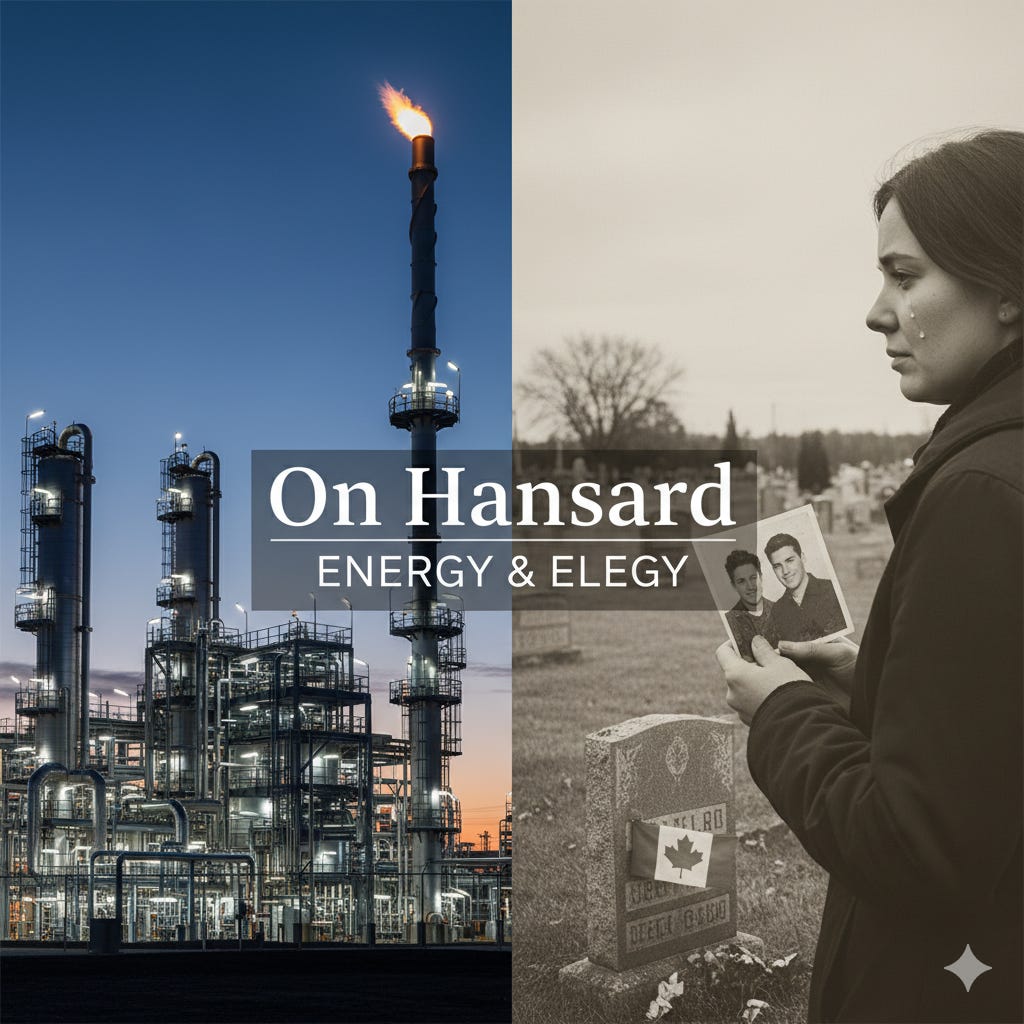
In a week of intense debate on Canada’s energy future, one of the most affecting moments came from a deeply personal story of friendship and loss used to frame the current state of American politics. What follows is an analysis of the key debates from the Senate floor.
This briefing will take you an estimated 5 minutes to read.
ENERGY
Canada’s “Energy Superpower” Ambitions Face Scrutiny
Driving the news: During a tense Question Period on October 9, Minister of Energy and Natural Resources Tim Hodgson defended the government’s strategy against accusations that its policies are driving investment to the United States and undermining the economy.
Catch-up: The session followed a letter from over 90 energy sector leaders who called on the government to streamline regulations, speed up project approvals, repeal anti-development laws like Bill C-69, and remove the oil and gas emissions cap. Minister Hodgson was pressed repeatedly on why these specific requests have not been implemented.
Big Picture: The debate highlights a fundamental conflict in federal policy. The government aims to attract $500 billion in new investment and has established a Major Projects Office in Calgary, yet industry leaders and opposition senators argue existing regulations and proposed emissions caps create uncertainty that pushes capital south.
Why it matters: The exchange reveals the core challenge facing the government: balancing its climate objectives with economic demands. Minister Hodgson argued that Canada is “building at a pace that it has not done in a long, long time,” citing new projects from Quebec to British Columbia. Critics counter that these are exceptions and that major firms like Enbridge are investing the majority of their capital in the U.S. due to a more favourable regulatory environment.
What’s next: The government has signaled its climate competitiveness strategy will be released in the coming weeks, which may provide more clarity on how it intends to resolve these competing priorities.
FOREIGN AFFAIRS
A Personal Reflection on a Fraying Friendship
Driving the news: In a remarkable speech on October 8, Senator Paula Simons paid tribute to her late American friend, Christopher Mario, using their decades-long relationship as a powerful metaphor for the deteriorating state of Canadian-American relations.
Catch-up: Senator Simons described her friend as a charismatic, intelligent man who, despite every advantage, followed a path of self-destruction fueled by addiction. She met him 39 years ago at Stanford University, and despite their wildly different politics, they forged a deep and lasting friendship.
Big Picture: The speech drew a direct parallel between her personal grief and the collective mourning many Canadians feel watching the United States. She described America as a “friend who seems hell-bent on self-destruction, drunk on hatred and division,” a sentiment she argued has shaken Canadians’ certainties about their closest ally.
Why it matters: This was not a standard policy speech. Senator Simons connected a personal tragedy to a national anxiety, capturing the sense of helplessness many Canadians feel as they watch American democracy “light itself on fire”. Her analogy suggests the problem is not just about tariffs or political disagreements but a fundamental sorrow over the loss of a shared ideal and the instability it creates for Canada. The speech concluded with a request for condolences from her Senate colleagues for her friend’s family, poignantly linking the personal and the political.
SOCIAL POLICY
Seniors Face Affordability and Housing Crisis
Driving the news: During the October 7 Question Period, Secretary of State for Seniors Stephanie McLean faced a barrage of questions regarding the mounting financial pressures on Canadian seniors, from the rising cost of living to housing affordability and elder abuse.
Catch-up: Senators pointed to data showing that over a third of seniors are considering part-time work to afford rising costs, and one in three are supporting their children or grandchildren at the expense of their own retirement savings.
Big Picture: The discussion exposed a widespread concern that federal support programs like Old Age Security (OAS) and the Guaranteed Income Supplement (GIS) are not keeping pace with inflation, particularly for essentials like groceries and rent.
Why it matters: The session underscored the gap between government assurances and the lived reality for many seniors. While the Secretary of State pointed to initiatives like the Canadian Dental Care Plan and the indexation of OAS benefits to inflation, senators from multiple parties argued for a more comprehensive national seniors strategy. The debate also highlighted the challenges facing caregivers and the need for greater support for those, primarily women, who care for elderly parents.
ON THE DOCKET
Motion on Gaza Sparks Tense Debate
A motion introduced by Senator Yuen Pau Woo calling on the government to examine the risk of Canadian complicity in violations of international law in Gaza led to a point of order on October 7, the second anniversary of the Hamas attacks. Senator Pamela Wallin objected to the use of the word “genocide” as “sharp and taxing language,” particularly on a day of commemoration for Israeli victims. The debate continued the next day, with senators speaking to the need for accountability and an end to violence.
Arab Heritage Month Bill Passes Senate
On October 8, the Senate passed Bill S-227 at third reading, which seeks to designate April as Arab Heritage Month in Canada. Senator Danièle Henkel, speaking in support of the bill, noted that Canadians of Arab descent are a “living force, rooted in history and fully committed to building the Canada of today and tomorrow”.
Tributes for Departing Senator David Richards
The Senate spent considerable time on October 7 paying tribute to the Honourable David Richards, the acclaimed novelist from New Brunswick, on his retirement. Colleagues from all groups praised his principled, independent voice and his dedication to representing the people of Miramichi. In his farewell address, Senator Richards shared a humorous story of his first, disorienting day on Parliament Hill, concluding with the sentiment that “the individual is everything or life is nothing”.
IN THEIR OWN WORDS
Senator Paula Simons on the state of the Canada-U.S. relationship.
“I think that’s how many Canadians feel about America right now. How long have we been charmed enthralled, even by America’s talent and generosity, by all its rich gifts? ... Watching Trump’s America demolish that legacy, watching American democracy light itself on fire and watching legendary American papers declaw and debase themselves has not just broken our hearts it has shaken our certainties.”
Why it matters: This quote, delivered during her October 8 address, reframes the Canada-U.S. relationship from a matter of pure policy to one of emotional and psychological impact. By comparing the political situation to the painful experience of watching a loved one self-destruct, Senator Simons articulated a deep-seated Canadian anxiety that goes beyond simple political disagreement.
ALSO NOTEWORTHY
The Senate recognized October as Korean Heritage Month, Islamic Heritage Month, and 2SLGBTQI+ History Month.
Senator Mary Robinson celebrated Pieter Valkenburg, a P.E.I. resident knighted by the Netherlands for his work identifying and honouring the graves of Canadian soldiers who died liberating the country in WWII.
Senators highlighted National Dental Care Day (October 10), an initiative providing free dental care to underserved Canadians.
Concerns were raised about the Canada Post labour dispute impacting upcoming municipal elections in Quebec.
The Senate recognized Co-op Week (Oct. 12-18) and the UN’s designation of 2025 as the International Year of Cooperatives.
A tribute was paid to the late Dr. Jane Goodall, who passed away last week at the age of 91.
Olympic champion Andre De Grasse was a guest in the gallery and was recognized for his athletic achievements and community impact.
Senator Victor Boudreau called for changes to the Disability Tax Credit, arguing its requirements prevent the poorest Canadians with disabilities from accessing the new Canada Disability Benefit.
Senator Michèle Audette delivered a statement remembering Joyce Echaquan and other missing and murdered Indigenous women and children.
THE DATA BRIEF
80%: The percentage of Canada’s crude oil exported to the United States last year, highlighting the country’s dependence on its southern neighbour.
$400,000: The estimated value of care provided through the National Dental Care Day initiative to people without dental coverage.
27%: The increase in grocery prices across Canada since 2020, a key factor in the affordability crisis facing seniors on fixed incomes.
7,600: The number of Canadian soldiers, sailors, and airmen who died to liberate the Netherlands between September 1944 and April 1945.
$200: The maximum monthly amount of the new Canada Disability Benefit, an amount senators argue is not enough to lift recipients out of poverty.
Sources:
Senate of Canada. (2025, October 7). Debates of the Senate (Hansard), 45th Parl, 1st Sess, Vol 154, No 22.
Senate of Canada. (2025, October 8). Debates of the Senate (Hansard), 45th Parl, 1st Sess, Vol 154, No 23.
Senate of Canada. (2025, October 9). Debates of the Senate (Hansard), 45th Parl, 1st Sess, Vol 154, No 24.