


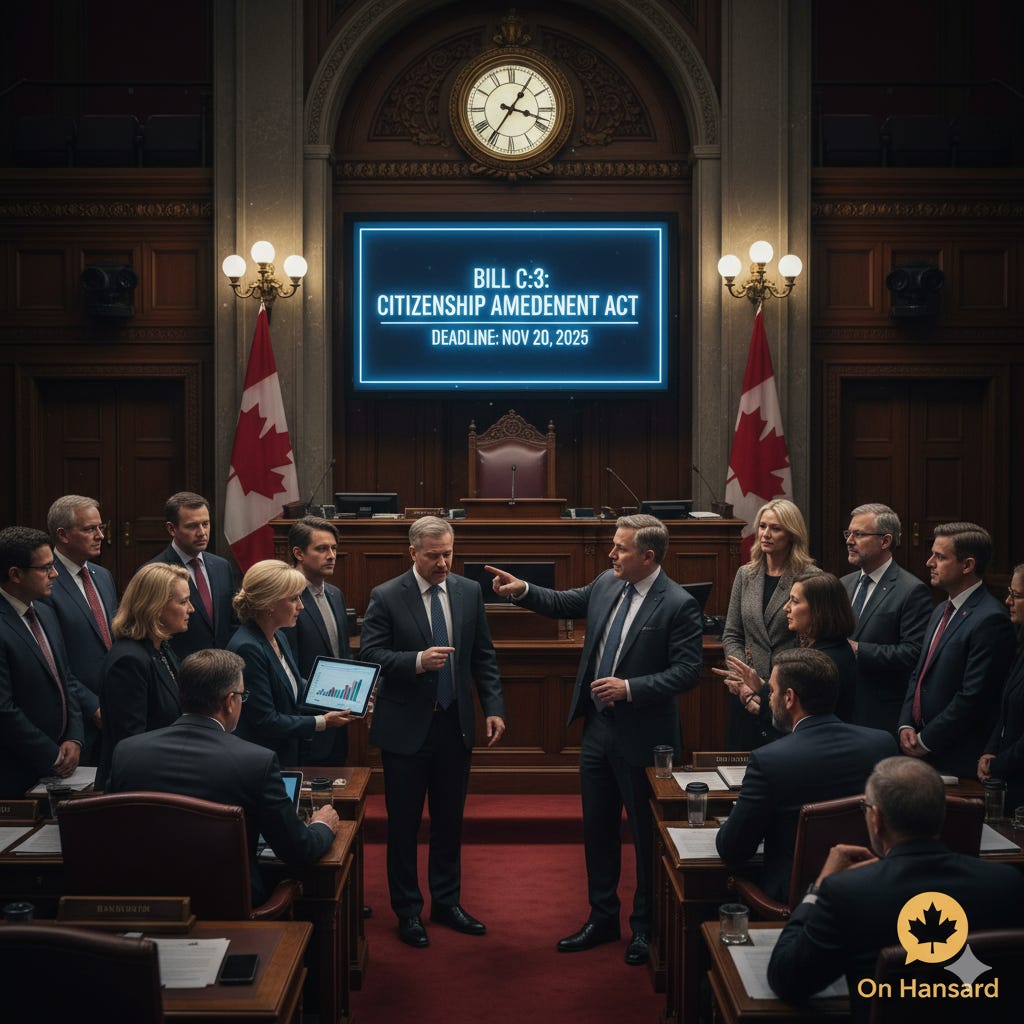
The Senate is now at the center of a tense, fast-moving debate over Canadian identity. On Thursday, the government introduced Bill C-3, An Act to amend the Citizenship Act, and immediately passed a motion to fast-track its review.
The legislation is the government’s official response to a 2023 Ontario Superior Court ruling that found a key part of the Citizenship Act unconstitutional. That provision, known as the “first-generation limit,” prevents Canadian citizens who were born abroad from automatically passing their citizenship to their own children if those children are also born abroad.
The court gave Parliament until November 20, 2025, to fix the law. With that deadline now looming, the government is moving to expedite the bill, sparking a significant clash over process, policy, and the very definition of “substantial connection” to Canada.
🏛️ The Bill and the Deadline
The push for this change is rooted in the 2023 Bjorkquist case. The court found that the first-generation limit unfairly creates two classes of citizens, violating the Charter of Rights and Freedoms.
Bill C-3 seeks to remedy this by creating a new test. Going forward, a Canadian parent born abroad could pass on their citizenship if they can demonstrate a “substantial connection” to Canada. The bill defines this as having been physically present in Canada for a cumulative total of 1,095 days (three years) before the child’s birth or adoption.
For those “Lost Canadians” born before the law comes into force (like the grandchildren of a Canadian born abroad), the bill proposes to automatically confer citizenship.
During the second reading debate, the bill’s sponsor, Senator Mary Coyle, framed the legislation as a matter of correcting a long-standing injustice. She shared her own family’s story to illustrate the arbitrary nature of the current law.
“My youngest daughter, Lindi... was born in Kanye, Botswana,” Senator Coyle explained. Her other two daughters were born in Canada.
When Lindi later had her own children in Mexico, she did not have the right to pass on her Canadian citizenship. Her children only gained citizenship through their Nova Scotia-born father. “If her partner had been Mexican... they would not have had the right to Canadian citizenship, even though their mom was Canadian and her mom was a Canadian senator,” Coyle said.
Because the court’s declaration of invalidity will take effect on November 20, Senator Coyle urged the chamber to move the bill forward quickly.
⏱️ The Opposition’s Case: “A Self-Imposed Race”
The opposition, however, argues the government’s “need for speed” is a manufactured crisis.
Senator Leo Housakos, the critic for the bill, delivered a sharp rebuke, arguing the government is using the court deadline as a “pretext to rush complex bills through without adequate deliberation.”
His case against the bill rests on two main points:
A Flawed Process: Senator Housakos argued that instead of appealing the Bjorkquist decision (a provincial superior court) to the Supreme Court for constitutional clarity, the government “chose expedience over clarity and politics over prudence.” He contrasted this with the Carter case on medical assistance in dying, where the government sought appellate review before legislating. “What should have been a moment of careful legal and policy reflection,” he said, “became a self-imposed race against the clock.”
A Flawed Policy: The opposition contends the bill “goes well beyond the necessary remedy.” Senator Housakos argued it extends automatic citizenship to individuals with “limited or no tangible connection to Canada,” creating new uncertainties rather than simply addressing the specific inequality identified by the court.
This concern was echoed in a question from Senator Percy E. Downe, who asked about the security implications of automatically granting citizenship to someone who may have spent their entire life abroad.
Senator Coyle’s response was direct: “My children, who are citizens, don’t have to go through security checks. Your children wouldn’t either. These are Canadian citizens.”
The bill ultimately passed its second reading on division, indicating formal opposition, and was referred to the Standing Senate Committee on Social Affairs, Science and Technology for its expedited study.
🗳️ The Other Citizenship Debate: Who Votes?
While Bill C-3 focuses on who is a Canadian, the Senate is simultaneously debating which Canadians get to vote.
Debate continued this week on Bill S-222, which proposes to lower the federal voting age from 18 to 16. This bill faced powerful opposition from senators who argued it was both institutionally illegitimate and civically unwise.
Key Arguments Against “Vote 16”
Institutional Legitimacy: Senator Housakos argued that the unelected Senate should not be changing the rules that determine how the elected House of Commons is chosen. “The Senate does not directly represent the people,” he stated, “and it would be paradoxical for any unelected chamber to redefine who can vote.”
Civic Maturity: Both Senator Housakos and Senator Denise Batters argued that 16, as an age, is legally and cognitively inconsistent with the responsibilities of voting.
They noted that 16-year-olds are not tried as adults under the Youth Criminal Justice Act.
They cannot sign legal contracts. Senator Batters pointed out that 17-year-old hockey phenom Connor Bedard “had to have his dad sign his first contract for him.”
Senator Batters also referenced cognitive development, noting that while 16-year-olds are capable of “cold cognition” (decision-making without emotion), their “cognitive-control system” (which resists social and emotional influence) does not mature until the mid-20s.
Senator Paulette Senior, speaking on November 4, offered a strong counter-argument, calling the age of 18 an “arbitrary barrier.” She described this generation as “politically savvy, hyperaware, and deeply engaged” on issues like climate justice and racial inequality, and noted that peers like Scotland, Wales, and Austria have already lowered the voting age.
💸 The Fiscal Backdrop: A Budget Under Scrutiny
These debates on identity and rights are happening against the backdrop of the new federal budget, “Canada Strong,” which was tabled in the Senate on November 5.
Question Period across all three days was dominated by intense clashes over the government’s fiscal management.
The Opposition View: Senator Housakos highlighted that interest payments on the federal debt ($55.6 billion) now exceed provincial health care transfers ($54.7 billion). He also pointed to data showing Canada’s gross debt-to-GDP ratio is 113.9%, the fifth largest among G7 nations, and Canadian household debt is the highest in the G7.
The Government View: Senator Pierre Moreau (Government Representative) defended the budget as a plan to “spend less so it can invest more.” He repeatedly cited Canada’s net debt-to-GDP ratio (13.3%) as the lowest in the G7 and framed the spending as “generational investments” in infrastructure and housing.
This fiscal tension was also felt in questions about specific spending. Senator Éric Forest noted that $8.5 billion in federal funds earmarked for Quebec (for housing, public transit, and climate) is still “tied up in Ottawa” due to jurisdictional disputes, while Senator Claude Carignan called the $375 million per year in new infrastructure funding for the province “an insult.”
The Data Brief
Bill C-3 (Citizenship Act), which responds to a court order striking down the “first-generation limit” on citizenship by descent, was introduced in the Senate and is being fast-tracked to meet a November 20 deadline.
The bill passed second reading on division and was referred to the Standing Senate Committee on Social Affairs, Science and Technology.
Bill S-222 (Vote 16) faced strong opposition during second reading debate, with critics arguing the unelected Senate lacks the legitimacy to change election laws and that 16-year-olds lack the legal and cognitive maturity to vote.
Bill S-206 (Guaranteed Livable Basic Income) passed second reading on division and was referred to the Standing Senate Committee on National Finance for study.
Bill S-217 (CRA Reporting), which would require the CRA to report on the “tax gap,” received support from its opposition critic, Senator Elizabeth Marshall.
The new Budget 2025 dominated Question Period, with the government defending its “investment” strategy while the opposition focused on high-interest payments and rising gross debt.
Source Documents
Canada. Parliament. Senate. (2025, November 4). Debates of the Senate (Hansard), 1st Session, 45th Parliament, 154(31).
Canada. Parliament. Senate. (2025, November 5). Debates of the Senate (Hansard), 1st Session, 45th Parliament, 154(32).
Canada. Parliament. Senate. (2025, November 6). Debates of the Senate (Hansard), 1st Session, 45th Parliament, 154(33).