


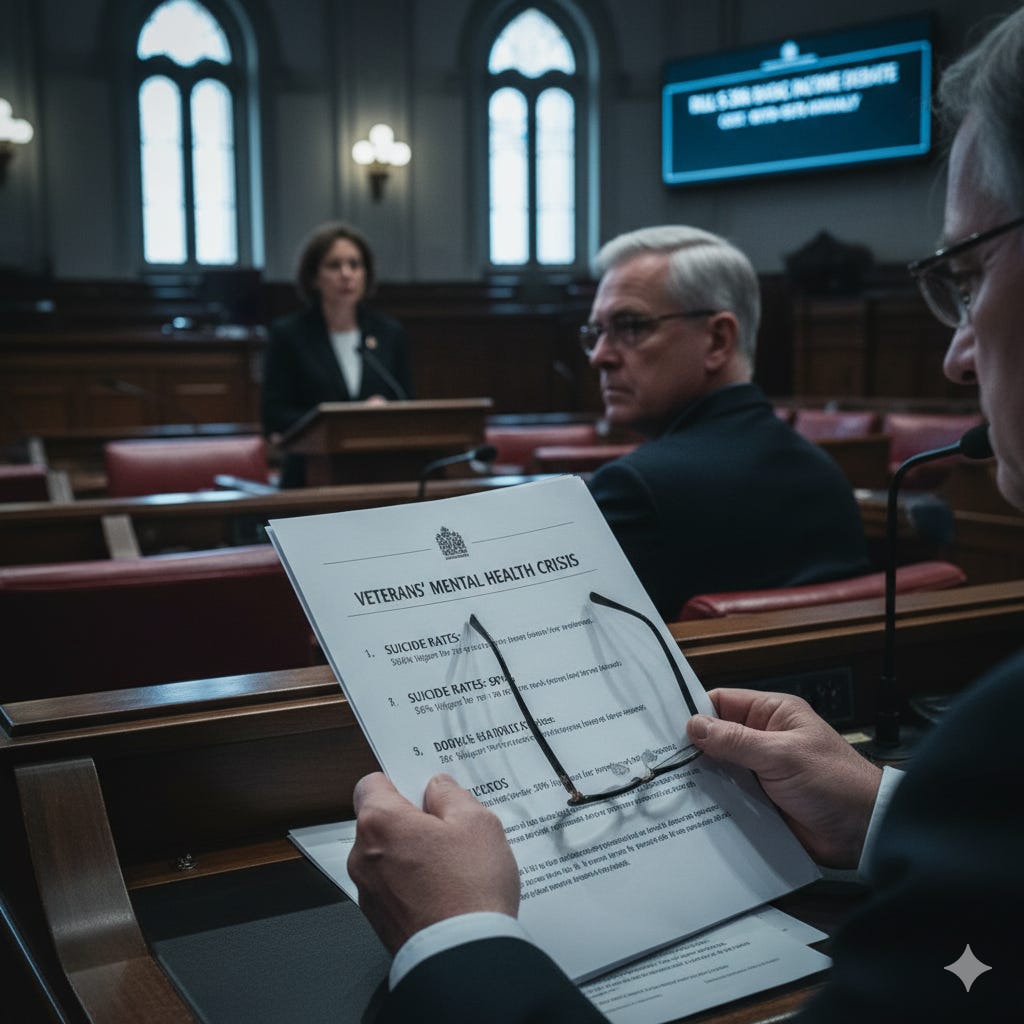
The temperature in the Senate chamber was markedly tense this week as senators pressed the Minister of Veterans Affairs, Jill McKnight, for concrete action on the mental health crisis affecting Canada’s veterans. In a lengthy Question Period on Thursday, the minister was repeatedly challenged on the government’s progress, or lack thereof, in providing critical support. The exchange set the tone for a week of debate focused on the state of Canada’s social safety net, from basic income proposals to the rights of federal prisoners. What emerged was a clear picture of a Senate grappling with urgent calls for change while confronting the hard realities of cost, jurisdiction, and government inaction.
A Minister Under Scrutiny
The central event of the week was Thursday’s Question Period, where Minister McKnight faced a barrage of questions about her department’s responsibilities. The primary focus was on the government’s response to the alarming suicide rates among veterans, which a 2023 Senate report noted were 50% higher for men and 200% higher for women compared to the general population.
The Psychedelic Therapy Impasse
Leader of the Opposition, Senator Leo Housakos, led the questioning by demanding to know what concrete steps the department has taken to advance psychedelic-assisted therapy for veterans with PTSD. He pointed out that two years have passed since a Senate report urged immediate action, yet little progress has been made.
The minister’s response was a study in careful bureaucratic language. She stated her officials “work closely” with Health Canada to “monitor emerging treatments and evaluate their appropriateness.” When pressed on why her department hasn’t taken a leadership role to establish a joint program, McKnight reiterated that they are “continually engaging with health experts” and will “continue to evaluate these opportunities as there’s evidence for the decisions.”
This pattern of deferring action pending further research became a theme. Senators Hassan Yussuff and Marty Deacon both made passionate pleas, framing the issue as a “desperate situation.” Senator Yussuff challenged the minister to commit to funding the necessary scientific studies, reminding her that new evidence “is not going to happen magically.” The minister replied that the department is committed to reviewing new scientific information as it comes forward, a response that did little to satisfy senators demanding proactive leadership.
Families Left Behind
The questioning quickly expanded to the mental health needs of veterans’ families. Citing a 2024 report from the Veterans Ombudsman, senators highlighted that families, including former spouses and children, continue to be denied access to federally funded mental health care, even when their illness is related to the veteran’s service.
Senator Stan Kutcher drove the point home, emphasizing that spouses and family members need to be treated as people with their own rights, “not as dependents of the veteran.” While the minister pointed to existing programs like the VAC Assistance Service, which offers 20 sessions of support, she conceded, “there is still more for us to do.” This acknowledgment was a recurring motif in her answers, serving as both a concession of current shortcomings and a promise of future, unspecified improvements.
Legislating a New Social Safety Net
While the minister’s appearance highlighted the challenges of executive accountability, legislative debates this week showed the Senate attempting to force action on its own. Two bills, in particular, revealed deep divisions on how to address the welfare of vulnerable Canadians.
A Divisive Debate on Basic Income
Debate resumed on Bill S-206, which calls for a national framework for a guaranteed livable basic income. Speaking as the critic, Senator Michael L. MacDonald delivered a sharp rebuke of the concept, framing it as fiscally untenable. His argument centered on the staggering potential cost, citing estimates ranging from $187 billion to $637 billion annually. For context, he noted that the total federal budget in 2024 was $450 billion.
How could such a program possibly be funded? MacDonald argued that it would require a complete overhaul of the tax and welfare system, not simply layering a new entitlement on top of existing programs. He warned that a guaranteed income risks creating a “welfare wall,” where high marginal tax rates and clawbacks discourage recipients from seeking work. “Fewer hours worked mean fewer hours taxed,” he explained, “and that means less revenue for the government.” In his view, the proposal is simply unsustainable given Canada’s trillion-dollar national debt and stagnant productivity.
A Battle Over Prisoner Mental Health
A similarly contentious debate unfolded over Bill S-205, a proposal to amend the Corrections and Conditional Release Act to ensure federal prisoners have access to mental health services. While the bill’s goal was widely supported, its mechanics drew sharp criticism.
Senator Scott Tannas argued that the bill, in its current form, is a flawed piece of legislation. His primary concern was that it effectively mandates government spending, something a Senate public bill is not supposed to do. A report from the Parliamentary Budget Officer estimated the cost could range from a modest $5 million to as high as $2 billion. Tannas explained this discrepancy by pointing out a loophole: the bill requires transferring inmates who need mental health services to a facility, but it doesn’t compel that facility to provide treatment. The lower cost estimate, he suggested, only covers “a round-trip ride to the hospital parking lot.”
His intervention sparked a broader discussion about the Senate’s role. He argued that with so many public bills being introduced, the chamber must be more purposeful about which ones proceed to committee, which consumes significant time and resources. “We can swamp our committees with public bills if we’re not careful,” he warned.
Despite these objections, the bill passed its second reading vote 53 to 21 and was referred to committee. The outcome suggests a majority of senators believe the urgency of the mental health crisis in prisons outweighs the procedural and financial concerns.
The Data Brief
Veterans’ Mental Health: The Minister of Veterans Affairs faced repeated questions on why “little progress has been made” on psychedelic-assisted therapy for veterans with PTSD. Suicide rates among veterans are 50% higher for men and 200% higher for women compared to non-veterans.
Guaranteed Basic Income: Bill S-206 proposes a framework for a guaranteed livable basic income. Critics warn the cost could range from $187 billion to $637 billion annually, potentially consuming the entire federal budget.
Prisoner Rights: Bill S-205, which aims to secure mental health care for federal inmates, passed its second reading vote (53-21-5) and was sent to committee despite concerns that it unconstitutionally mandates government spending.
Assaults on First Responders: Bill S-233, which makes an assault on a health care worker an aggravating circumstance for sentencing, was fast-tracked and passed third reading. 75% of Canadian paramedics report experiencing violence at work.
The debates this week underscore a Senate actively pushing for systemic change on behalf of vulnerable Canadians. However, they also reveal a fundamental tension between the desire for bold action and the constraints of fiscal reality, constitutional procedure, and a government that appears to favor incremental evaluation over decisive intervention.
Source Documents
Parliament of Canada. (2025a, October 21). Debates of the Senate (Hansard), 154(25).
Parliament of Canada. (2025b, October 22). Debates of the Senate (Hansard), 154(26).
Parliament of Canada. (2025c, October 23). Debates of the Senate (Hansard), 154(27).