


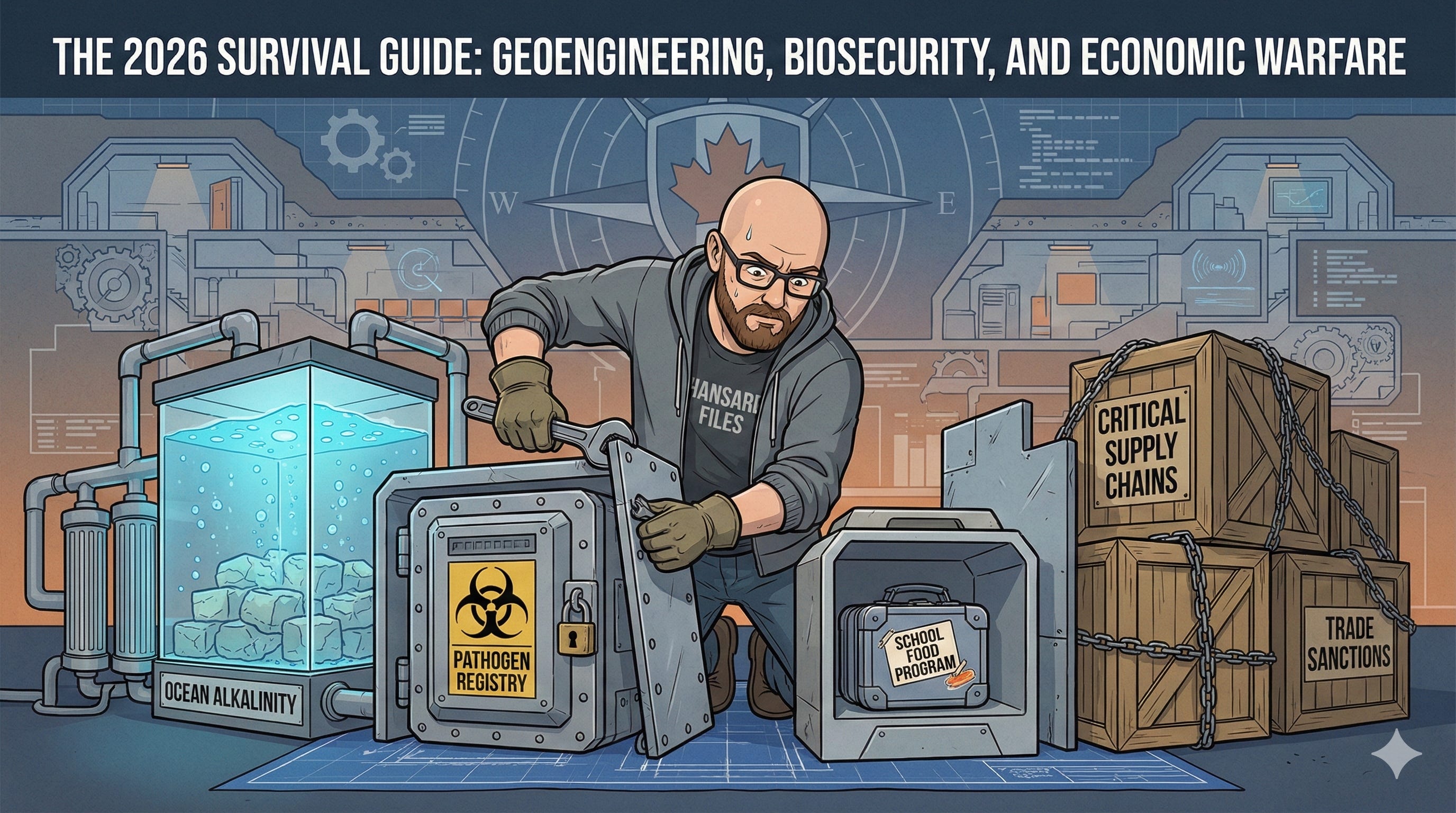
The Quiet Rooms of February
In the first week of February 2026, while the surface of Canadian politics likely focused on the usual daily skirmishes, the real machinery of the state was humming in the quiet, carpeted committee rooms of the Senate. Here, far from the cameras of the House of Commons, senators were not merely debating policy; they were rewriting the operating manual for national survival.
A review of four key Senate Committee Reports tabled between February 3 and February 5 reveals a government bracing for existential threats on multiple fronts. The documents—covering fisheries, social affairs, foreign trade, and internal audits—paint a portrait of a nation rushing to future-proof itself. The topics range from the sci-fi ambition of altering the ocean’s chemistry to stop climate change, to the granular spy-craft of tracking deadly pathogens in domestic labs.
These files, collectively, are not just legislative reviews. They are a recognition that the old rules of nature, commerce, and biology no longer apply.
The Climate Hail Mary: Re-Engineering the Ocean
The most startling document in the stack is the report from the Standing Senate Committee on Fisheries and Oceans (POFO), titled Carbon Removal, From Air to Sea. While most climate policy focuses on reducing emissions (turning off the tap), this report admits a darker reality: the bathtub is already overflowing.
The committee, chaired by Senator Fabian Manning, explores a technology that sounds like planetary terraforming: Ocean Alkalinity Enhancement (OAE).
The science is simple but radical. The ocean is the “lungs of the planet,” absorbing 30% of all carbon dioxide emissions. But as it absorbs CO2, it becomes acidic, killing marine life. OAE involves adding alkaline materials—like limestone—to rivers and harbours to lower that acidity. This chemical tweak forces the water to absorb even more carbon from the atmosphere, effectively turning Canadian waters into a giant sponge.
The stakes outlined in the report are astronomical. To meet global climate goals, humanity needs to remove up to 9 gigatonnes of CO2 per year by 2050. For context, Canada’s entire national emissions in 2023 were just 0.694 gigatonnes.
The Senate report urges the government to stop treating this as a theoretical experiment. It recommends setting “national carbon dioxide removal targets” by the end of 2026 and creating a “regulatory sandbox” to fast-track these technologies. The language is urgent: Canada is already a leader in the research, but it must now lead the deployment. This is no longer conservation; it is active planetary management.
The Biosecurity Firewall: Bill C-15 and the Pathogen Registry
While the Fisheries Committee looked to the sea, the Standing Senate Committee on Social Affairs, Science and Technology (SOCI) turned its gaze to a microscopic threat. In its review of Bill C-15, specifically Division 25, the committee examined amendments to the Human Pathogens and Toxins Act (HPTA).
The context for this legislation is chilling. Since the HPTA was last updated in 2015, the biomanufacturing sector has exploded, meaning more facilities are handling “high-risk human pathogens”. But growth brings vulnerability. The committee heard testimony from the Public Health Agency of Canada about an “evolving cybersecurity landscape,” specifically citing “insider threats” and “potential for foreign interference”.
The government’s response is to tighten the net. The amendments compel the Minister of Health to establish a rigorous registry of who has these toxins and where they are kept. It is a tacit admission that in 2026, the next national security crisis might not come from a missile, but from a petri dish in a compromised lab.
The Economic Weapon: Sanctions and Supply Chains
The threat of foreign interference extends beyond biolabs into the very plumbing of the financial system. The Standing Senate Committee on Foreign Affairs and International Trade (AEFA) tabled its report on Divisions 18 and 27 of Bill C-15, revealing how Ottawa is sharpening its economic claws.
Witnesses from Global Affairs Canada described the amendments as necessary tools to protect Canada from “economic coercion”. Division 27, in particular, amends the Export and Import Permits Act to allow the government to control trade not just for safety, but to ensure a “secure and reliable supply of economically important goods”.
This is the language of a trade war. It grants the government the power to shut down exports or imports to protect critical supply chains from being weaponized by foreign adversaries. Simultaneously, Division 18 amends the Special Economic Measures Act to give the Minister of Finance a heavier hand in assessing how sanctions impact the Canadian financial sector. The era of free-market innocence is over; the economy is now a theatre of national defense.
The Human Element: Students and School Food
Amidst these high-level threats, the SOCI committee also addressed the vulnerabilities of Canada’s social fabric. Division 36 of Bill C-15 takes aim at “predatory” recruitment practices by private, for-profit international institutions. The amendment denies financial assistance to students at these schools, a move designed to stop the exploitation of students who are often used as cash cows rather than scholars.
Simultaneously, the committee reviewed the National School Food Program Act (Division 44). While supportive, the Senate offered a critique of the government’s metrics. They urged Employment and Social Development Canada (ESDC) to measure success not just by money spent, but by actual improvements in “child and youth health and well-being”. It is a reminder that national security also means ensuring the next generation is fed and educated, rather than indebted and malnourished.
The Internal Watchdog
Finally, undergirding all this external activity is the internal health of the Senate itself. The Standing Committee on Audit and Oversight (AOVS) tabled its fourth report on “Senate Contracting using Data Analytics”.
While less cinematic than geoengineering or bioweapons, this audit is the bedrock of legitimacy. The committee used advanced data analytics to scour Senate contracts, looking for irregularities. The result was largely positive, but the call for a “performance dashboard” and better data management signals that the Senate is applying the same rigorous scrutiny to itself that it applies to the government.
Conclusion: The Architecture of 2026
Taken together, these Senate Committee Reports form a mosaic of a nation in transition. In February 2026, the Canadian state is attempting to do four things at once: re-engineer the environment to survive climate change, lock down its biological research against foreign spies, weaponize its trade laws against economic coercion, and clean up its own internal bureaucracy.
It is a massive undertaking, mostly hidden in PDF files and committee transcripts. But make no mistake: the blueprints for Canada’s survival are being drawn up in these quiet rooms.
If you value deep-dive investigations that comb through thousands of pages of parliamentary records to find the stories that matter, please consider subscribing to the Hansard Files. Your support keeps the lights on in the archives.
Source Documents
Standing Senate Committee on Social Affairs, Science and Technology. (2026, February 3). Fourth Report: Subject matter of elements contained in Divisions 25, 36 and 44 of Part 5 of Bill C-15. Senate of Canada.
Standing Senate Committee on Fisheries and Oceans. (2026, February). Carbon Removal, From Air to Sea: Canada, a leader in restoring ocean ecosystems and fighting climate change. Senate of Canada.
Standing Committee on Audit and Oversight. (2026, February 3). Fourth Report: Review of Senate Contracting using Data Analytics. Senate of Canada.
Standing Senate Committee on Foreign Affairs and International Trade. (2026, February 5). Second Report: Subject matter of elements contained in Divisions 18 and 27 of Part 5 of Bill C-15. Senate of Canada.
SEO Metadata
URL Slug: senate-committee-reports-bill-c-15-biosecurity-climate-2026
word-count: 1045
The next national security crises will come from hybrid warfare. These areas are great first steps. But Canada needs to separate and harden its electrical, communication and digital grids and technologies against attacks from the USA.
Hansard, once again my brain is awash with all this information. To be honest, every hearing in the US congress is mainly conducted in public and I thought, well there is a government “in action”. I knew we had standing committees but they are rarely televised in the usual media. Ergo, I thought “what is our government doing”?
Like many of your subscribers, I am indebted to you for covering the important work of governance. Although parliament sometimes moves at the speed of a boulder trapped in a glacier, I see they do conduct matters and issues important to us.
Thank you!