


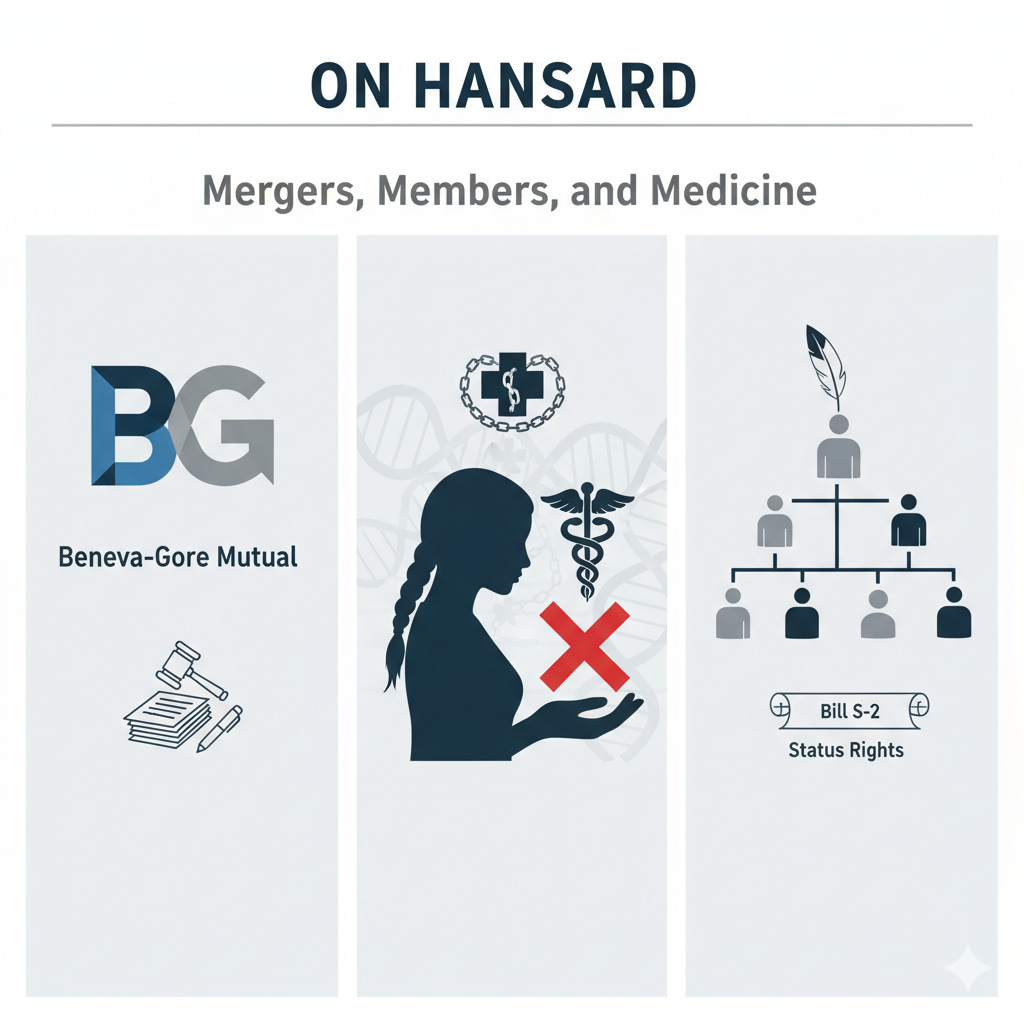
Two of Canada’s largest insurance companies are merging, but first, they need Parliament’s permission to move a federally chartered company into Quebec’s legal jurisdiction. Meanwhile, two other Senate bills tackle the painful legacies of forced sterilization and discriminatory sections of the Indian Act, sparking debates about incremental change versus comprehensive reform.
5-minute read
BUSINESS
Parliament Scrutinizes Beneva-Gore Mutual Merger
Driving the news: The Standing Senate Committee on Banking, Commerce and the Economy reviewed Bill S-1001, legislation required for the federally incorporated Gore Mutual Insurance Company to merge with the Quebec-based Beneva.
Catch-up:
The merger would create Canada’s largest mutual insurance company. Gore Mutual is Canada’s oldest property and casualty mutual insurer, founded in 1839.
Because federal law has no provision for a company to move to a provincial jurisdiction, a private Senate bill is required to authorize the move before the merger can be formalized.
Why it matters: The process highlights the complex regulatory steps involved in major interprovincial business deals. During the September 25 hearing, senators raised pointed questions about what the move to Quebec’s legal framework means for policyholders, specifically regarding language rights for communications, residency requirements for the board of directors, and changes to voting rights from a one-vote-per-policyholder system to a delegate system. This points to a critical question: how are individual member rights protected when large corporations restructure across jurisdictions?
What’s next: If the bill receives Royal Assent, the National Assembly in Quebec must undertake its own legislative process to finalize the merger.
JUSTICE
Bill to Criminalize Forced Sterilization Sparks Debate on Physician “Chilling Effect”
Driving the news: The Standing Senate Committee on Legal and Constitutional Affairs studied Bill S-228, which aims to explicitly criminalize forced or coerced sterilization by defining it as aggravated assault under the Criminal Code.
Catch-up:
The bill is sponsored by Senator Yvonne Boyer, who has been a leading advocate on the issue since 2017. It clarifies that sterilization without free, prior, and informed consent constitutes wounding or maiming.
Forced sterilization is already illegal under existing assault provisions, but Senator Boyer argued in the September 24 hearing that the absence of an explicit prohibition has enabled impunity, with no prosecutions ever brought forward.
Why it matters: The testimony reveals a sharp divide on the bill’s practical impact. The Canadian Medical Association supports the bill, stating its clarity can improve prevention and investigations. However, the Society of Obstetricians and Gynaecologists of Canada voiced strong opposition, arguing that even the perception of criminalization could create a “chilling effect,” causing physicians to hesitate in life-saving emergency procedures for fear of prosecution. This debate forces you to consider whether explicit criminalization is a necessary deterrent or an unintended risk to urgent medical care.
What’s next: The committee completed its clause-by-clause review on September 25, and the bill will be reported back to the Senate.
INDIGENOUS AFFAIRS
Indian Act Amendments Draw Fire for Not Going Far Enough
Driving the news: The Standing Senate Committee on Indigenous Peoples began its study of Bill S-2, which amends the Indian Act to restore registration entitlement to individuals who lost it through enfranchisement.
Catch-up:
“Enfranchisement” was a colonial policy that forced First Nations people to give up their identity and status to gain certain rights, such as voting or pursuing professions like law or medicine.
The bill would restore status to approximately 3,500 individuals and also removes offensive language like “mentally incompetent Indians” from the Act.
Why it matters: The hearings highlighted deep frustration that the bill fails to address the “second-generation cut-off,” a rule that prevents status from being passed down after two generations of one parent not having status. Indigenous Services Minister Mandy Gull-Masty defended the incremental approach during the September 24 session, citing the complexity of the issue and ongoing consultations, but senators argued that the government is simply delaying action on a long-standing and discriminatory issue that affects an estimated 300,000 people. Here’s the detail I find most revealing: the government has a court-imposed deadline of April 30, 2026, to fix the enfranchisement issue, which explains the urgency of this specific bill while broader issues remain unresolved.
On The Docket
The Senate Banking Committee paid tribute to the Honourable Senator Paul J. Massicotte for his outstanding contribution as a member since 2003.
The Canadian Medical Association publicly condemned the historical role of the medical profession in unethical practices like forced sterilization, which are rooted in systemic racism and discrimination.
A previous attempt by the RCMP to investigate forced sterilization by asking Indigenous women to come forward was described by Senator Yvonne Boyer as a “fiasco” due to distrust and intimidating tactics.
In Their Own Words
Dr. Diane Francœur, CEO of the Society of Obstetricians and Gynaecologists of Canada
The Quote: “Unfortunately, when women start having doubts because they were given false information and doctors start fearing criminal charges, it is the perfect storm for women to be left alone with their problems and no solution.”
Why it matters: This quote, from the September 25th hearing on Bill S-228, captures the core of the SOGC’s opposition. Dr. Francœur argues that while forced sterilization is abhorrent, adding a specific criminal provision could create a climate of fear among doctors, particularly in high-stakes emergencies. Her statement frames the debate not as a disagreement on the goal, but on whether criminalization is the right tool, warning it could inadvertently harm women’s access to care.
Also Noteworthy
Gore Mutual Insurance Company, founded in 1839, is Canada’s oldest property and casualty mutual insurer.
Beneva, with over 3.5 million members, was created in 2020 by the merger of La Capitale and SSQ Insurance.
Conservative MP Connie Cody has agreed to sponsor the Gore Mutual-Beneva merger bill when it reaches the House of Commons.
Bill S-228 is identical to the previous session’s Bill S-250, which passed the Senate in October 2024 but died on the Order Paper.
Over 1,700 individuals have already applied for registration, waiting for Bill S-2 (Indian Act amendments) to pass.
The government faces a court deadline of April 30, 2026, to address inequities related to enfranchisement in the Indian Act.
The Society of Obstetricians and Gynaecologists of Canada worries that criminalizing sterilization could lead to a “chilling effect” similar to what has occurred in the U.S. regarding reproductive health laws.
The Indian Act’s “second-generation cut-off” affects an estimated 300,000 people.
Indigenous Services Canada has a backlog of nearly 12,000 applications for registered status.
The Data Brief
94.6%: The percentage of Gore Mutual members who voted in favour of the merger with Beneva at their annual meeting.
$27 billion: The total assets held by Beneva as of December 31, 2024, making it a major player in the Canadian insurance industry.
3,500: The approximate number of individuals who will have their First Nations status and rights restored immediately should Bill S-2 pass.
14 years: The maximum prison sentence for aggravated assault, the charge that would apply to non-consensual sterilization under Bill S-228.
300,000: The estimated number of people impacted by the Indian Act’s second-generation cut-off, an issue not addressed in the current Bill S-2.
Sources:
Standing Senate Committee on Banking, Commerce and the Economy. (2025, September 25). Evidence. 45th Parliament, 1st Session.
Standing Senate Committee on Indigenous Peoples. (2025, September 24). Evidence. 45th Parliament, 1st Session.
Standing Senate Committee on Legal and Constitutional Affairs. (2025, September 24). Evidence. 45th Parliament, 1st Session.
Standing Senate Committee on Legal and Constitutional Affairs. (2025, September 25). Evidence. 45th Parliament, 1st Session.