


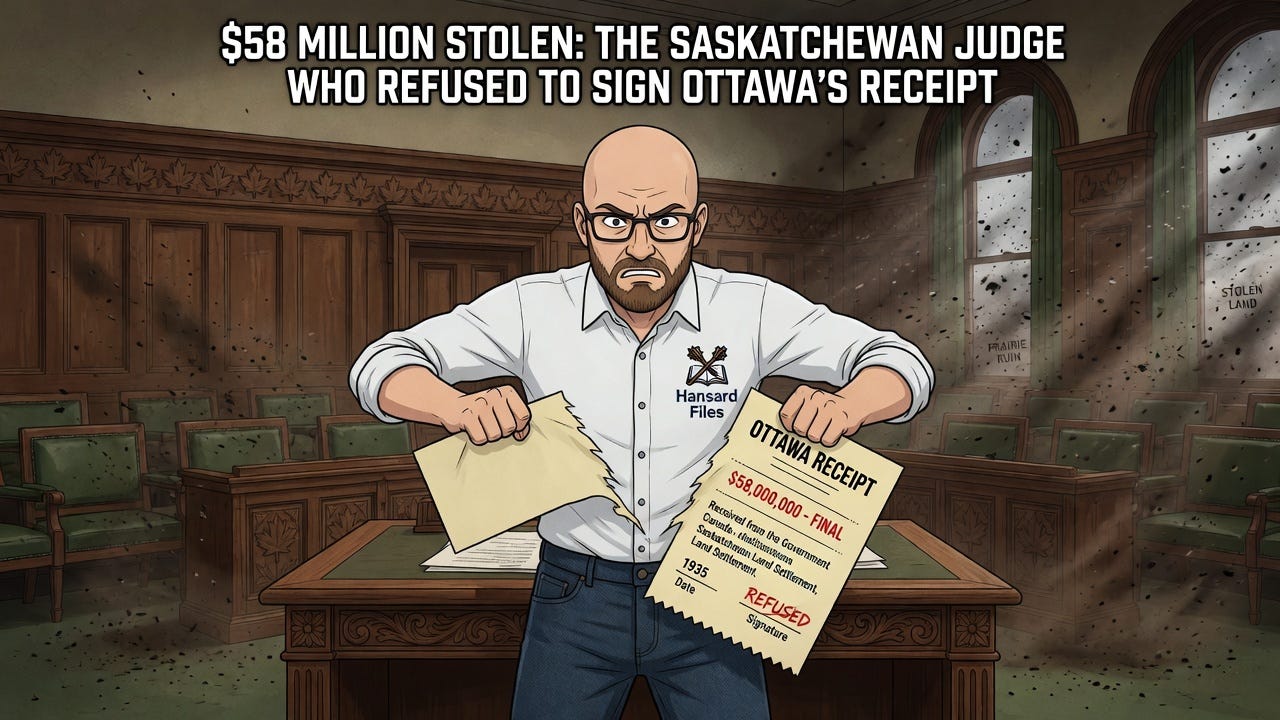
By March of 1935, the soil of Saskatchewan was no longer staying on the ground. It was in the air, drifting in black blizzards that choked cattle and buried fences, blowing all the way to the Prime Minister’s windows in Ottawa. The Great Depression had broken the back of the prairie economy, and the province was effectively bankrupt.
It was against this apocalyptic backdrop that a heavy, typeset document landed on the desk of Prime Minister R.B. Bennett. It was the Report of the Royal Commission on the Natural Resources of Saskatchewan. The Commission had one job: to calculate how much money the Dominion of Canada owed Saskatchewan for twenty-five years of resource control.
From 1905 to 1930, Ottawa had treated Saskatchewan not as a partner in Confederation, but as a colonial possession. While the federal government controlled the land, it gave away millions of acres to railways and settlers to fulfill the “purposes of Canada.” Now, the bill was due.
The Commission’s majority—a Manitoba judge and a Montreal accountant—recommended a modest “readjustment,” a settlement designed to balance the books without breaking the federal treasury. But the third commissioner, a local Saskatchewan judge named Henry V. Bigelow, did something rare in the polite world of Canadian inquiries. He refused to sign. Instead, he issued a blistering dissent that accused the federal government of shortchanging the province by nearly $60 million.
The Colony Within a Nation
To understand Bigelow’s fury, one must understand the “purposes of Canada.” When Saskatchewan was carved out of the Northwest Territories in 1905, it entered Confederation on unequal terms. Unlike Nova Scotia or Ontario, which owned their timber, minerals, and soil from day one, Saskatchewan’s natural resources were retained by the Dominion.
The federal logic was ruthless but effective: Canada needed to build a nation from sea to sea. To do that, it needed to lure immigrants and build railways. The currency for this nation-building was prairie land. The Dominion needed the power to give away Saskatchewan’s soil to homesteaders and railway syndicates without local interference.
For a quarter of a century, the Department of the Interior in Ottawa acted as the landlord of the West. They gave away homesteads to populate the country. They granted vast tracts of tax-exempt land to the Canadian Pacific Railway to pay for the steel spine of the nation. In exchange, the province received a yearly cash “subsidy in lieu of land.”
By 1930, the Dominion finally agreed to hand over control of the remaining resources to the province. But the question remained: what about the millions of acres that were gone forever?
The Accountant’s Ledger
The Majority Report, signed by Chairman A.K. Dysart and accountant George C. McDonald, approached the problem with the cold detachment of a bankruptcy audit. They acknowledged that Saskatchewan had been denied its birthright, but they argued that the Dominion had been a benevolent guardian.
Their calculation relied on a “net accounting” method. They tallied up the revenue the province might have made if it had sold the land itself. Then, they subtracted the “administrative costs” the Dominion had incurred—the armies of surveyors, land agents, and bureaucrats. Finally, and most controversially, they deducted the subsidies the province had already received.
The Majority viewed the past subsidies not as rent for the use of the land, but as a down payment on its value. They pointed to the precedent of Manitoba, which had recently settled a similar claim for approximately $4.5 million. They reasoned that since Saskatchewan had received generous subsidies and had its population boosted by federal immigration policies, the net debt owed to the province was minimal. To them, the “purposes of Canada” had benefited Saskatchewan as much as the Dominion.
The Bigelow Calculus
Justice Bigelow saw the math differently. In his dissenting report, he tore through the Majority’s logic with the precision of a prosecutor.
Bigelow anchored his argument in a staggering statistic: Alienation. During the federal tenure, the Dominion had alienated—given away or sold—nearly 30 million acres of Saskatchewan land. He compared this to Manitoba, where only 11 million acres had been alienated. If Manitoba was worth $4.5 million, how could Saskatchewan’s loss be valued similarly?
“The interests of a province in the land is in the revenue it can derive from the sale of the lands,” Bigelow wrote, quoting a parliamentary debate. “The interest of the Dominion in the lands is in the revenue it can derive from the settler who makes that land productive.”
Bigelow argued that the Dominion had used Saskatchewan’s assets to generate federal wealth. The “free homesteads” weren’t truly free; they purchased customs duties, manufacturing markets for Ontario, and traffic for the railways. The Dominion had “made millions out of these lands without selling an acre,” Bigelow noted. Meanwhile, the province was left with the cost of building roads and schools for a population scattered across a railway-dictated map.
The Fifty-Eight Million Dollar Gap
The divergence between the two reports came down to a fundamental dispute over value. The Majority was willing to credit the Dominion for the “administrative expenses” of running the land office. Bigelow scoffed at this. Why should Saskatchewan pay for an administration it didn’t control, often run inefficiently from an office two thousand miles away?
He pointed to the “School Lands”—a specific trust of land set aside to fund education. The Dominion had managed to generate $33 million from these lands. Bigelow argued that if the province had managed its own resources with a revenue-focused policy, rather than a settlement-focused policy, it would have generated massive surpluses.
His final calculation was stark. He rejected the idea that the subsidies should be deducted from the principal value of the lost land. The subsidies were rent, paid for the occupation of the territory. You don’t subtract the rent paid from the purchase price of a house.
“My conclusion,” Bigelow wrote, “is that the province in twenty-five years would have realized at least $58,000,000 from their resources, over and above the subsidy provided in 1905.”
He didn’t stop there. He demanded interest. The province had been borrowing money at 5% to build infrastructure while the Dominion sat on its capital assets. To Bigelow, the refusal to pay interest on this historic debt was an insult to the financial injury of the Depression.
A Legacy of Discontent
The Royal Commission of 1935 was supposed to close the book on the “Natural Resources Question.” Instead, it highlighted the deep structural fracture of Confederation. The Majority Report prevailed, offering a settlement that was a fraction of Bigelow’s calculation—a sum that barely kept the lights on in Regina.
The $58 million figure remained a ghost in the provincial consciousness. It represented the difference between a province treated as a partner and a province treated as a colony. In the dry wind of 1935, with the topsoil blowing east, Justice Bigelow’s dissent wasn’t just a legal opinion; it was a declaration that the West had paid for the Dominion’s greatness, and the receipt was still unpaid.
The “Hansard Files” digs into the dusty archives of royal commissions and parliamentary inquiries to find the stories that shaped our nation. Subscribe to support independent historical investigation.
Source Documents
Dysart, A. K., Bigelow, H. V., & McDonald, G. C. (1935, March 12). Report of the Royal Commission on the Natural Resources of Saskatchewan. J. O. Patenaude, Printer to the King’s Most Excellent Majesty.
A critical question to ask: was the entity that the soil was stolen from called "Saskatchewan"?
Should that entity (similar to the Canadian Crown imagining the Alberta Crown into "existence" in 1905) have ever been granted claims to land and life (incorrectly thought of as "resources") that the Canadian Crown itself didn't "own" (even according to its own laws) and thus could never have sublet title to a Provincial Crown?
As I read this, I felt like I did reading the book "Don't Tell the Newfoundlanders: The True Story of Newfoundland's Confederation with Canada" by Greg Malone
https://r.flora.ca/p/reviewing-dont-tell-newfoundlanders