


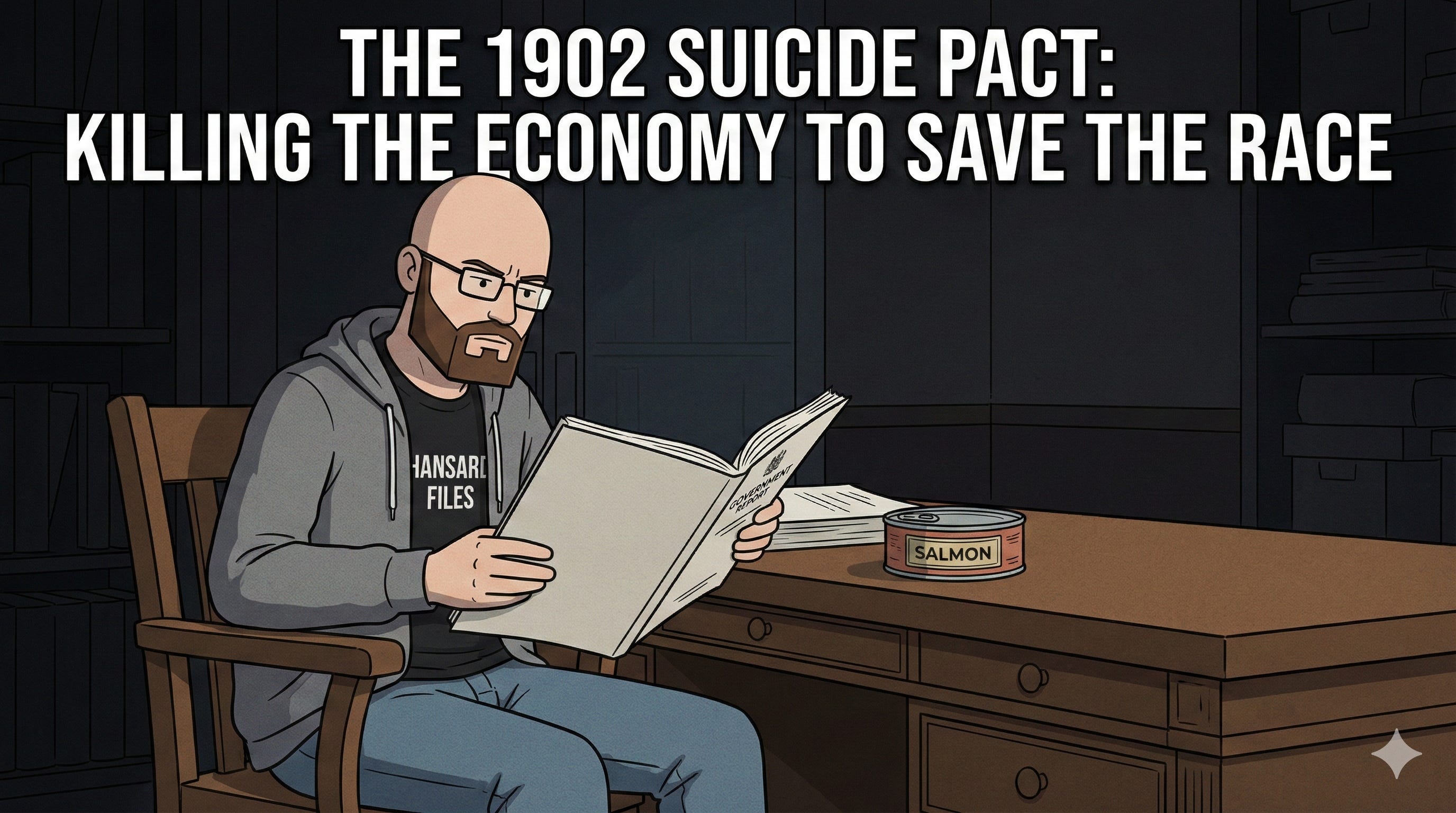
In the spring of 1902, the Canadian government convened a tribunal in British Columbia that was tasked with solving an impossible equation. The Royal Commission on Chinese and Japanese Immigration was not merely a fact-finding mission; it was a battleground where the province’s economic reality collided violently with its racial ideology. The Commissioners—charged with investigating the “Oriental menace”—sat in the drafty halls of Victoria and Vancouver to hear testimony from the captains of industry, labor leaders, and the immigrants themselves.
They were looking for a justification to shut the door. The political pressure from the white electorate was boiling over, demanding a “White Man’s Country” free from the perceived degradation of Asian competition. Yet, as the testimony unfolded over hundreds of pages, a stark and inconvenient truth began to emerge. The witnesses, under oath, were forced to admit that the entire industrial infrastructure of the province—from the river mouths to the deep woods—was not merely supported by Asian labor. It was addicted to it.
The resulting report, released later that year, stands as one of the most paradoxical documents in Canadian history. It is a detailed, quantitative confession that British Columbia’s prosperity was built by the very hands the government sought to expel. It lays out, dollar by dollar and worker by worker, how the Chinese and Japanese workforces were the engine of the West, only to conclude that the engine had to be dismantled to save the soul of the nation.
The Salmon Kings and the Industrial Scale
To understand the sheer magnitude of the issue, the Commission had to look no further than the Fraser River. By 1902, the salmon canning industry was not just a business; it was the lifeblood of the coastal economy, ranking in importance alongside the great mines and lumber camps. The scale of production was staggering. The Commission’s report noted that for the season of 1901, the Pacific Coast packed an “enormous” five million cases of salmon. British Columbia alone was responsible for over 1.2 million of them .
When the Commissioners peered inside the tin-roofed canneries, however, they did not find the white settlers the government was so desperate to attract. They found a workforce that was almost exclusively Asian. The report stated bluntly that the canning process was “almost entirely in the hands of the Chinese.” These were not casual laborers but a highly organized industrial corps, managed by Chinese contractors who guaranteed the supply of manpower that white labor simply could not—or would not—provide.
The statistics collected by the Commission revealed a dependency that terrified the exclusionists. In 1896, out of 3,583 fishing licenses issued, 452 went to Japanese fishermen. By 1900, the total licenses had dropped slightly, but the Japanese share was rising, a trend that signaled a shift in control over the harvest itself. The canners testified that without this labor pool, the industry would collapse. White workers, they argued, were too prone to strikes, too demanding of higher wages, and simply too scarce to process a harvest that had to be canned within hours of being caught.
The Commissioners were forced to record the uncomfortable fact that the “Japanese and Chinese engaged in it greatly exceeds” all other groups. The industry that put British Columbia on the global trade map was, for all intents and purposes, an Asian enterprise managed by white capital.
The Lumber Mills and the “Shade of Difference”
The dependency extended from the water to the treeline. In the smoke-filled hearings, mill owners faced the Commissioners to defend their hiring practices. Their argument was not based on affection for the Asian worker, but on the cold, hard math of survival. They pointed south to Washington and Oregon, where American mills were churning out lumber at cutthroat prices.
The testimony revealed that the American mills on Puget Sound possessed a critical advantage: they had larger local markets and could produce cheaper lumber. To compete, British Columbia mills needed an equalizer. That equalizer was the Chinese laborer. Witnesses admitted that while there was only a “shade of difference” in the cost of production, that single shade was the margin between profit and bankruptcy in a global market.
The mill owners argued that the Chinese and Japanese were “convenient” and “available.” They took on the dangerous, back-breaking work that white men refused to do. The report noted that “neither white men nor boys will work if they can avoid it at what is called a Chinaman’s job.” This created a segregated labor hierarchy where the most grueling tasks were permanently assigned to the Asian workforce.
Despite this testimony, the Commission attempted to twist the logic. They concluded that while the Asian workforce was “convenient,” it was not “essential.” They argued that if the Chinese were expelled, the industry would eventually adjust, perhaps by employing boys or investing in better machinery. It was a dismissal of the mill owners’ sworn testimony, prioritizing a theoretical white future over the tangible present reality of the lumber trade.
The Urban Panic: Boots, Shoes, and Survival
In the cities of Victoria and Vancouver, the economic anxiety took a more personal form. The Commission investigated the smaller trades—bootmaking, tailoring, and manufacturing—where the competition between white and Asian labor was most visible.
The case of Angus McKeown, a boot and shoe factory owner in Victoria, provided a microcosm of the crisis. McKeown testified that eight years prior, the industry had been booming, employing 150 Chinese workers. By 1902, that number had plummeted to just sixteen Chinese and four white men. When pressed on why he employed Chinese workers at all, McKeown was blunt: “I do not think the factory would have existed here but for the Chinese.”
McKeown’s testimony exposed a vicious cycle. He admitted that he was facing pressure from white consumers who “complain as to Chinese labour.” His customers preferred goods made by white hands, yet they demanded prices that only Chinese labor could sustain. McKeown stated he was planning an experiment to switch to an all-white workforce, but he was skeptical it would survive. The market was too small, and the eastern Canadian manufacturers were too powerful.
The garment industry told a similar story. Wholesale houses in Victoria, desperate to compete with eastern prices, had replaced journeyman tailors with a mix of women and Chinese workers. One firm, after investing $2,000 in modern machinery (a fortune at the time), found that even with mechanization, they could not compete without cutting wages. The Chinese contractors offered to do the work for less, driving the price down until white women could only earn 40 cents a day. The firm was eventually driven out of business, leaving the trade “entirely in the hands of the Chinese.”
The “Indigestible Mass” and the Vote
If the economic testimony was a testament to Asian efficiency, the political testimony was a crusade against their very existence. Throughout the report, the Commissioners and witnesses returned to a single, dehumanizing metaphor: the “indigestible mass.”
The central argument of the Commission was that a democracy required a homogenous population. They believed that the safety of the state depended on voters who shared a common “love and appreciation for our institutions.” In the eyes of the Commission, the Chinese were fundamentally incapable of this. They were described as “distinctive in language, pagan in religion, inferior in mental and moral qualities.”
This was not merely cultural snobbery; it was viewed as a matter of national security. The report argued that giving the vote to such a “distinctive large class” would be a “public safety” risk. They feared that a block of Chinese voters would undermine the democratic process, not because they were anarchists, but because they were “controlled” by their own internal structures and loyalties.
The Commission framed the Chinese ability to survive on low wages not as a virtue, but as a “revolting characteristic.” The report stated, “They can subsist where the American would starve.” This biological efficiency was presented as an unfair advantage. To compete with the Chinese, the white worker would have to “come down to their level,” a prospect the Commission viewed as the degradation of the white race.
The Tale of Lee Dye: The Successful “Threat”
Nothing illustrated the “unfair advantage” more clearly than the case of Lee Dye. A market gardener in Victoria, Dye was hauled before the Commission not because he was a failure, but because he was a success.
Dye’s testimony painted a picture of a model citizen. He managed four gardens totaling 193 acres. He paid taxes. He supplied vegetables to the steamboats and wholesale merchants of Vancouver and Victoria. His business, established by his father thirty-two years prior, generated sales of over $24,000 a year—a massive sum in 1902. He employed twenty-four men, paying them wages that included board and lodging.
Yet, to the Commission, Dye represented the ultimate threat. He was a Chinese man who had mastered the Western economic game. He testified that he had sent his wife and two children back to China for their education, planning to bring them back later. This trans-pacific life, common among the Chinese diaspora, was used as evidence that they were not “settlers” but wealth-extractors.
The white market gardeners who testified were furious. They controlled a fraction of the market compared to the 198 Chinese gardeners in Victoria. They argued that the Chinese monopoly on vegetables was driving white farmers off the land, preventing the agricultural settlement that the government desperately wanted. Lee Dye’s green fields were seen not as a sign of productivity, but as occupied territory.
The Japanese Paradox: The Fear of the Civilized
While the Chinese were reviled for being too different, the Japanese were feared for being too similar. The Commission’s report on Japanese immigration struck a different, more urgent tone. Between 1896 and 1901, nearly 14,000 Japanese immigrants had arrived in the province, and unlike the Chinese, they were rapidly adopting Western ways.
William P. Winsby, the Tax Collector for Victoria, offered a chilling assessment that summarized the white anxiety. “The Japanese is a more dangerous competitor than the Chinese,” Winsby testified, “because he is more adapted to white men’s labour.”
The Japanese immigrants refused to be confined to the “caste” roles assigned to the Chinese. They wore Western clothes, learned English, and sought work in every sector. They were not content to be servants. The report noted that the Japanese “does not confine himself to one or two things... He will work at any kind of work.”
This adaptability was interpreted as imperial aggression. The Commissioners viewed the Japanese not just as workers, but as subjects of a rising military power in the Pacific. A “power like the Japanese,” the witnesses warned, would never accept a subservient position in Canadian society. If the Chinese were an “indigestible mass” that clogged the system, the Japanese were a rival army that threatened to take it over.
The Final Verdict
After months of testimony and hundreds of pages of evidence proving the economic necessity of Asian labor, the Royal Commission reached a conclusion that defied the laws of economics but perfectly adhered to the laws of racism.
They acknowledged that industries like the boot factory “would not have existed” without the Chinese. They admitted the canneries were dependent on them. But they concluded that the presence of this workforce “discourages and retards white immigration.” They argued that a “white man’s country” could only be built if the labor market was artificially cleared of this cheaper, more efficient competition.
The report’s final recommendation was a call for the exclusion of the very people who were building the province. They declared that “free institutions... can only be maintained where based on intelligent and adequately paid labour.” It was a decision to burn the bridge that had carried British Columbia to prosperity, in the hopes that a white society would eventually figure out how to cross the chasm on its own.
The 1902 Royal Commission laid the intellectual and legal groundwork for the head taxes and exclusion acts that followed. It remains a haunting testament to a time when the government looked at the thriving industries of the West Coast, saw the people who made them work, and decided that the price of their presence was simply too high to pay.
Hansard Files digs through the archives to find the stories that shaped our nations. Subscribe to support independent historical investigation.
Source Documents
Royal Commission on Chinese and Japanese Immigration. (1902). Report of the Royal Commission on Chinese and Japanese Immigration (Sessional Paper No. 54). Ottawa: S.E. Dawson.
"The central argument of the Commission was that a democracy required a homogenous population."
I find it interesting that throughout the involvement of European (which includes Canadian) systemic involvement with this continent (not part of Europe) that there has been an inability to differentiate obedience and conformity (to Western Christian Eurosupremacist ideologies) with democracy.
Obedience and conformity is more in line with Monarchy and Feudalism, which remain embedded within Western European worldviews. The peoples of this content have centuries more exposure to actual democratic governance, which Canadian institutions continues to try to erradicate.
It is critical to remember that Europeans in BC were clearly actually DOING to the (at the time) Indigenous majority what the Europeans were worried that (less foreign to the West coast of THIS continent) Asians might do to the far more foreign Western Europeans. There was never any legitimate way to claim that the Europeans (especially Western Europeans) could be victims with respect to the Pacific regions of this continent (reminder – not Europe, and not Atlantic).
What this type of documentation demonstrates is that the Dominion of Canada wants to be able to claim to be democratic (myth of "Canada the good"), while at all times seeking to protect these foreign imposed institutions from actual democracy.
https://r.flora.ca/p/canadian-democracy
Thank you, Hansard. For me reading this article, I can only say that it is a difficult subject to unpack. This isn’t to say that Canada through its history that our nation doesn’t have a “wall of shame”. Unlike the United States, where there has been a government effort to whitewash American history and its attempts to re-establish its purported Judeo-Christian roots and primacy.
I am absolutely against that belief and fear its adoption by elements in Canada. Unfortunately, without any logical thought, some people parrot those matters occurring in the States.
My big question is how does our nation move on from this.
And Mr. McOrmond, thank you for providing the link to your excellent article.