


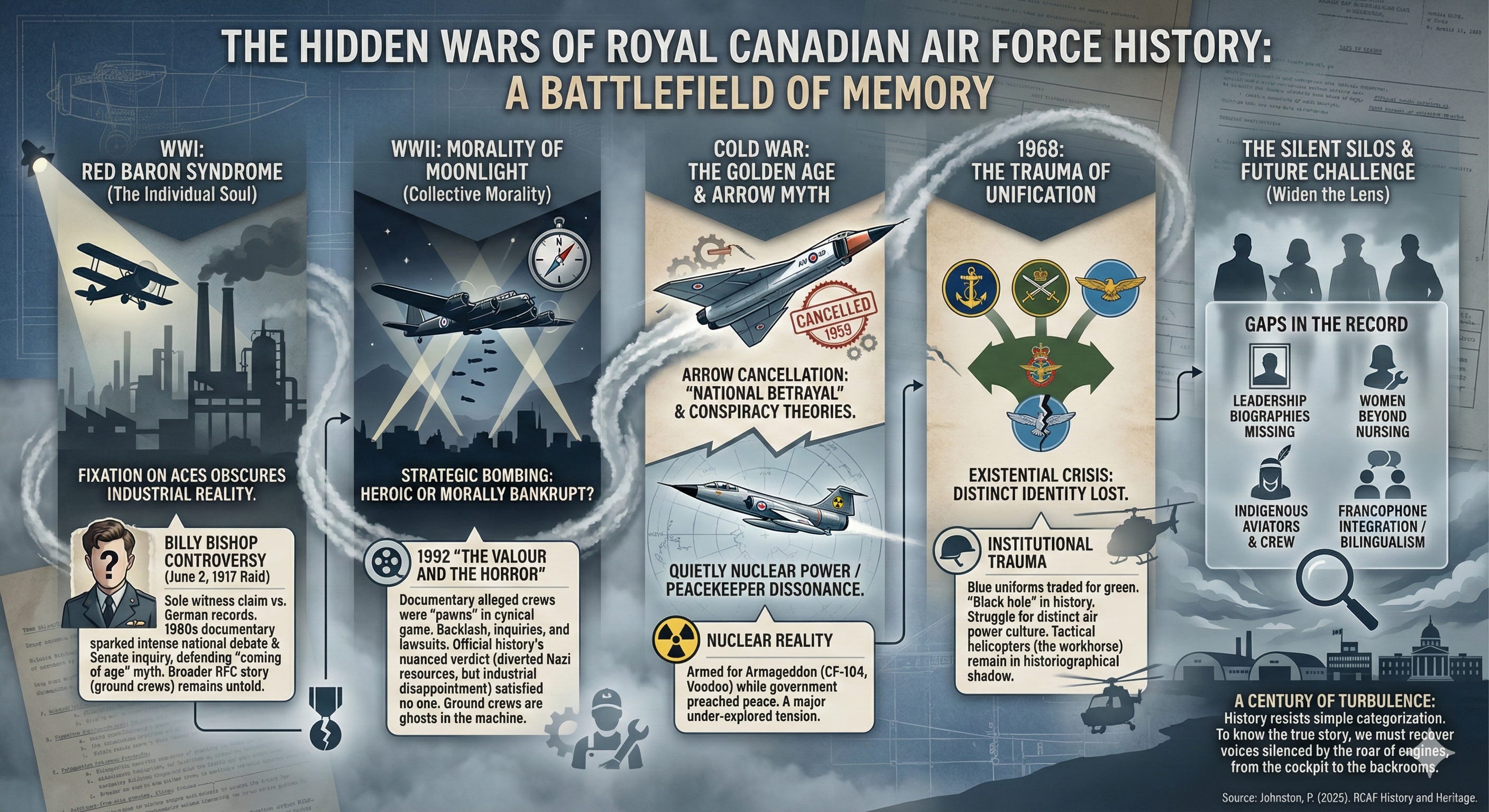
The airspace over the Canadian historical landscape is crowded, yet there is a peculiar silence where the engines should be roaring. For a nation that punched well above its weight in the skies over Europe during two world wars, the written record of Royal Canadian Air Force history is surprisingly sparse. While library shelves groan under the weight of books detailing the exploits of the Canadian Army at Vimy Ridge and Juno Beach, the aviators who patrolled the Atlantic, bombed the Ruhr Valley, and stood guard against Soviet bombers in the Arctic often find their stories relegated to the margins.
This is not merely a matter of missing pages. It is a symptom of a deeper struggle over identity, morality, and the very nature of Canadian martial valour. A comprehensive new survey of the historiography reveals that the history of Canada’s air force is not a settled narrative. It is a series of dogfights between historians, veterans, and filmmakers. From the disputed kill counts of First World War aces to the radioactive secrets of the Cold War, the story of the Royal Canadian Air Force is defined as much by what has been suppressed as by what has been celebrated.
The Red Baron Syndrome
The first great battle of Canadian air history is fought not over strategy, but over the soul of the individual pilot. Historians have diagnosed a condition known as Red Baron Syndrome. This describes a fixation on the knights of the air, the solitary aces who dueled in canvas and wood biplanes above the trenches of the Western Front. This romanticized view has largely obscured the industrial reality of air warfare, but it has also birthed one of the most vitriolic debates in Canadian military history.
At the center of this storm stands Billy Bishop. Officially credited with seventy-two victories and awarded the Victoria Cross, Bishop is the quintessential Canadian hero. Yet, his legacy is a minefield. For decades, a faction of historians and skeptics has argued that the math simply does not add up. The controversy centers on Bishop’s raid of June 2, 1917, an event for which he was the sole witness. He claimed to have attacked a German aerodrome alone, shooting down three aircraft before limping home. Critics argue the incident was fabricated, a bold lie from a brave flyer who understood the value of propaganda.
This academic debate spilled into the public square in the 1980s with the release of a documentary that questioned Bishop’s integrity. The reaction was visceral. Veterans groups mobilized, politicians fulminated, and a Senate committee was convened to adjudicate the truth of a war fought seventy years prior. The intensity of the defense of Bishop revealed a deep national anxiety. To question the ace was to question the nation’s coming of age. While recent scholarship suggests that many of Bishop’s claims align with German records, the obsession with his individual veracity has left the broader story of the thousands of other Canadians who flew in the Royal Flying Corps largely largely untold.
The Morality of Moonlight
If the First World War debate is about individual honour, the Second World War controversy is about collective morality. The Royal Canadian Air Force reached its zenith during the conflict, fielding the fourth-largest air force in the world. Yet, the centerpiece of that effort, the contribution to the strategic bombing of Germany, remains a festering wound in the national memory.
For decades, the narrative was one of heroic contribution to victory. That consensus shattered in 1992 with the broadcast of The Valour and the Horror. The documentary series argued that the bombing campaign was not only militarily ineffective but morally bankrupt, suggesting that Canadian aircrews were pawns in a cynical game played by British high command. The film alleged that young men were sent to their deaths to inflict terror on civilians rather than to degrade the German war machine.
The backlash was immediate and ferocious. Senate inquiries were launched, and lawsuits were filed. The establishment fought to preserve the image of the “just war.” However, the official history of the Royal Canadian Air Force, published shortly after the controversy, did not offer the full exoneration veterans hoped for. It concluded that the bombing campaign was a disappointment in terms of destroying German industry, though it forced the Nazis to divert massive resources to air defense. This nuanced verdict satisfied no one. It left the aviators of Bomber Command in a historical purgatory, celebrated for their bravery but tethered to a strategy that modern sensibilities find difficult to digest.
This tension highlights a critical gap in the historical record. While there are endless memoirs of life in the cockpit, there is a profound lack of rigorous analysis regarding the ground crews who kept the planes flying. These men and women, who comprised the vast majority of the force, are ghosts in the machine. Their technical expertise, their daily grind, and their contribution to the operational tempo of the war remain almost entirely unexamined. The focus on the “tip of the spear” has rendered the shaft invisible.
The Golden Age and the Arrow Myth
The post-war era is often remembered as the Golden Age of the Royal Canadian Air Force. In the 1950s, the service commanded the largest share of the defense budget, boasting over fifty thousand personnel and a frontline force of cutting-edge jets stationed in Europe. It was a time of confidence and expansion, symbolized by the development of the CF-105 Avro Arrow.
The cancellation of the Arrow in 1959 is perhaps the single most traumatizing event in the Canadian cultural memory of technology and defense. It is viewed not just as a policy decision, but as a national betrayal. The order to destroy the prototypes and the blueprints birthed a cottage industry of conspiracy theories. Books and documentaries have argued that the United States pressured Canada to kill the project to eliminate a competitor, or that the plane was so advanced it threatened the geopolitical balance.
The historiography suggests a more mundane, yet tragic, reality. The project was crushed by spiraling costs and the shifting strategic belief that the age of the manned interceptor was over, replaced by the missile. However, the emotional weight of the Arrow has distorted the history of the era. The fixation on the “plane that never was” has obscured the reality of the planes that were.
While the public mourned the Arrow, the Royal Canadian Air Force was quietly becoming a nuclear power. The debate over the Arrow often overshadows the fact that Canada accepted nuclear weapons for its CF-104 Starfighters in Europe and its Voodoos at home. This nuclear role, which persisted until the 1980s, sits uncomfortably alongside Canada’s self-image as a global peacekeeper. The historical record shows a military arming itself for Armageddon while the political leadership dithered and denied. The dissonance between the operational reality of the Air Force and the diplomatic posture of the government remains one of the most under-explored tensions of the Cold War.
The Trauma of Unification
In 1968, the Royal Canadian Air Force ceased to exist as a distinct legal entity. The unification of the Canadian Armed Forces merged the Navy, Army, and Air Force into a single service. For the aviators, this was an existential crisis. The distinctive blue uniforms were traded for generic green, and the rank structure was harmonized with the Army.
The historiography of this period is essentially a study in institutional trauma. The Air Force was dismantled, its assets scattered across new functional commands. It would take years before a distinct Air Command was re-established, and decades before the traditional blue uniforms and rank insignia returned. This era represents a black hole in the historical narrative. The internal struggle to maintain a distinct air power culture within a unified force is a story of bureaucratic survival that has yet to be fully told.
This period also saw the rise of a critical capability that history has largely ignored: the tactical helicopter. Born from Army aviation requirements but orphaned by unification, the helicopter community became the workhorse of domestic and deployed operations. Despite their ubiquity in modern conflicts, from the Balkans to Afghanistan, the tactical helicopter squadrons operate in a historiographical shadow, lacking the romantic allure of the fighter jets or the strategic weight of the transport fleet.
The Silent Silos of History
The gaps in the record are as telling as the controversies. There is a glaring lack of biography regarding the senior leadership of the Air Force. While Army generals have their lives dissected in scholarly tomes, the Air Marshals who built the service and directed its wars remain ciphers. Figures like Gus Edwards, who fought for the “Canadianization” of the force during the Second World War, or the commanders who navigated the nuclear politics of NATO, are missing from the national pantheon.
Furthermore, the history of the Royal Canadian Air Force is predominantly a white, male history. The experiences of women, particularly outside of the traditional nursing roles, are only now beginning to be explored with critical rigor. The story of Indigenous aviators and ground crew is even more obscure, a fragmented narrative that has barely begun to be assembled.
The integration of Francophones into a service that was historically dominated by Anglophone culture and the English language is another critical, yet under-studied, dynamic. The tension between the “Two Solitudes” played out on the tarmacs and in the mess halls, yet few works have dared to examine how the bilingualism policies of the federal government intersected with the operational imperatives of the Air Force.
A Century of Turbulence
As the Royal Canadian Air Force marks its centennial, the battle for its history continues. It is a history that resists simple categorization. It is a story of immense industrial achievement and devastating political cancellation. It is a narrative of individual heroism clouded by the fog of war and memory. It is a record of a service that prepared for nuclear war while its government preached peace.
The archives are full, but the story is incomplete. The historiography reveals a distinct “Air Force view of history,” one that prioritizes technology and operations over social and institutional analysis. To fully understand the role of air power in the Canadian experience, the lens must be widened. The fixation on the cockpit must yield to a broader understanding of the hangars, the headquarters, and the political backrooms where the fate of the service was decided.
Until these hidden wars of history are resolved, the true story of the Royal Canadian Air Force will remain grounded, obscured by the myths we have constructed to replace it. The challenge for the next generation of historians is to fly into the turbulence, to question the legends, and to recover the voices that have been silenced by the roar of the engines.
Source Documents
Johnston, P. (2025). Royal Canadian Air Force in history and memory: A survey of the historiography, 1909-2025. RCAF History and Heritage.
Thank you for this. Your insight adds another dimension, for me, to the mystery of the man who was my father: the WWII rear gunner; the Cold War loadmaster; the co-creator of the Canadian Bomb Data Centre; and the lecturer.