


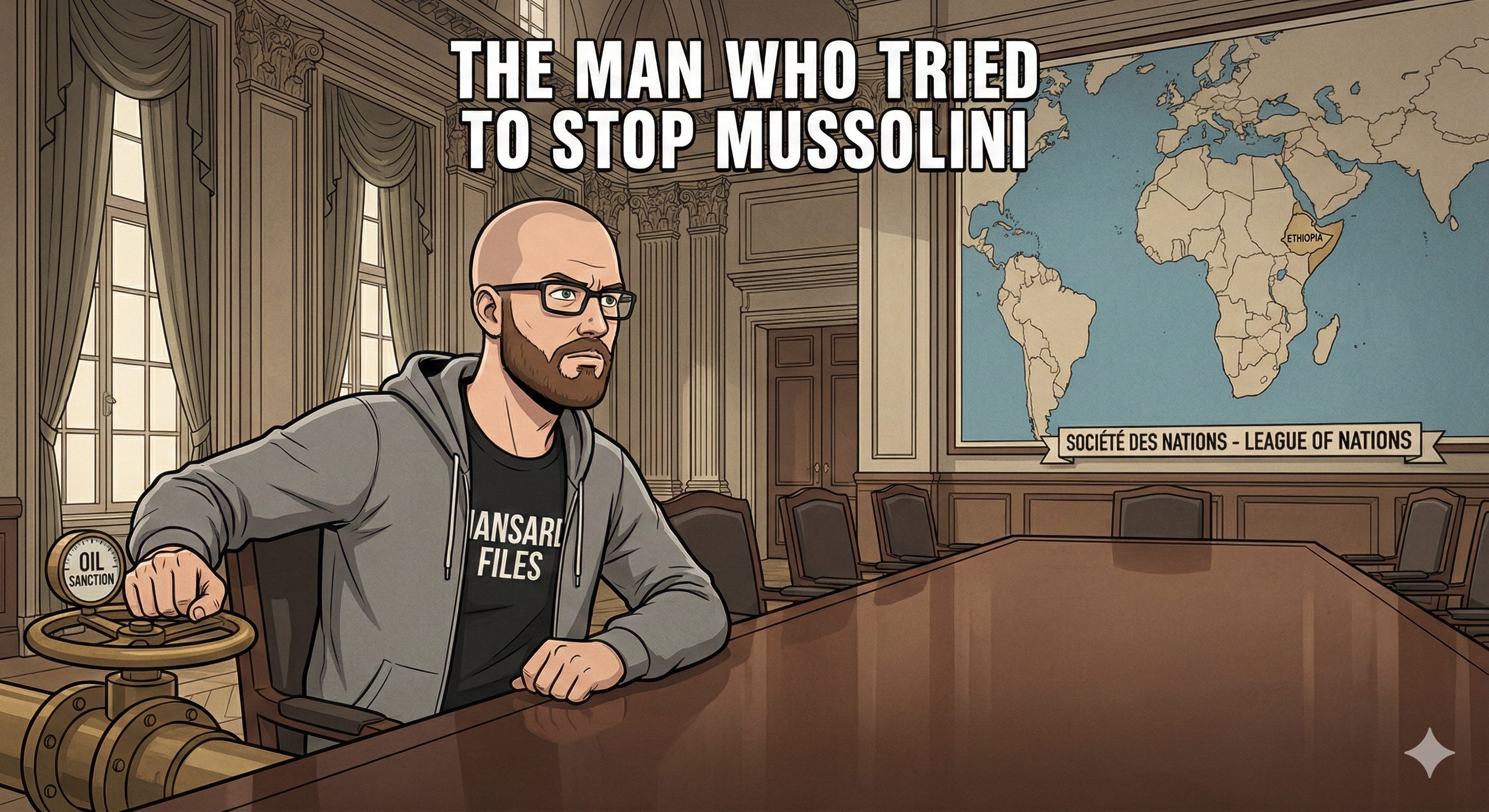
The room in Geneva was heavy with the smell of stale tobacco and the paralyzed fear of a world sliding toward the abyss. It was November 2, 1935, and the League of Nations was failing. Benito Mussolini’s legions were burning their way through Abyssinia (Ethiopia), using mustard gas and aerial bombardment to crush a sovereign member state. The Great Powers—Britain and France—dithered, terrified that effective action might push the Italian dictator into the arms of Adolf Hitler. In this vacuum of leadership, a quiet Canadian bureaucrat named Walter Riddell stood up and did the unthinkable: he proposed the one measure that could actually stop the war. This moment, known to history as the Riddell Incident, remains one of the most tantalizing “what ifs” of the twentieth century. It was a flash of moral clarity from a nation that usually prided itself on being invisible.
The Policy of Silence
To understand the magnitude of Riddell’s gamble, one must understand the Canada he represented. By the mid-1930s, the Great Depression had hollowed out the nation’s economy and its political will. The government, first under the bombastic Conservative R.B. Bennett and then the cautious Liberal William Lyon Mackenzie King, was obsessed with domestic survival. Foreign policy was a minefield to be avoided at all costs.
Canadian diplomats were under strict, if unwritten, orders: keep your head down. The Department of External Affairs, led by the brilliant but isolationist Under-Secretary O.D. Skelton, viewed the League of Nations not as a sword for justice, but as a dangerous entanglement that could drag Canada into European wars. The standing orders were to “refrain from word or deed” that might jeopardize peace or, more importantly, Canada’s detachment.
Yet, the world was becoming impossible to ignore. Tensions were flaring everywhere. On the home front, the violence of the era played out in the icy waters of the Atlantic, where U.S. Coast Guard cutters waged a lethal war against Canadian rum-runners. The diplomatic cables of the time were clogged with the fallout of incidents like the sinking of the I’m Alone and the shelling of the Josephine K., whose captain was killed by American fire. If the border with a friendly neighbor was this volatile, Europe seemed a cauldron about to boil over.
The Man in Geneva
Walter Riddell was Canada’s Advisory Officer to the League of Nations. He was a man who believed in the collective security promised by the League’s Covenant. For months, he had watched the Committee of Eighteen—the body charged with coordinating sanctions against Italy—pass weak, ineffectual measures. They banned imports of Italian lemons and exports of camels, measures that annoyed Mussolini but hardly slowed his tanks.
Riddell knew, as did every diplomat in Geneva, that modern armies march on oil. Without petroleum, Mussolini’s trucks, tanks, and bombers would grind to a halt in the Ethiopian mountains within weeks. But oil was the “key product” that Britain and France were too afraid to touch.
On that fateful Saturday morning in November, the debate in the Committee of Eighteen was stalling. The Spanish delegate argued that banning iron ore was unfair if iron and steel were not included. Seeing an opening, and perhaps banking on the moral momentum of the moment, Riddell took the floor. He didn’t just suggest a minor adjustment; he moved to extend the sanctions list to include “petroleum, coal, iron, and steel.”
The Canadian Proposal
The effect was electric. The motion was immediately dubbed “The Canadian Proposal.” For the first time, a nation had stepped forward to put a stranglehold on the aggressor’s war machine. The proposal was referred to the Economic Sub-Committee, and the machinery of the League began to turn with newfound purpose.
Back in Ottawa, the reaction was not pride, but panic.
The timing could not have been worse. Canada was in the midst of a chaotic political transition. Mackenzie King’s Liberals had just defeated Bennett’s Conservatives in a landslide election. The government was in flux. Riddell, operating with the autonomy often granted to diplomats in the era of slow telegraphs, believed he was acting within the spirit of his general instructions to cooperate with the League.
O.D. Skelton was furious. He fired off a telegram to Riddell, stating he had noted with “much surprise” that the diplomat had taken the initiative “without authorization.” Skelton’s cables became a drumbeat of reprimand: “You must of course realize that you are acting for the Government of Canada... and not for any other government, delegation or committee.”
Riddell tried to defend himself. He argued that he was merely trying to make the sanctions effective, that “equity” demanded finished products be banned alongside raw materials. But he was fighting a losing battle against his own capital.
The Betrayal at Sea Island
The final act of the tragedy played out not in Geneva or Ottawa, but at a resort in Sea Island, Georgia, where Prime Minister Mackenzie King had gone to rest after the election. King was horrified to find Canada in the vanguard of an international crisis. He feared the oil sanction would lead to war with Italy, or worse, rupture Canada’s fragile national unity by alienating French Canadians who were sympathetic to Mussolini and the Pope.
From his vacation retreat, King dictated the death warrant of the Canadian Proposal. He instructed his subordinates to disavow Riddell. On December 2, 1935, the Canadian government issued a press statement that struck the final blow. It declared that Riddell’s views were merely his own and did not represent the views of the Canadian government.
The repudiation was devastating. “The Canadian Proposal” became an orphan. Without Canada’s backing, the British and French had the perfect excuse to back down. The oil sanction stalled, then died. Mussolini, emboldened by the League’s weakness, completed his conquest of Ethiopia. He later admitted to Hitler that if the League had extended sanctions to oil, he would have been forced to withdraw “in a week.”
The Slide to War
The Riddell Incident was more than a diplomatic embarrassment; it was a turning point. It signaled to the dictators of the world—Mussolini, Hitler, Franco—that the democracies lacked the will to stop them. The League of Nations never recovered its credibility.
Riddell was effectively sidelined, his career branded by his moment of courage. The archives reveal a man who believed he was serving the highest ideals of his country and the world, only to find that his government preferred safety to morality. In the end, the safety was an illusion. The war that Riddell tried to stop in 1935 would arrive four years later, on a scale far more terrible than any oil sanction could have provoked.
Source Documents
Department of External Affairs. (1973). Documents on Canadian External Relations, Volume 5, 1931-1935. Information Canada.
Thanks for researching and writing this. Moral clarity requires others to care about something larger than themselves. I don’t blame people. It takes a lot of courage to do that and you must try to park as much as possible.
Now if this kind of history was being taught in schools rather than angry denunciations & smears of Sir John A Macdonald, perhaps Canada wouldn't be sliding into totalitarianism.