


A core function of a constitutional democracy is the predictable application of its rules. The laws that govern our institutions are not meant to be aspirational guidelines, they are meant to be firm requirements that ensure fairness, competence, and public trust. When those rules appear to be bent or broken, it creates a frustrating sense of civic dissonance. You begin to question if the system you believe in operates the way you assume it does. Such a moment occurred during the Senate’s Question Period on September 23, 2025, when the government was challenged on a judicial appointment that, on its face, seems to ignore a fundamental legal requirement for the job.
The exchange was not a complex, abstract debate. It was a direct and pointed accusation of political cronyism and a failure to adhere to the law. The response from the government, however, avoided the central charge. Instead, it reframed the question as an attack on the judiciary itself. This deflection reveals more than the details of any single appointment. It exposes a deep tension between political accountability and institutional deference, leaving you to ask a critical question: what happens when the gatekeepers of our legal system are appointed without meeting the basic qualifications for the role?
The Ten-Year Rule
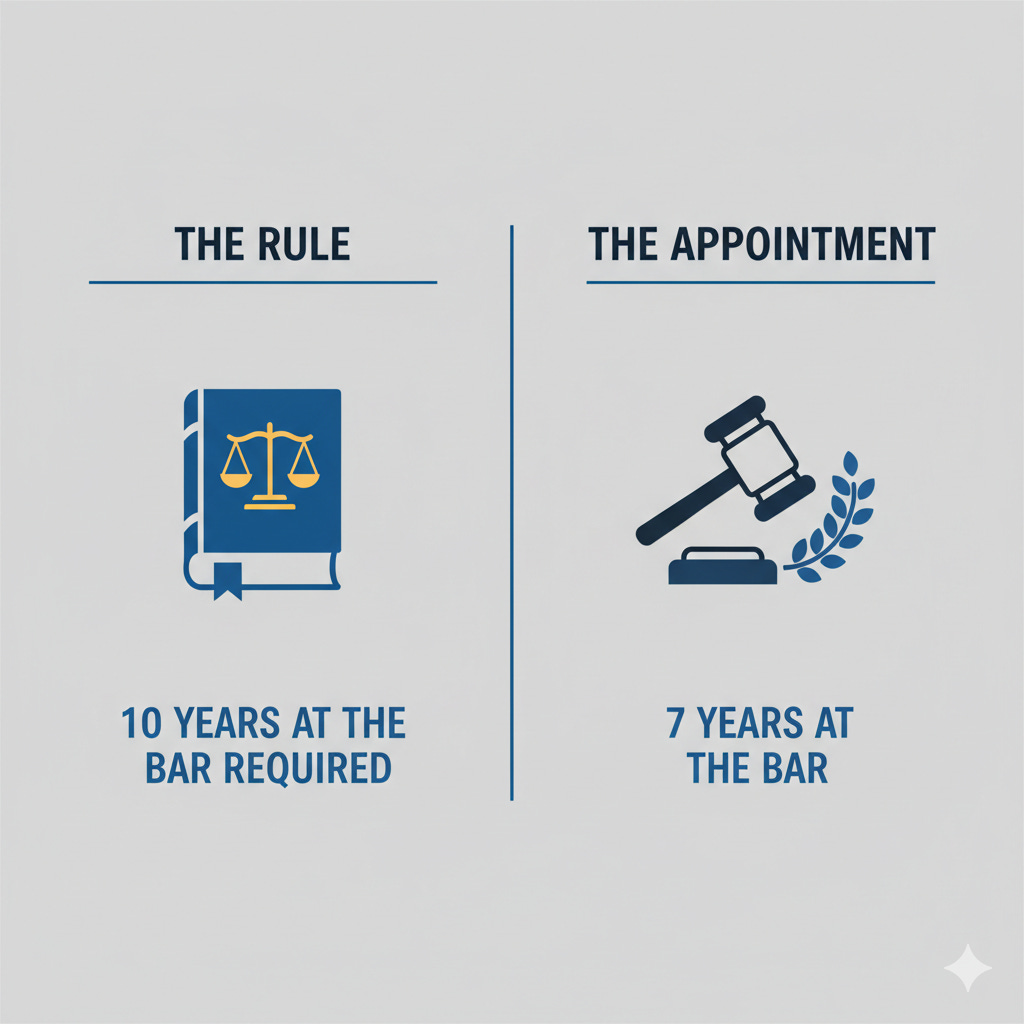
The problem presented to the Senate is straightforward. In January 2025, the government appointed lawyer Robert Leckey to the Superior Court of Quebec. According to the Judges Act and the Constitution, a candidate for such a position must have been a member of their provincial bar for at least ten years. During Question Period, Senator Claude Carignan, a lawyer himself, laid out a series of troubling facts for the chamber to consider.
However, contrary to the usual rules, Justice Leckey had been a member of the Barreau du Québec for only seven years and not the 10 years required by the Judges Act and the Constitution. Robert Leckey was a prolific donor to the Liberal Party of Canada, persistently criticized Bill 21 on laicity and Bill 96 on the French language, two Quebec bills. How can your government justify this appointment, which bears the hallmarks of good old fashioned cronyism?
This accusation is not a subtle matter of interpretation. It is a direct challenge to the legality of the appointment. The ten-year requirement is a baseline for experience, designed to ensure that judges possess a requisite level of legal maturity and practical knowledge. Senator Carignan’s statement frames this as a two-part failure: first, a failure to meet a clear legal standard, and second, the appearance of a politically motivated appointment, given the appointee’s donation history and public stances on contentious provincial laws. This presents a clear source of public frustration, a feeling that a position of immense public trust was awarded based on political alignment rather than demonstrated qualification. The principle at stake is foundational. The rule of law demands that the law applies to everyone, especially the government that appoints the judges who interpret it.
The Accountability Deflection
Here is the detail I find most revealing. When confronted with the specific allegation that the appointee failed to meet the ten-year requirement, the new Government Representative in the Senate, Pierre Moreau, did not address the substance of the charge. He did not confirm or deny the seven-year timeline. He did not explain how the appointment was legally justified. Instead, he deflected the question by reframing it as an inappropriate attack on the judicial system itself.
This introduces our central analogy for this issue: The Gatekeeper’s Key. The qualifications for becoming a judge, like the ten-year rule, are not mere suggestions. They are the specific keys required to unlock the gate to one of our most important institutions. These keys ensure that only those with the proper credentials and experience are allowed entry. Senator Carignan’s question was simple: how did someone get through the gate without the required key? Senator Moreau’s response was not to discuss the key, but to admonish the questioner for challenging the integrity of the institution behind the gate.
I believe that comments made by politicians, whether in the other place or here in this chamber, must first and foremost seek to emphasize our support for judicial institutions. They must also respect the separation of powers between the legislative, judicial and executive branches. When the independence of the courts or the independence and impartiality of judges is called into question, it does not serve the cause of the rule of law in Canada.
This is a masterful pivot. The government’s response transforms a question about its own accountability in the appointment process into a question about the questioner’s respect for judicial independence. When pressed again on the undisputed fact that the judge did not meet the ten-year rule, Senator Moreau doubled down, stating that the questions “undermine the credibility of Canada’s justice system in the eyes of the public”. The principle here is one of misaligned accountability. The government suggests that to question its process is to attack the judiciary. The counterargument is that true support for the judiciary requires ensuring the appointment process itself is beyond reproach. By refusing to answer a direct question of fact, the government shields its decision-making behind the reputation of the very institution it may have compromised.
The Principle of Legitimate Scrutiny
This exchange forces you to confront a fundamental principle of governance. At what point does legitimate scrutiny of a government action become an illegitimate attack on a democratic institution? The government’s position implies that once a judge is appointed, any challenge to the appointment is a dangerous violation of the separation of powers. This position, however, conveniently ignores the government’s role as the sole agent in that appointment. The judiciary is independent in its judgments, but the process of selecting those judges is a political one for which the government is, and must be, accountable to Parliament.
The frustration you feel watching this exchange is not an attack on the rule of law. It is a defense of it. The public’s trust in the justice system is not preserved by ignoring questions about the qualifications of those appointed to it. Trust is built on transparency and the visible adherence to established rules. When the government’s response to a charge of breaking the rules is to accuse the questioner of disrespecting the game, it signals that accountability is secondary to protecting the institution from scrutiny. The issue is not the judge, who continues to hear cases despite a legal challenge to his appointment. The issue is the decision-making process that placed him there.
An Unanswered Question
The September 23rd debate did not resolve the question of the Leckey appointment. It did, however, provide a perfect illustration of a government deflecting a direct challenge with an appeal to institutional sanctity. Your agency as an informed citizen comes from seeing this tactic for what it is. It is not an answer, but an avoidance of one. The core facts remain unchallenged: a legal requirement of ten years at the bar, and an appointee with only seven. The government was asked to explain this discrepancy and instead chose to lecture on the importance of judicial independence.
We are asked to trust the integrity of our legal system, and that trust is predicated on the belief that its gatekeepers are chosen by a process that is itself unimpeachable.
Sources:
Senate of Canada. (2025, September 23). Debates of the Senate (Hansard), 45th Parl, 1st Sess, Vol 154, No 17.