


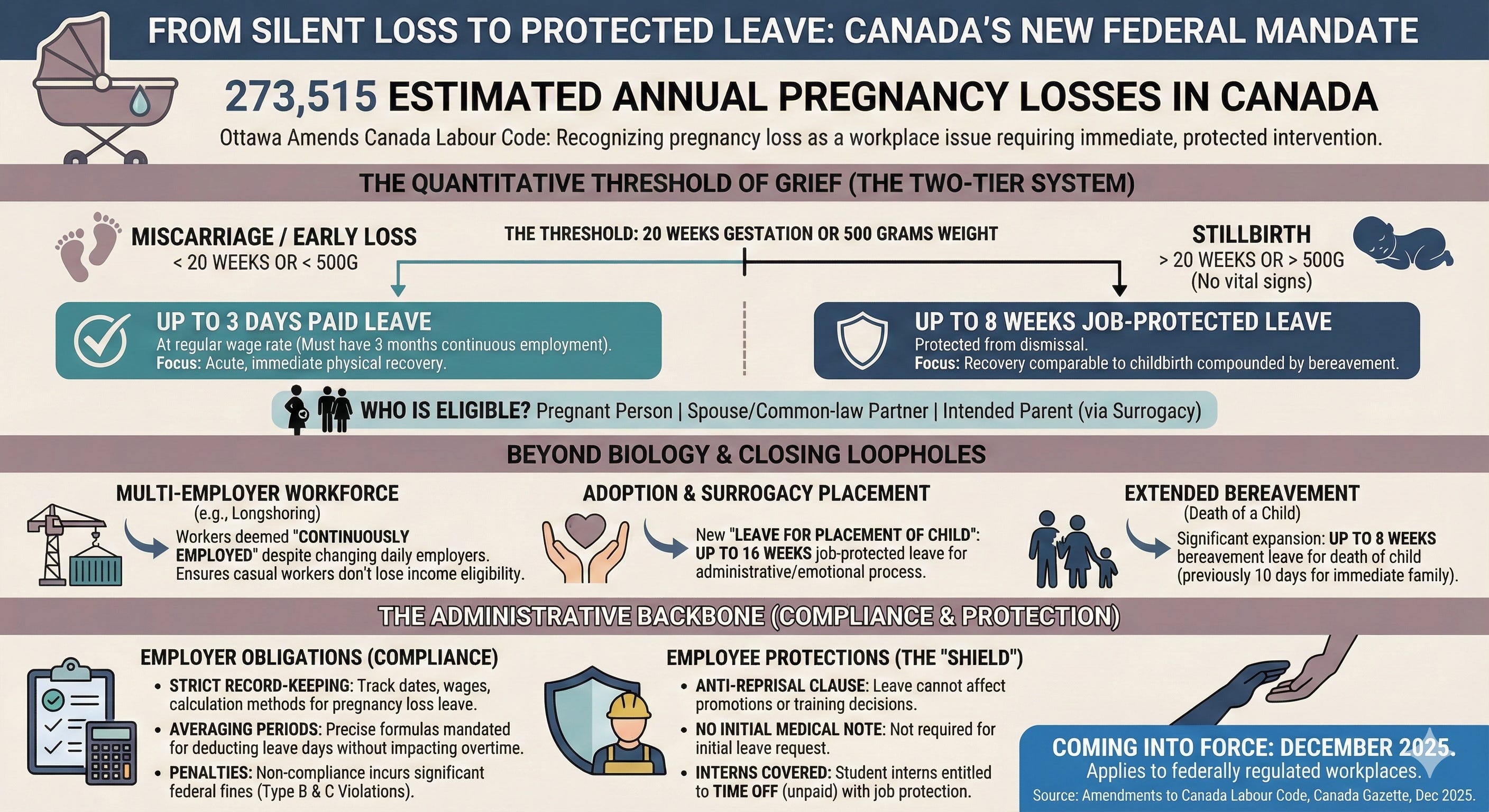
The distinction is drawn at five hundred grams. In the eyes of the federal government, a fetus that weighs less—or has gestated for fewer than twenty weeks—occupies a different legal category than one that crosses those thresholds. For decades, this bureaucratic line in the sand dictated whether a grieving worker in a federally regulated industry was entitled to time off to mourn, or if they were expected to return to the warehouse floor, the airport tarmac, or the bank teller wicket the very next day.
This week, that calculation changed. Amidst a massive regulatory update published in the Canada Gazette, the federal government quietly enshrined a new reality for the estimated 273,515 Canadians who experience pregnancy loss annually. The amendments to the Canada Labour Code introduce explicit protections for workers facing the physical and psychological trauma of miscarriage, stillbirth, and the complex grief of adoption disruptions. For the first time, the law mandates paid pregnancy loss leave, forcing employers to recognize that the end of a pregnancy is not merely a medical event, but a workplace issue requiring immediate, protected intervention.
The regulations, set to come into force in December 2025, do not just offer time; they impose a rigid new framework of compliance, creating a buffer between the personal tragedy of an employee and the operational demands of the supply chain. For the dockworker in Vancouver or the rail engineer in Montreal, the silence of a nursery will no longer be compounded by the silence of a paycheque.
The Quantitative Threshold of Grief
The regulatory text is precise, stripping away ambiguity to define exactly when and how the state intervenes in private loss. The amendments categorize the leave based on the biological progression of the pregnancy, creating a two-tiered system of support that employers must now integrate into their payroll systems.
For a pregnancy that does not result in a live birth, the new standard grants a leave of absence of up to three days. If the employee has completed three consecutive months of continuous employment, these three days are to be paid at their regular rate of wages. This provision targets the acute, immediate physical recovery required after a miscarriage—a period previously covered only by sick leave, vacation days, or the goodwill of a manager.
However, the regulations shift dramatically when the loss is classified as a stillbirth. Defined in the new text as the “complete expulsion or extraction” of a fetus after the twentieth week of pregnancy, or after the fetus has attained the weight of 500 grams, the law now mandates a leave of up to eight weeks. The text specifies the grim criteria: the absence of breathing, heart beating, pulsation of the umbilical cord, or movement of voluntary muscle. In these cases, the employee is protected from dismissal or suspension for a period spanning two months, acknowledging that the recovery from a stillbirth is comparable to the recovery from childbirth itself, compounded by bereavement.
Crucially, this leave is not restricted to the person who was pregnant. The amendments extend these rights to the spouse or common-law partner of the individual who experienced the loss. Furthermore, the legislation anticipates the complexities of modern family planning, extending eligibility to employees who intended to be the legal parent of a child born to another person, such as through a surrogacy arrangement. If that pregnancy fails, the intended parent—who may have been preparing a home for a child they will never bring home—is granted the same statutory protection to grieve.
The Longshore Loophole
A significant portion of the regulatory analysis focuses on a specific, often overlooked demographic: the multi-employer workforce. In industries like longshoring, where workers are dispatched daily to different marine terminals and may work for dozens of different employers over a single year, standard labour protections often fail. A worker might be employed for years in the industry but fail to meet the “continuous employment” threshold for a specific employer required to qualify for paid leave.
The new regulations aggressively close this loophole. Under the amended Canada Labour Standards Regulations, employees engaged in multi-employer employment are “deemed to be continuously employed” for the purpose of qualifying for paid leave related to pregnancy loss. This technical adjustment has profound real-world implications. It ensures that a casual longshore worker who suffers a miscarriage does not lose their income simply because they work for a dispatch hall rather than a single corporation.
The government’s own analysis estimates that approximately 1,352 longshoring employees will utilize this specific paid leave provision over the next decade. While the number seems small in the context of the national workforce, for those specific families, it represents the difference between financial stability and poverty during a medical crisis. The regulations stipulate that the wages for these days must be calculated based on the employee’s average earnings, ensuring that the precarious nature of their employment does not strip them of the benefit.
Beyond Biology: The Adoption and Surrogacy Shield
Parallel to the provisions for biological loss, the amendments introduce a new category of protection: “Leave for Placement of Child.” This reflects a modernization of labour standards to align with the realities of adoption and surrogacy.
The Canada Labour Code will now entitle employees to a leave of absence of up to sixteen weeks to carry out responsibilities related to the placement of a child into their care. This provision is designed to coordinate with changes to the Employment Insurance Act, providing job security while parents navigate the often bureaucratic and emotionally taxing process of adoption.
This section of the regulations anticipates the fragility of these arrangements. If a placement falls through—if a birth mother changes her mind, or an international adoption is halted at the eleventh hour—the employee is already covered under the broader umbrella of these protections. The law acknowledges that the administrative burden of adopting a child often requires a physical presence and time commitment that is incompatible with a standard nine-to-five schedule. By protecting this time, the government is effectively classifying the “administrative work” of forming a family as a protected activity, on par with the biological work of gestation.
The Eight-Week Expansion
The amendments also overhaul the existing framework for bereavement leave. Previously, the Code provided for up to ten days of leave in the event of a death in the immediate family. The new regulations significantly expand this for the most tragic of circumstances: the death of a child.
Employees are now permitted to take bereavement leave for up to eight weeks in the event of the death of their child, or the child of their spouse or common-law partner. This expansion recognizes that the grief associated with the loss of a child requires a recovery trajectory that far exceeds the standard two weeks allocated for the loss of a parent or sibling.
The regulatory text includes specific protections against employer retaliation during this extended vulnerability. It explicitly prohibits employers from taking an employee’s leave into account when making decisions regarding promotions or training. This “anti-reprisal” clause is critical. It attempts to legislate against the “mommy track” or, in this case, the “grieving parent track,” where workers who take significant time off for family crises are quietly sidelined from career advancement.
Furthermore, the regulations extend these protections to “student interns.” Historically, interns—who are not classified as employees—have been excluded from most labour standards. The amendments clarify that while interns may not be entitled to pay, they are entitled to the time. An intern who suffers a pregnancy loss or the death of a child cannot be terminated or have their internship cancelled for taking the allowable unpaid leave. This ensures that young workers entering the federal workforce are not forced to sacrifice their career prospects on the altar of personal tragedy.
The Administrative Burden of Empathy
Implementing these humanitarian protections requires a rigid administrative backbone. The regulations impose strict record-keeping requirements on employers, transforming personal grief into auditable data points.
Employers are now required to keep detailed records of any “leave related to pregnancy loss” taken by an employee. This includes the dates of the leave, the wages paid, and the method used to calculate those wages. While the employee is not required to provide a medical certificate to substantiate the initial request for leave—a decision made to reduce the burden on the grieving individual—the employer must maintain a paper trail that proves they complied with the law.
The regulations also introduce a new layer of complexity regarding “averaging periods.” In industries where hours of work fluctuate, such as transportation or shipping, calculating overtime and standard hours is already complex. The amendments prescribe exactly how days of paid pregnancy loss leave must be deducted from the employee’s standard hours of work to ensure that taking the leave does not negatively impact their overtime entitlement. This mathematical precision ensures that a worker who takes three days off to recover from a miscarriage is not penalized when their hours are averaged out over a two-week period.
To enforce these new standards, the government has updated the Administrative Monetary Penalties (Canada Labour Code) Regulations. The penalties for non-compliance are categorized by severity. Denying an employee their right to take leave related to pregnancy loss is classified as a “Type C” violation—a serious infraction that carries significant financial penalties. Failing to pay an employee for the first three days of that leave is a “Type B” violation.
This punitive framework signals that the government views these leaves not as perks, but as fundamental rights. A shipping company that refuses a docker time off after a stillbirth is no longer just being callous; they are committing a regulatory violation subject to federal fines.
The Cost of Compassion
The Regulatory Impact Analysis Statement accompanying the amendments provides a cold but necessary accounting of the cost of these new protections. The government estimates that the total net present value of costs to employers over a ten-year period will be approximately $3.3 million. This figure includes the wages paid to employees during their leave, the administrative costs of updating payroll systems, and the time spent training management on the new requirements.
However, the analysis argues that these costs are negligible compared to the qualitative benefits. By providing financial support and job security, the regulations aim to reduce the stress on recovering employees, potentially leading to better long-term retention and mental health outcomes. The analysis explicitly notes that for the longshoring sector alone, employers will pay an estimated $1.1 million in incremental wages over ten years to cover these leaves.
The government also updated its prevalence estimates to justify the policy. Utilizing data on live births, stillbirths, and induced abortions, analysts calculated that approximately 2.5% of the federally regulated workforce could qualify for pregnancy loss leave in any given year. This translates to roughly 26,000 employees annually who will now have legal access to paid time off during a reproductive crisis.
A Parallel Crisis: The Formula Exemption
While the Canada Labour Code amendments address the loss of a child, a separate legal order published in the same Gazette addresses the desperate struggle to feed one. The Exemption Order in Respect of Foods for a Special Dietary Purpose creates a permanent legal mechanism to handle shortages of human milk fortifiers and infant formulas.
This order serves as a grim companion piece to the leave amendments. It allows the Minister of Health to exempt certain imported infant formulas from bilingual labelling and specific compositional requirements if there is a verified shortage in Canada. The order creates two lists: one for products manufactured abroad, and one for Canadian products originally destined for export that are repatriated to the domestic market.
This measure effectively creates a regulatory “break glass in case of emergency” protocol for infant nutrition. It acknowledges the fragility of the supply chain for these critical products—a fragility that terrified parents across North America during the shortages of recent years. By streamlining the importation process, the government is prioritizing the immediate biological needs of infants over the strict adherence to packaging regulations.
Together, these two regulatory updates paint a picture of a government grappling with the biological realities of its workforce and population. From the quiet tragedy of a miscarriage to the panic of an empty formula shelf, the state is extending its regulatory reach into the most intimate and vulnerable moments of family life.
The New Notice
Effective December 12, 2025, every federally regulated workplace—from the railway yards of Winnipeg to the bank towers of Toronto—will be required to update their posted notices. The standard poster listing labour rights, often ignored on a breakroom bulletin board, will now carry new lines of text: “Leave related to pregnancy loss” and “Leave for placement of child.”
For most workers, these lines will blend into the background noise of regulatory compliance. But for the worker returning after a week of silence, glancing at that board while clocking in, those words will represent a profound shift. They are an acknowledgement that their loss is real, that their grief is valid, and that their government has mandated that they be given the time—and the money—to heal.
Source Documents
Canada Gazette Part II. (2025, December 17). Vol. 159, No. 26.
Department of Health. (2025, December 9). Exemption Order in Respect of Foods for a Special Dietary Purpose, SOR/2025-248.
Employment and Social Development Canada. (2025, November 28). Regulations Amending Certain Regulations Made Under the Canada Labour Code (Leave Related to Pregnancy Loss, Bereavement Leave and Leave for Placement of Child), SOR/2025-240.