


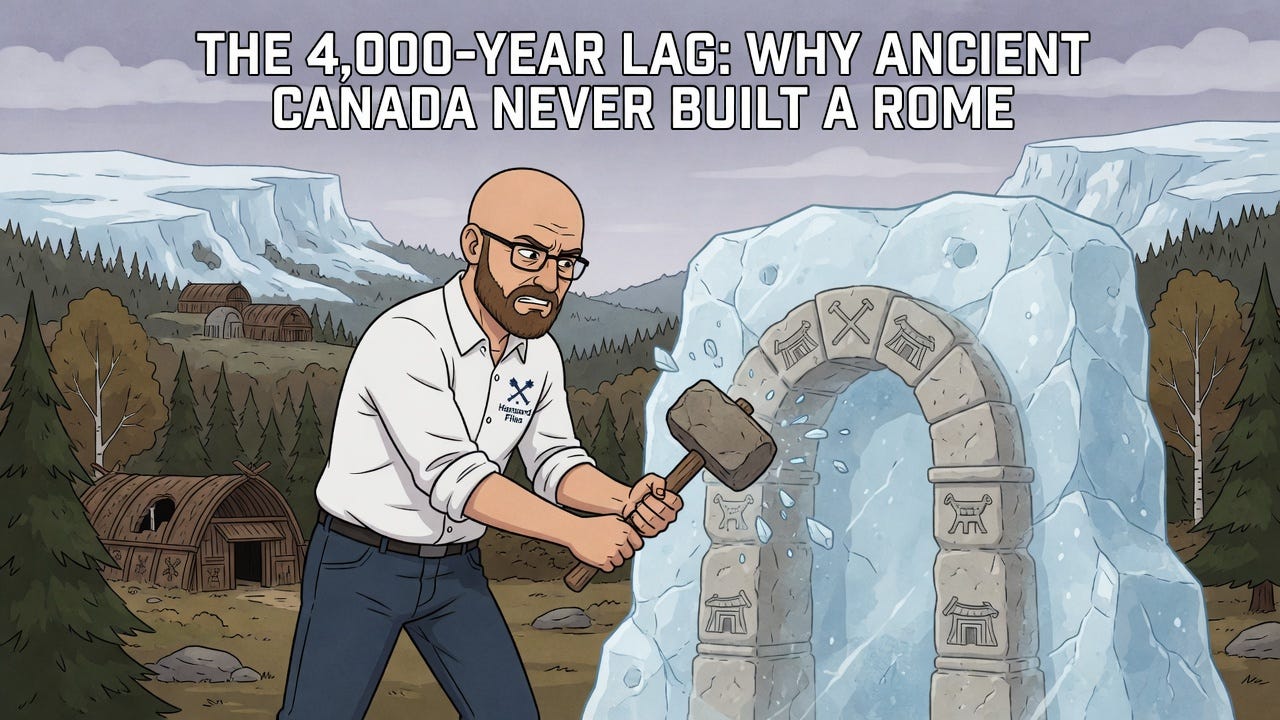
The contest for the New World was decided not on the battlefields of Quebec or the plains of Abraham, but in a shipyard in fifteenth-century Europe. When Christopher Columbus and his successors set their sights on the Western Hemisphere, they carried with them two technological terrors that would seal the fate of two continents: a firearm more deadly than any bow, and a decked vessel capable of sailing against the wind. These two inventions, perfected between the time of the Vikings and the voyage of 1492, turned the Atlantic from a barrier into a highway, delivering the “Old World” to the doorstep of the “New” with the force of a tidal wave.
But the true mystery of pre-European Canadian history is not why the Europeans won. It is why they found a continent that seemed, to their eyes, frozen in time. Why, in ten thousand years of habitation, had the indigenous peoples of North America not built a Rome, a London, or a Beijing? Why was there no Canadian Caesar commanding legions, no great stone cities in the Ontario woodlands? In 1937, anthropologist Diamond Jenness, writing for the National Museum of Canada, produced a startlingly modern answer to this question—one that stripped away the racism of his era to reveal a tragedy of geography, isolation, and biological luck.
The Myth of the “Pure” Race
In the racialized atmosphere of the 1930s, when eugenics was fashionable and empires justified themselves by blood, Jenness’s report, The Indian Background of Canadian History, was a radical departure. He ruthlessly dismantled the prevailing theory that the First Nations were biologically inferior. “Pure races,” he argued, “have only a fanciful existence”. He pointed to the Iroquois of Ontario and the Haida of the Queen Charlotte Islands, tribes that displayed political genius and artistic mastery, as proof that the “intellectual power” of the American aborigine was equal to that of any Englishman or Chinese mandarin.
If the Iroquois were the intellectual peers of the Romans, why were they still living in longhouses while Europe built cathedrals? Jenness identified the culprit not as blood, but as a “time lag” imposed by the ice age. The Old World had a 5,000-year head start. While the ancestors of the Pharaohs were domesticating cattle and wheat in the Fertile Crescent, the glaciers were still retreating from Canada, leaving behind a frozen waste that humans could barely penetrate.
The Geographic Prison
The tragedy of the Americas, according to Jenness, was a tragedy of isolation. Civilization is a contagion; it spreads through contact. But the Americas were a quarantine zone, cut off from the “momentous discoveries” of Asia and Europe.
Consider the silence of the Canadian forests. For millennia, they lacked the sounds that drove progress elsewhere: the lowing of cattle, the squeal of pigs, the whinny of horses. The entire hemisphere was devoid of suitable draft animals. Without the horse or the ox, the wheel was useless. Without the wheel, transport was limited to the human back and the canoe. And without transport, the “interaction of cultures”—the friction that sparks innovation—was slowed to a crawl.
Even agriculture, the bedrock of city-building, was fighting a losing battle against the map. In the Old World, crops could travel east and west along similar latitudes, spreading easily from China to Spain. In the Americas, the axis was north-south. Corn, domesticated in the highlands of Mexico, had to fight its way through tropical jungles and arid deserts, adapting slowly to new climates before it could even reach the temperate lands of the United States. By the time it reached southeastern Ontario, thousands of years had been lost. The “agricultural revolution” that built the Mayan temples was only just beginning to take root in Canada when Cartier arrived.
The Three Great Waves
Despite these handicaps, the history of pre-European Canada was not static. It was a dynamic, violent theater of migration and conquest. Jenness reconstructs the peopling of the continent as a series of dramatic waves crossing the Bering Strait—the only open gate between the worlds.
First came the Eskimo (Inuit), the pioneers who braved the retreating ice. Jenness theorized they were the earliest arrivals, a distinct people who were later pushed aside or “pushed through” by subsequent invasions, eventually sealing the gate behind them. They spread across the Arctic littoral, a fringe civilization clinging to the edge of the habitable world.
Then came the Algonkians. These were the classic woodland warriors—the Cree, the Ojibwa, the Blackfoot—who swept into the heart of the continent. For centuries, they dominated the landscape, their hunting territories stretching from the Atlantic to the Rockies. They were a restless, migratory people, masters of the birchbark canoe, living lightly on the land.
Finally, the Athapaskans arrived—the latecomers. Massed in the northwest corner of the continent, these aggressive tribes began a slow, grinding southward trek that would eventually see some of their number, the Apache and Navajo, reach the borders of Mexico. In Canada, they pressed against the older tribes, creating a chaotic mosaic of languages and territories that defied simple categorization.
The Iroquoian Revolution
But it was in the forests of Ontario and New York that the “Rome” of Canada was finally beginning to rise. Around 1200 A.D., a new force entered the region: the Iroquoian tribes. Unlike the migratory Algonkians, the Iroquois were farmers. They brought with them the precious seeds of maize, tobacco, and beans—the “economic resources” that allowed for permanent towns and complex societies.
The Iroquoian invasion was a cultural shockwave. They seized southeastern Ontario, driving a wedge into the Algonkian domains. In their wake, they built something unprecedented in the north: the League of the Five Nations (Mohawk, Oneida, Onondaga, Cayuga, Seneca). This was not a mere alliance of savages; it was a federal republic. Jenness marveled at their “talent for political organization,” noting that they possessed an “innate genius for subordinating village communities to tribal units”.
By the 15th century, the League stood as a “united and hostile front,” a nascent empire poised to dominate the northeast. Had the Atlantic remained closed for another thousand years, it is easy to imagine an Iroquoian super-state expanding westward, its cornfields replacing the forests, its “representative councils” evolving into a parliament of the plains.
The Fatal Collision
It was not to be. The “time lag” had not yet closed when the French sails appeared on the St. Lawrence. The Iroquois, for all their political genius, were still in the Stone Age. They had no iron, no gunpowder, no horses. The collision between the Stone Age and the Renaissance was catastrophic.
Jenness’s analysis concludes with a somber recognition of the inevitability of the outcome. The indigenous cultures, “too weak to withstand the impact, collapsed and disappeared without exerting any further stimulus on the invaders”. The Europeans did not just conquer; they replaced. They brought their own animals, their own grains, their own laws. The “Indian background” became just that—a background, a faint echo of a history that might have been.
Yet, in recovering this history, Jenness forces us to re-evaluate the people who lived it. They were not “backward” because of their minds, but because of their map. They were the victims of a geographic lottery, trapped in a hemisphere that awoke late from the ice, fighting to build a civilization without the tools the rest of the world took for granted. That they achieved so much—the League of the Iroquois, the artistry of the Haida, the mastery of the Arctic—is a testament not to their savagery, but to a human resilience that even the ice age could not extinguish.
This article is based on the 1937 bulletin “The Indian Background of Canadian History” by Diamond Jenness. The “Hansard Files” digs into the dusty archives of government reports to resurrect the forgotten narratives of our past. Subscribe now to support independent investigative journalism that reads the fine print so you don’t have to.
Source Documents
Jenness, D. (1937). The Indian Background of Canadian History (Bulletin No. 86). National Museum of Canada.
There is no mention of the Native Americans following the coast of the Americas in boats. Also, David Graeber and David Wengrove in "The Dawn of Everything" address the issue of choice of hierarchical versus flat societies many times. Domestication of animals brought disease (small pox, measles, etc.) and domestication of plants brought a multi-level society that was bad for most.
Jenness' theory may accurately explain some of the evolutionary aspects of some indigenous peoples in the northern hemisphere, but how to reconcile that with the clear evidence of the establishment of cities and major empires in Central and South America. If, as is pretty much universally accepted, the Americas were originally populated by peoples crossing the Bering Strait, it would have to have been tens of thousands of years just to get from the extreme north to South America. Yet they had time to develop civilisations that had been in place for several thousand years before the first Europeans arrived. Indeed, the Inca had developed a civilisation an then it died out before the Europeans arrived.
Smilarly, it is pretty much universally accepted that humanity "started" in Africa, and while the Egyptians had established a civilisation aorund 10,000 years ago, nothing like that happened anywhere else in Africa. Applying Lenski's theory of socialcultural evolution based on the modes of production, by the 1400s, most peoples in Africa and North America were at the hunter-gatherer, pastoral, or horticultural level, Only the Egyptians in Africa had achieved agricultural, as had the major peoples in Central and South America.
My point is that the indigenous peoples of North America did have the time to develop into civilisations that would have been somewhat comparable to European civilisatioons of the time, but chose not to. One might theorize that they did not do that because, culturally, they were quite content to live the way they had always lived.