


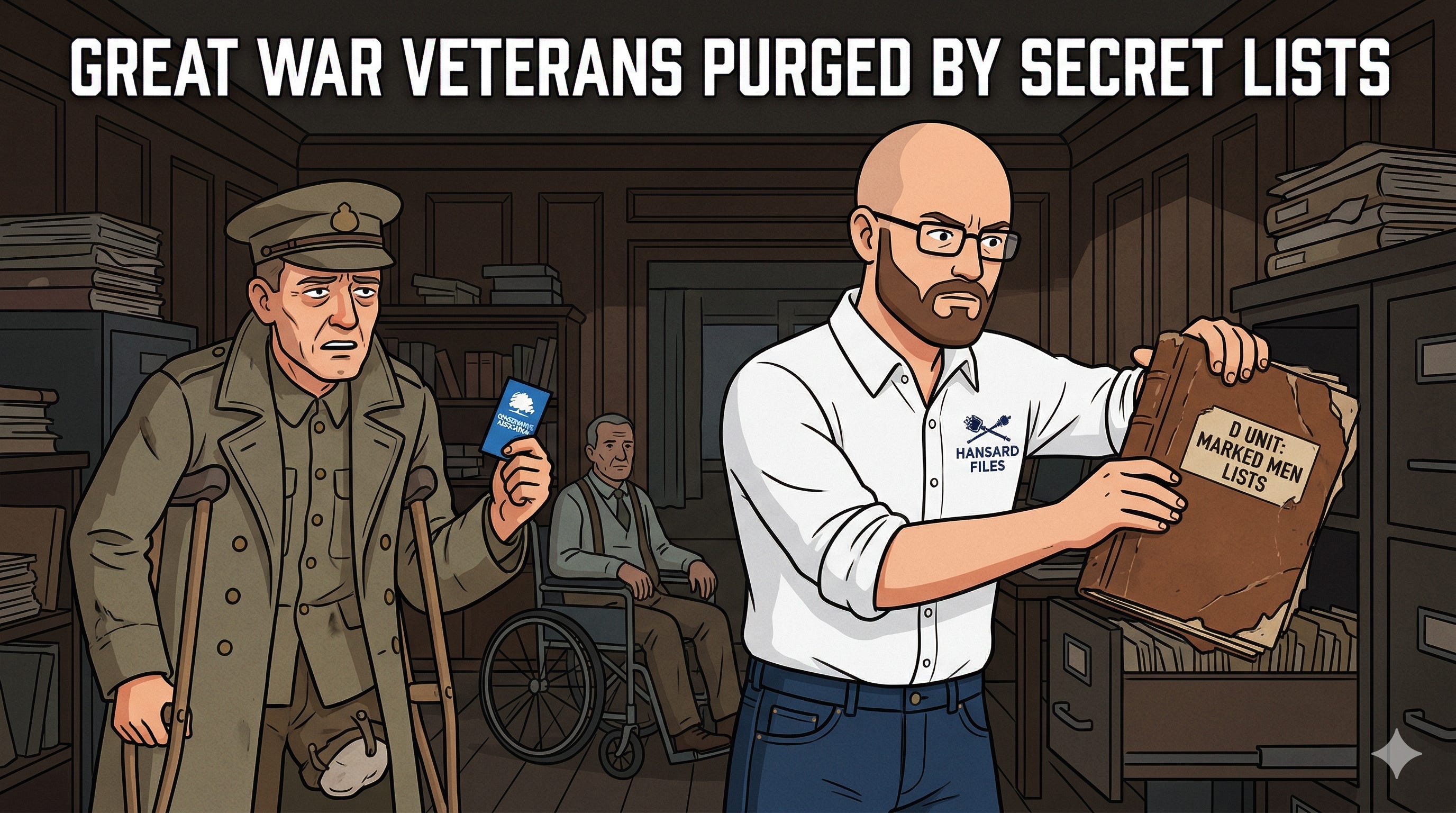
The corridors of the Christie Street Hospital in Toronto were filled with men who had left parts of themselves in the mud of Passchendaele and Vimy Ridge. By 1927, however, these veterans were fighting a new, silent war within the very department designed to heal them. It was a war not of artillery, but of political partisanship.
In the years following the Great War, the Department of Soldiers’ Civil Re-establishment (DSCR) had become a “fog of administration,” a place where a man’s employment depended less on his service record and more on which party he supported in the last election. When the government changed, the “outs” feared the “ins,” and rumors of secret lists and political spies poisoned the air.
This toxic atmosphere culminated in the appointment of a Royal Commission led by Alfred Taylour Hunter in 1928. His mandate was to investigate charges that the administration of “D Unit” in Toronto had transformed from a hospital into a partisan machine, purging Liberals to install Conservatives, and using the livelihoods of disabled veterans as poker chips in a cynical game of patronage.
The Seven Amps in a Day
The tension at Christie Street broke into open scandal with an event known as “Seven Amps in a Day.” In a sudden administrative move, seven members of the Amputation Association—men who had lost limbs in the war—were fired simultaneously. The official reason was economy; the staff was being reduced from its post-war peak of ten thousand down to two thousand.
But among the veterans, the firing was read differently. The executive of the “Amps” viewed it as a “Tory move to discredit a Grit Government,” a calculated attempt to stir up public outrage against the sitting Liberal administration by making them look heartless.
Two of these men, Jones and Dupuis, both of whom had lost their right legs at the hip, became central figures in the investigation. After their dismissal, they were desperate for work. Jones described the humiliation of being sent up a ladder to do painting despite his missing leg. When they returned to their former boss, Lt. Col. G.F. Morrison, begging for help, the response they received stripped away any pretense of non-partisan benevolence.
Morrison gave them a letter of introduction to a local politician, Mr. George Shields. When the two one-legged veterans presented the letter, Shields asked the question that mattered most: “Do you belong to the Conservative Association?” When they said no, they were told the jobs were for members only. They returned to Morrison, dejected. The Colonel’s advice was chilling in its pragmatism: “Go ahead and take a card and get a job through it. You don’t have to vote that way”.
Commissioner Hunter, in his final report, branded this the “most cynically atrocious political principle ever enunciated by a Canadian public official”.
The Newmarket Raid
The investigation revealed that the hospital was not just a site of patronage, but a base of operations for political warfare. Commissioner Hunter uncovered a plot from the 1925 general election that he termed “The Newmarket Raid.”
The plan was audacious and “impudent in its widespread openness.” Organizers intended to load two large motor buses with patients and orderlies from Christie Street Hospital and drive them to Newmarket. Their mission was not a medical outing, but a “buccaneering project” to physically break up a political meeting being held by the Prime Minister, William Lyon Mackenzie King.
The plot was only stopped when peremptory telegrams arrived from Ottawa warning officials of the consequences of such overt partisanship. While the “higher officials” managed to keep their hands clean, Hunter noted that the confidence with which the plotters operated gave a “fair idea of the density of the Tory atmosphere of the place”.
The Lunch-Hour Spies
Inside the hospital, paranoia reigned. The lunch hour, usually a time for camaraderie among old soldiers, became a trap. Hunter found that employees were “furtive Liberals,” dissembling their politics even from desk-mates for fear of being marked.
Their fears were justified. The inquiry identified two employees, Nash and Mundy, as “stool pigeons” or intelligence officers for the administration. They sat in the lunchroom, listening to the “dogmatic vehemence” of the veterans’ political arguments, and reported back to their superiors. Liberals who spoke too freely found themselves on the “marked men” list.
One veteran, Graham Smith, learned this lesson the hard way. During a staff address where Colonel Morrison mentioned that “This Government may change tomorrow,” Smith impulsively interjected, “It may not.” That single interruption triggered a cascade of retribution. Within hours, Smith was hauled before two separate supervisors, Mr. J.D. Anderson and Mr. W.J. Young, and “ridden” about his punctuality and minor infractions. Hunter concluded the coordination was too precise to be accidental: “Two coincidences in one day are too many: the facts point to a bit of Conservative team-play”.
The Crime-Maker
At the center of the “remorseless attrition” of Liberal employees stood Mr. J.D. Anderson, head of the General Division. Hunter described him as a “crime-maker”—an army term for a non-commissioned officer who destroys discipline by nagging subordinates over trivialities until they snap.
Anderson was found to have “nagged” veterans like Mr. Hutt and Mr. Kershaw out of the service entirely. Hunter noted the cruelty of these tactics when applied to “shock-troops” whose war injuries made them “peculiarly sensitive to and resentful of bullying”.
In one egregious case, a highly capable employment scout named Herb Lewis was passed over for promotion. Lewis was a “real scout,” praised by all for finding jobs for veterans. Yet, the administration recommended Nash and Mundy—the lunchroom spies—for the positions, despite their total lack of experience. The excuse given was that Nash and Mundy had severe disabilities. Hunter dismissed this as “amazing imbecility,” noting that an incompetent employment scout could cost hundreds of veterans their livelihoods. The real reason, the report concluded, was that Lewis was a Liberal, and the spies were Conservatives.
The Asiatic Mystery
Commissioner Hunter’s report painted a portrait of a department that had lost its way. He compared the internal organization of the DSCR not to the British Army, but to “some Asiatic mystery or complex conspiracy”.
The classification of civil servants, which determined their pay and future, was a “nebulous proposition” shrouded in fog. Files were unnumbered and could be “pruned or plundered with impunity.” Men were fired or promoted based on “mystery” rather than merit.
For the veterans of the Great War, who had fought for a nation’s freedom, the realization that their own livelihoods were subject to the petty tyranny of ward bosses and political lists was a bitter peace. The “merit system,” Hunter concluded, had been replaced by a system where a man’s service record mattered less than his willingness to pay fifty cents for a party card.
The Hansard Files digs through the dense, forgotten archives of history to bring you the stories that shaped—and scarred—the nation. Subscribe to support independent investigative history.
Source Documents
Hunter, A. T. (1928). Report of Royal Commission Appointed to Investigate Charges of Political Partisanship in the Department of Soldiers’ Civil Re-establishment. King’s Printer.
One would like to think such antics are a relic of the distant past... but on PEI (my home province) back in the 1980s, a change of gubbermint meant seasonable employees (ie: road repair crews etc.) who'd worked for the previous gubbermint were unlikely to be able to get a job with the new one.
That's part of the reason why I left PEI as a young man; to escape the soul grinding cycle of seasonal employment & unemployment. 40 years later when I returned, that cycle hasn't changed.