


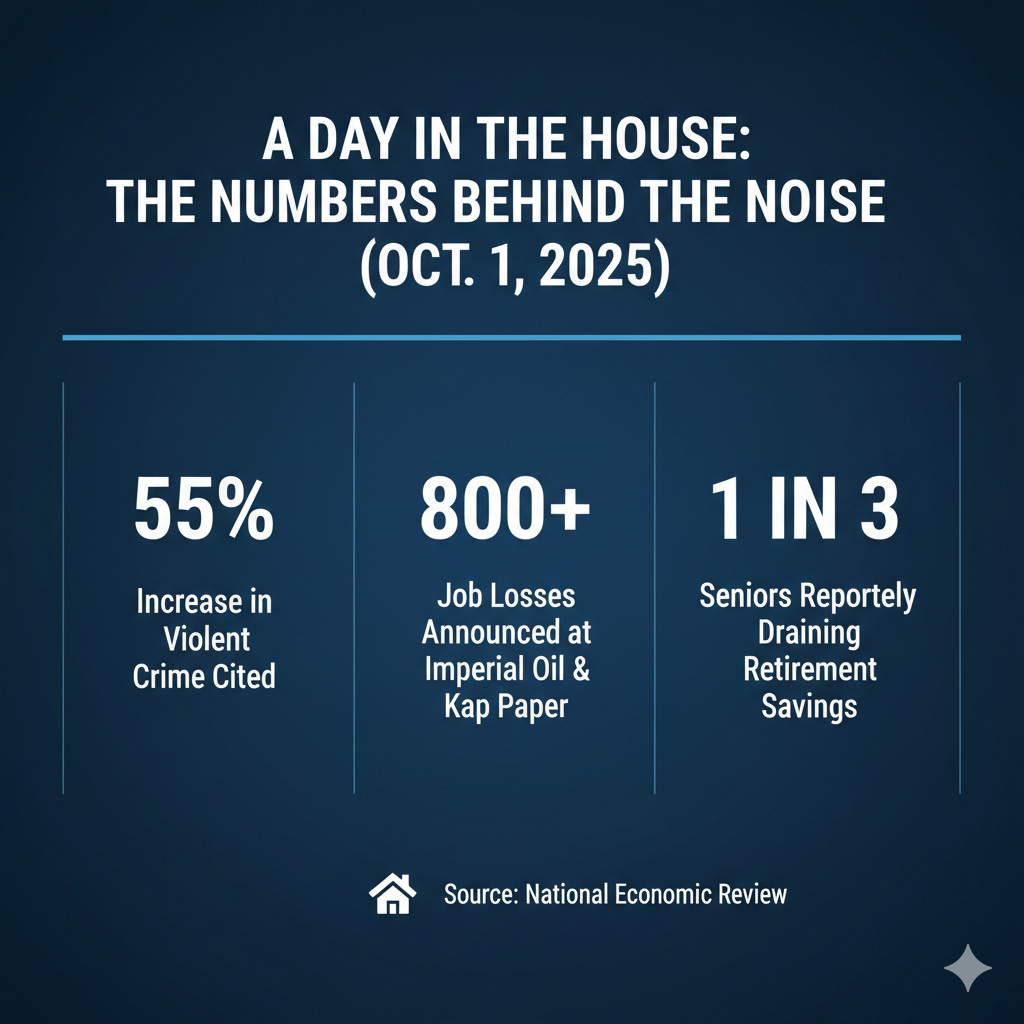
If you read the official record of the House of Commons from October 1, 2025, you are confronted with a jarring disconnect. On one hand, Members of Parliament raised issues of critical importance to you and your family. They spoke of violent crime rising 55%, of businesses laying off hundreds of workers, of a housing crisis forcing grandparents to drain their retirement savings to support their adult children, and of a wave of hate leaving communities feeling unsafe in their own neighbourhoods.
On the other hand, the responses to these crises felt formulaic, almost scripted. The debate, particularly during the daily theatre of Oral Questions, rarely resembled a collaborative effort to solve national problems. Instead, it looked more like a performance, with each party delivering its lines for an audience watching at home. This points to a critical question: when Parliament is in session, are we witnessing genuine governance or a carefully staged production? The evidence from this single day suggests it is far too often the latter.
The Problem of Policy Potemkin Villages
To understand the dynamic at play, it helps to introduce an analogy: the Policy Potemkin Village. Historically, a Potemkin village was a fake settlement, built only to impress visiting dignitaries. From a distance, it looked real and prosperous. Up close, it was nothing but a hollow facade. In modern politics, a Policy Potemkin Village is a piece of legislation or a political talking point designed to create the appearance of a solution. It looks sturdy and impressive in a press release or a talking point, but it collapses under the slightest scrutiny, revealing that it does little to fix the underlying structural problem. Our Parliament is becoming a factory for these facades, and the October 1 session provides a master class in their construction.
Question Period as Scripted Conflict
The most obvious stage for this performance is Oral Questions. Consider the exchange on government spending. The Leader of the Opposition, Pierre Poilievre, cited the independent Parliamentary Budget Officer to create a sense of impending doom:
...the Parliamentary Budget Officer rates his deficits as “very alarming”, “stupefying”, “shocking”, “unsustainable”, “if you don’t change, this is done”, “something’s going to break” and as if we are at the edge of a cliff.
The Prime Minister, Mark Carney, responded not by engaging with the PBO’s specific warnings, but by changing the frame of reference entirely to an international comparison:
We have the strongest credit rating in the world, a AAA from S&P and Moody’s; the lowest deficit in the G7; the lowest debt level in the G7; the lowest net debt-to-GDP in the G7; and the biggest potential in the G7.
This is not a debate. It is two actors performing different scripts in the same room. One script is about a looming domestic fiscal crisis. The other is about outperforming international peers. Both use selective data to tell a simple, compelling story to their respective bases. The goal is not to arrive at a shared truth about Canada’s fiscal health or to find a path forward. The goal is to win the scene. This is Legislative Theatre, and its result is not clarity for Canadians, but more confusion and division.
The Flawed Architecture of the Combatting Hate Act
The performance continues beyond Question Period and into the legislative process itself. The debate on Bill C-9, the Combatting Hate Act, offers a perfect case study of a Policy Potemkin Village. The bill was presented by the government as a necessary and robust response to a documented rise in hate crimes. Protecting communities from hate is a goal every Canadian shares. The bill is the facade, the impressive-looking solution. But when opposition members began inspecting its architecture, they found it was mostly for show.
Here’s the detail I find most revealing: critics from the Conservative benches argued repeatedly that the bill’s key provisions were redundant. Member after member stood to point out that the actions Bill C-9 purports to criminalize are, in fact, already illegal.
Hate Symbols: The bill creates an offence for promoting hatred by displaying symbols. But as multiple members noted, a person was charged just weeks prior under the existing subsection 319(2) of the Criminal Code for mowing a swastika into their lawn. The existing law already works.
Intimidation and Obstruction: The bill creates new offences for intimidating or obstructing access to religious places. But the Criminal Code already contains provisions against intimidation (section 423), criminal harassment (section 264), and mischief related to religious property (subsection 430(4.1)).
Hate as a Crime: The bill creates a new “hate crime” offence. But section 718.2 of the Criminal Code already designates hatred as an aggravating factor in sentencing, allowing judges to impose tougher penalties for any crime motivated by hate.
The government’s proposed structure, upon inspection, is largely a replica of a structure that already exists. So what does the bill actually do? It makes two significant changes that weaken the existing foundation. First, it removes the requirement for the Attorney General to consent to hate speech prosecutions, a long-standing safeguard against frivolous or politically motivated charges. Second, it codifies a new definition of “hatred” that removes the word “extreme” from the Supreme Court’s standard, lowering the threshold and risking the criminalization of speech that, while offensive, is not hateful.
The bill is a classic Policy Potemkin Village. It is presented as a strong new structure to protect vulnerable Canadians, but in reality, it duplicates existing laws while quietly removing crucial safety features. It is designed to be applauded from a distance, not examined up close.
The Principle of Substantive Scrutiny
This brings us to a foundational principle of governance. The role of Parliament is not to stage compelling dramas for public consumption. Its purpose is to act as a workshop, a place where the nation’s most difficult problems are examined, debated, and addressed through the meticulous construction of sound law. When our elected officials choose to be actors instead of artisans, the system fails. The problems do not get solved. The public’s trust erodes. You, the engaged citizen, are left with the frustrating sense that you are watching a performance that has little to do with your life or the country’s future.
From Spectator to Scrutinizer
The frustration you feel watching these debates is justified. It stems from the recognition that a process meant for serious work has been co-opted for performance. The solution is not to cheer louder for one set of actors over the other. The solution is to stop being a passive audience and become an active scrutinizer. By understanding the techniques of Legislative Theatre and the architecture of Policy Potemkin Villages, you can see past the facade. You can begin to judge your representatives not by the quality of their talking points, but by their commitment to the substantive, often unglamorous, work of building sound policy. True civic power is not found in cheering for your chosen actor, but in demanding the theatre be turned back into a workshop.
In Other News...
Beyond this deep dive, you can find more analysis and commentary on the On Hansard site.


Sources:
House of Commons. (2025, October 1). House of Commons Debates (Hansard), 45th Parliament, 1st Session, Vol. 152, No. 031.