


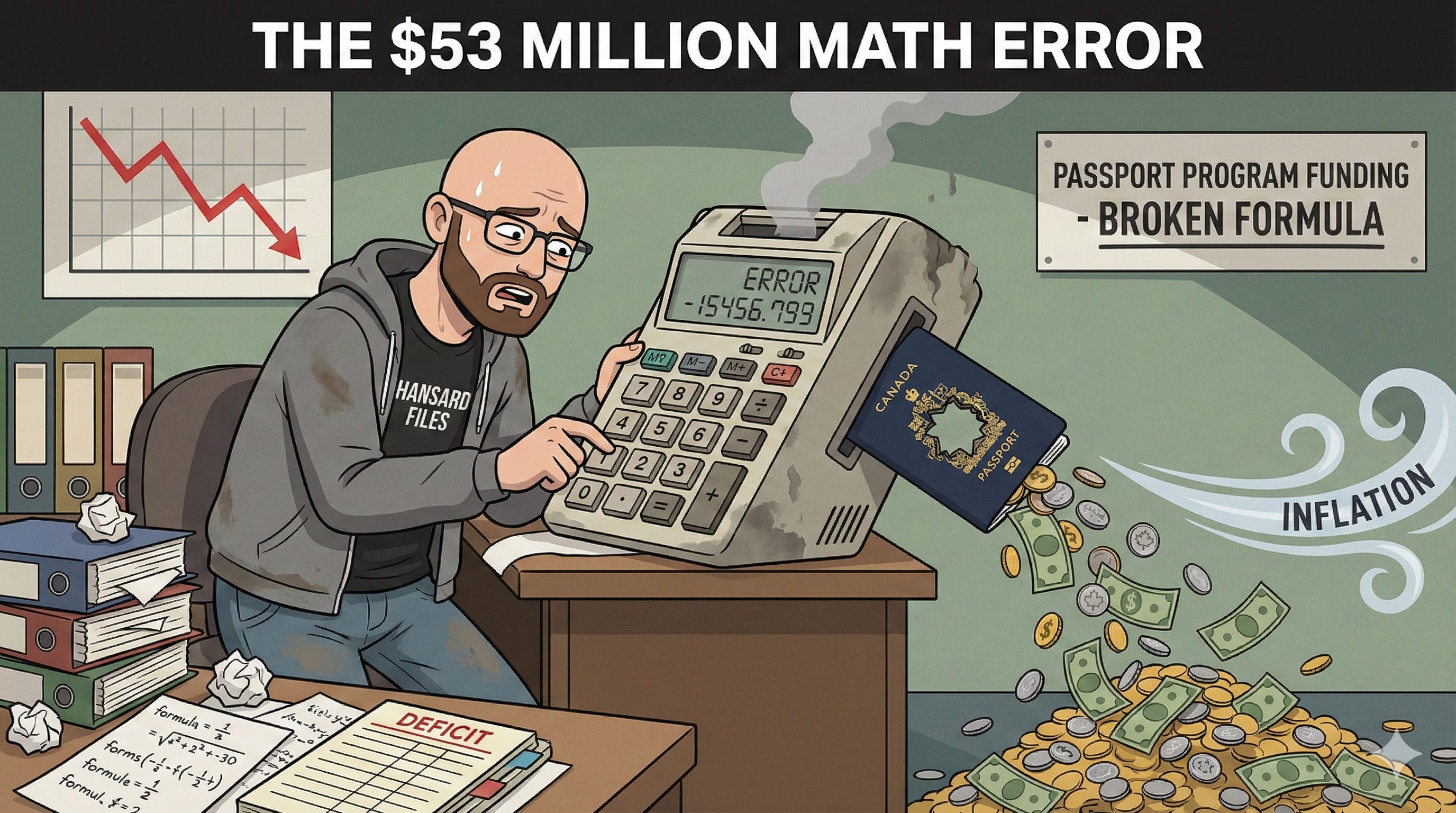
Ottawa, February 11, 2026 — Buried within the dense legalese of today’s Canada Gazette lies a multimillion-dollar admission of failure. For over a decade, the Canadian government has been operating its passport program using a pricing formula so fundamentally broken that, had it been followed to the letter, it would have required lowering the price of a domestic passport just as the program was spiraling into a $121 million deficit.
The result has been a quiet administrative paralysis. Unable to justify raising fees using the flawed regulation, and unable to afford the status quo, the federal government simply froze the price—and swallowed the losses.
Today, that paralysis ends. With the publication of SOR/2026-7 and SI/2026-1, the government has officially repealed the old pricing mechanism, written off approximately $53 million in “foregone revenue” that it failed to collect, and cleared the way for passport fees to begin an automatic annual climb, tethered directly to the Consumer Price Index (CPI), starting March 31, 2026.
This is the story of how a well-intentioned bureaucratic equation failed to account for the real world, and why the era of the $120 ten-year passport is coming to a close.
The “Unsuitable Mechanism”
To understand the scale of the error, one must look back to 2013. That year, the Passport Program established a new fee structure designed to cover its costs for a 10-year business cycle ending in 2023. To keep fees fair, regulations included a complex “fee adjustment formula” intended to tweak prices annually based on external costs beyond the government’s control, such as courier services and mailing rates.
It was a logical idea that failed spectacularly in practice.
According to the Regulatory Impact Analysis Statement released today, this formula ignored the vast majority of the program’s actual operating expenses. It accounted for shipping and handling but completely excluded “material costs, processing costs... salaried employees, and information and technology costs”. In total, the formula ignored roughly 85% of the program’s operational reality.
The absurdity of the math became apparent as inflation surged. While the cost of producing a passport skyrocketed—driven by a 14.5% jump in the CPI and salary increases—the 2013 formula remained fixated on shipping costs. The government’s own analysis reveals the bizarre scenario that would have unfolded had they followed the rule:
“If the Program were to collect on the adjustments in accordance with these formulas in fiscal year 2025-2026, they would require a 20% fee increase for abroad applications, but a 1% decrease for domestic applications.”
Domestic applications make up 95% of the workload. Lowering their price while the program faced a nine-figure deficit would have been fiscal suicide. Faced with this “unsuitable mechanism,” the government chose to ignore its own regulation, collecting the base fee and forgoing the adjustments.
The $121 Million Deficit
The decision to freeze fees rather than apply a broken formula came with a heavy price tag. The Passport Program operates on a “cost-recovery” basis, meaning it is supposed to pay for itself without drawing on tax dollars. It is currently failing to do so.
Today’s documents reveal a program in deep financial distress. In the fiscal year 2024-2025, expenditures outpaced revenues by approximately $121 million. The surplus accumulated in the early years of the 2013 business cycle has evaporated, eaten away by inflation that the old fee structure never anticipated.
To clean up the books, the Governor General in Council issued Remission Order SI/2026-1. This legal instrument effectively forgives the debt that technically existed because the government didn’t charge the fees the old (flawed) formula said they should. The order remits roughly $53 million in foregone revenue accumulated between April 2020 and March 2025.
It is a retroactive fix—a way to wipe the slate clean before the new system kicks in.
The New Reality: Inflationary Hikes
The repeal of the old formula (SOR/2026-7) brings the Passport Program under the Service Fees Act (SFA). This is the pivot point. Under the SFA, fees will no longer be stagnant. They will be subjected to an “annual inflation adjustment requirement”.
This ensures the program’s revenue stream will track with the cost of living, theoretically preventing another $121 million hole from opening up. However, for Canadian travelers, it means the price on the application form is about to become a moving target.
The first adjustment is scheduled for March 31, 2026. While the exact dollar figure of the increase will depend on the April 2024 “All-items Consumer Price Index,” the direction is clear: up.
The “Performance” Guarantee
Perhaps sensing the public frustration that comes with fee hikes, the government simultaneously issued a second order, SI/2026-2, which acts as a concession to applicants. Titled the Consular Services Fees (Performance Standards) Remission Order, it mandates a refund of fees if the government fails to do its job on time.
Specifically, if the processing time for a travel document exceeds the established service standard (generally 30 days for standard processing), the applicant is entitled to a remission of the fees paid. This aligns the passport regime with broader service standards, essentially telling Canadians: We will charge you more, but if we are slow, you don’t pay.
Implications
The regulatory overhaul gazetted today is a housekeeping measure on a massive scale. It closes the book on a decade of bad math that technically required the government to undercut its own revenue during a deficit. But it also signals a shift in how Ottawa views user fees. The era of static pricing is over. By pegging passport fees to inflation, the government is insulating its budget from the next economic shock—and passing that cost directly to the traveler.
The $53 million “math error” has been written off. The $121 million deficit remains. And come March 2026, Canadians will begin paying the difference.
If you value deep-dive analysis of the documents that shape Canadian policy—stories that go beyond the press release—please consider subscribing to the Hansard Files. We read the fine print so you don’t have to.
Source Documents
Department of Finance. (2026, January 30). Order Amending the China Surtax Remission Order (2024), No. 2 (SOR/2026-14). Canada Gazette, Part II, 160(3).
Immigration, Refugees and Citizenship Canada. (2026, January 26). Regulations Amending the Passport and Other Travel Document Services Fees Regulations (Removal of Fee Adjustments) (SOR/2026-7). Canada Gazette, Part II, 160(3).
Treasury Board of Canada. (2026, January 26). Remission Order for Certain Fees Under the Passport and Other Travel Document Services Fees Regulations (SI/2026-1). Canada Gazette, Part II, 160(3).
Treasury Board of Canada. (2026, January 26). Consular Services Fees (Performance Standards) Remission Order (SI/2026-2). Canada Gazette, Part II, 160(3).
So I'll need a second mortgage when my passport needs to be renewed. Crap.