


It was a week of major transitions in the Senate. The chamber spent much of Thursday, October 30, paying tribute to the departing Senator Gwen Boniface, who was lauded by all sides as a trailblazer for her career as the first female Commissioner of the Ontario Provincial Police and for her consensus-building work in the Senate.
But beneath the valedictories, a sharp-edged debate on accountability emerged. A new piece of legislation, Bill S-213, is proposing a significant change to how federal political parties operate. Its goal is to force transparency on the very organizations that control access to Parliament. This legislative push for party accountability ran parallel to a week where senators, in two separate, intense Question Periods, demanded more accountability from both the government and the Senate’s own internal administration.
The Case for Bill S-213
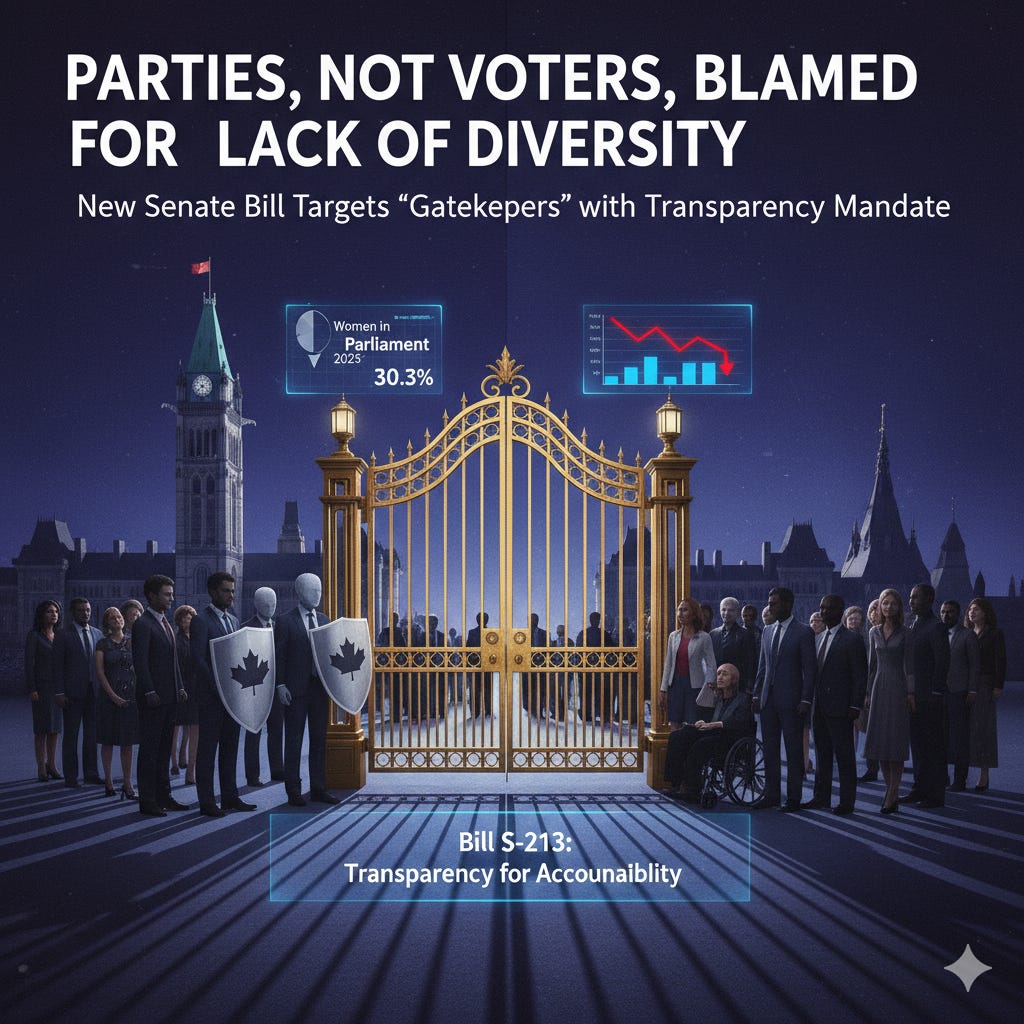
On Thursday, Senator Donna Dasko introduced Bill S-213, An Act to amend the Canada Elections Act. The bill targets what she described as Canada’s “long-standing and continuing failure” to elect women and other under-represented groups.
What’s the core problem? Senator Dasko, the bill’s sponsor, laid out the data. She noted that in 1997, Canada ranked 21st in the world for the percentage of women in its national parliament. Today, it ranks 70th.
Worse, the progress has stalled and even reversed. In the April 2025 federal election, the percentage of women elected to the House of Commons dropped slightly, from 30.5% in 2021 to 30.3%. Senator Dasko pointed out that both the Liberal and Conservative parties nominated “significantly fewer” women as candidates in 2025 compared to 2021.
Who Is Responsible for the Gap?
The central argument of the bill is that the blame for this stagnation lies with political parties, not voters.
“Voters are not responsible for the gender gap,” Senator Dasko stated. “Research shows that there is no voter bias of any consequence against women. Canadians vote for parties.”
She also argued that women are not responsible for the gap, citing an Abacus Data survey showing that women and men are equally interested in running for office (5% each). The problem, she explained, is that men are twice as likely as women to have been asked to run (14% of men versus 7% of women).
Because parties are the “gatekeepers to Parliament,” she argued, their candidate selection process is the “main factor responsible for the gender gap.”
How Would the Bill Work?
The bill’s solution is not quotas. Instead, it’s about transparency, built on a “comply or explain” model similar to the diversity disclosure rules in the Canada Business Corporations Act.
It has two main functions:
Data Collection: It would authorize the Chief Electoral Officer to collect voluntary, confidential demographic information from all candidates, nomination contestants, and leadership contestants.
Party Reporting: It would require major political parties to publicly post on their websites what they are doing to increase diversity, including any formal search committees, written policies, or targets. If a party chooses to do nothing, it must “state their reasons for opting out.”
“The bill does not say, ‘Do this,’” Senator Dasko clarified. “The bill actually says, ‘Tell Canadians what you are choosing to do.’”
Skepticism and Counter-Arguments
The proposal met with immediate and practical skepticism.
Senator Denise Batters, the bill’s critic, questioned its mechanics. She asked if the Green Party would even meet the bill’s threshold to be included (Senator Dasko was unsure). She also pointed to “confusing definitions” for terms like “demographic information” and “diversity” and questioned the “very quick” 90-day timeline for the Chief Electoral Officer to produce a report after an election.
Senator Batters also raised a key operational concern: Can Elections Canada even handle this? She reminded the chamber that the Elections Canada website “was down for hours on election day” in 2025, questioning whether the agency should be taking on new tasks before it ensures “they have the basics... handled.”
Senator Leo Housakos raised a more philosophical objection. He questioned why an “independent” senator was tabling a bill that so directly intervenes in the partisan process. He also asked if the bill was trying to “design outcome” for Elections Canada, which he argued goes down a “very slippery slope.”
Senator Dasko was firm in her reply. “There are no outcomes specified in this bill,” she stated. “This bill involves a process where parties are reporting.” She also noted that the Chief Electoral Officer has, in fact, “asked for this mandate” in reports following the 2019 and 2021 elections because Elections Canada is already receiving requests for this data and cannot legally collect it.
Finally, Senator Yonah Martin worried the bill moves away from a “truly merit-based system” and risks “tokenism.”
Senator Dasko countered that if a party feels it has made great progress on merit, “then you should be happy to do the reporting that’s required... You can tell Canadians about what you have put in place to achieve results.”
A Broader Theme of Accountability
This focus on party transparency in Bill S-213 mirrored a wider demand for accountability that defined the week’s proceedings.
Governmental Accountability
On Tuesday, Minister of Indigenous Services Mandy Gull-Masty faced a difficult Question Period over her department’s performance.
On the Auditor General’s Report: Senators repeatedly cited the AG’s recent report finding “unsatisfactory progress” on 53% of its recommendations for Indigenous Services Canada (ISC).
On Backlogs: Senator Yonah Martin pressed the minister on the 12,000-application backlog for Indian Status cards, with an average wait of 16 months. Senator Brian Francis cited an even larger backlog of 140,000 unresolved applications for Jordan’s Principle.
The Minister’s Response: Minister Gull-Masty acknowledged the backlogs, attributing some delays to COVID-19 and the need to get documents from the provinces. She stated that addressing the Jordan’s Principle file was her “most important file” and that a task force was being created. More broadly, she defended her department’s spending, arguing it was necessary to correct “years of critical underfunding” and that true success requires co-development with communities, not rushing to meet an “outside institution’s” timeline.
Internal Senate Accountability
The scrutiny also turned inward, as the Chair of the Standing Committee on Internal Economy, Budgets and Administration (CIBA), Senator Lucie Moncion, faced two days of pointed questions.
Meeting Frequency: Senator Denise Batters alleged a “decline in the frequency” of CIBA meetings (only 13 in 2023 and 12 in 2024, versus 20 in 2018), resulting in a lack of “proper accountability of taxpayer dollars.” Senator Moncion countered that the steering committee meets regularly.
In-Camera Decisions: Senator Yonah Martin questioned why decisions on a new ethics code for senators’ staff were made in camera and took months to be communicated. Senator Moncion replied that the policy was 40 years old, had been studied for four years, and was pulled for further review after “irritants” were identified.
Net-Zero Commitment: On Thursday, Senator Colin Deacon asked if the committee had discussed integrating the Senate’s 2022 net-zero commitment into its accounting processes. Senator Moncion’s answer was blunt: “The answer is no... when you have issues such as this, please write to the committee... to ask that the item be discussed.”
The Data Brief
Bill S-213: Proposes amending the Canada Elections Act to require demographic data collection from candidates and mandatory public reporting by parties on their diversity action plans.
Global Ranking: Canada’s world ranking for percentage of women in Parliament has fallen from 21st in 1997 to 70th in 2025.
2025 Election: The percentage of women MPs elected fell from 30.5% (2021) to 30.3%. Both the Liberal and Conservative parties nominated fewer women candidates.
Indigenous Services: Minister Gull-Masty confirmed a backlog of nearly 12,000 Indian Status applications and approximately 140,000 unresolved Jordan’s Principle applications.
Senate Administration: The Chair of the Internal Economy Committee stated the committee has not discussed integrating the Senate’s net-zero commitment into its accounting, two years after the commitment was made.
Source Documents
Debates of the Senate (Hansard), 1st Session, 45th Parliament, Volume 154, Number 28 (Tuesday, October 28, 2025).
Debates of the Senate (Hansard), 1st Session, 45th Parliament, Volume 154, Number 29 (Wednesday, October 29, 2025).
Debates of the Senate (Hansard), 1st Session, 45th Parliament, Volume 154, Number 30 (Thursday, October 30, 2025).