


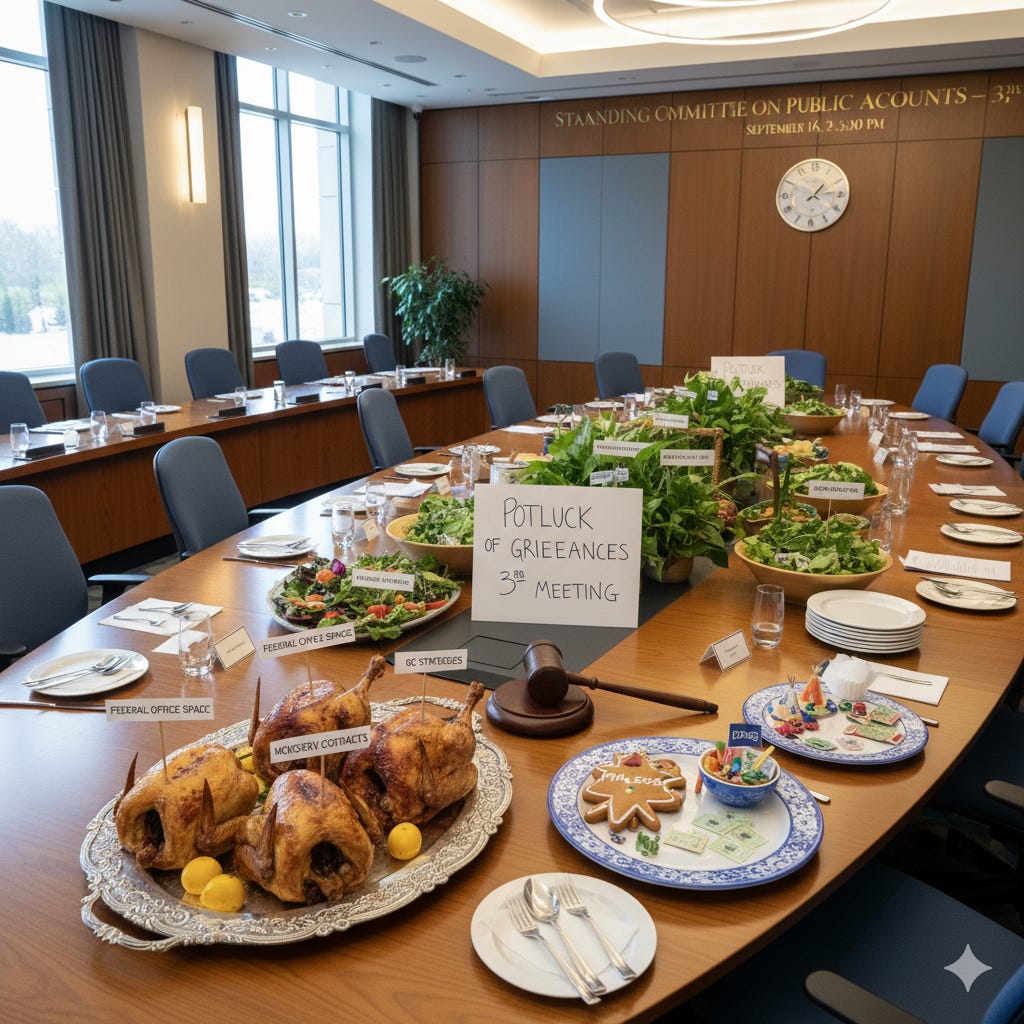
On the afternoon of September 16, 2025, members of the Standing Committee on Public Accounts gathered for their third meeting of the session. These organizational meetings are a routine part of the parliamentary calendar, a time to set priorities and plan the work for the months ahead. Your frustration with a political system that seems to produce more conflict than results is not misplaced. It is a logical reaction to a system whose foundational procedures often favor performance over progress. The proceedings of that Tuesday afternoon offer a perfect case study. They reveal how a committee with one of the most vital, non-partisan mandates, to ensure the government spends your money wisely, is structured from its opening moments to become just another stage for political maneuvering.
The conversation began with a sense of renewed purpose. Several members, fresh from a public accounts conference in Regina, spoke of collaboration and a shared mission. They had spent time discussing best practices with their provincial counterparts, learning about the committee’s ideal function, which is not to critique policy, but to determine if the implementation of policies has been properly executed. Liberal MP Kristina Tesser Derksen summarized the spirit of the conference, noting a recurring theme was the “inherent and necessary non-partisan nature of public accounts committees.” Conservative MP Stephanie Kusie echoed this, stating a desire to “move forward in a collaborative fashion.” The stated goal was clear: to work together to find “value for money” for the Canadian taxpayer. Here was the promise of a committee rising above the partisan fray to conduct objective financial oversight.
The Turn to Partisan Wish Lists
This spirit of collaboration lasted only a few minutes. As soon as the Chair opened the floor for members to propose studies, the meeting pivoted from a collaborative discussion to a series of prepared partisan statements. The structure of the meeting, organized into formal speaking rounds like a parliamentary debate, encouraged each party to present a pre-packaged list of priorities.
The Conservatives went first, proposing studies into three Auditor General reports which highlight perceived government failures.
“Report 3: Current and Future Use of Federal Office Space”
Professional services, highlighting McKinsey
Report 4, which is on GC Strategies.
The Bloc Québécois followed by formally moving two motions for studies on topics of particular interest to the party: the federal government’s financial commitments to the 2026 FIFA World Cup and the “Additions to Reserve” process for Indigenous peoples. The government members, in turn, suggested a focus on environmental reports, noting it has been “quite some time” since the committee has examined any. The non-partisan ideal of finding the most critical areas for review was instantly replaced by a more familiar political dynamic, each party advocating for topics that best served its messaging.
The Potluck of Grievances
To make sense of this dynamic, I propose an analogy: The Potluck of Grievances. Think of the committee’s agenda-setting process not as a kitchen where chefs collaborate on a single, coherent menu, but as a potluck dinner where each guest arrives with their own dish, prepared in isolation. The goal is not to create a balanced meal, but to ensure your dish gets noticed.
At this potluck, the Conservatives brought three dishes designed to critique the government’s management of money and contracts. The Bloc brought two distinct dishes reflecting its unique political priorities, FIFA and Indigenous land claims. The Liberals, wanting to steer the conversation toward their own agenda, brought a collection of environmental reports. The result is not a unified oversight plan based on a collective assessment of risk. It is a buffet of disconnected grievances, each chosen to appeal to a specific political palate.
The process is about staking a claim. It is about getting your preferred issue onto the table. The underlying assumption is not “what is the most important issue facing the country,” but “what is the most important issue to my party.” This mindset was perfectly captured when Liberal MP Jean Yip, seeking a fair compromise, suggested a path forward.
However, it would be good if, in the spirit of what was stressed at the public accounts conference being non-partisan and collaborative every party could choose one report. Then it would be fair: three reports for the three parties here.
Here is the detail I find most revealing. The proposed solution to a lack of collaboration was to formalize the partisanship. “Fairness” was defined as giving each party an equal slice of the agenda, not as achieving a unified purpose. This transforms the committee’s work from a collective responsibility into a transactional division of spoils. It codifies the potluck model as the official operating procedure.
A System Built for Fragmentation
The proceedings of September 16th were not an anomaly. They were the predictable outcome of a system whose procedures encourage fragmentation. The committee’s mandate is to examine the Public Accounts of Canada and all reports of the Auditor General. With dozens of reports to choose from, the selection process itself becomes a political battleground. Instead of beginning with a collaborative discussion to identify the most pressing systemic issues and then selecting reports accordingly, the committee begins with each party claiming a report like a piece of territory.
This points to a critical question. If the committee’s own operating procedure encourages members to think as partisans first and overseers second, can it ever fulfill its non-partisan mandate? The meeting revealed a group of well-intentioned parliamentarians trapped in a structure that pulls them toward political performance. The desire for collaboration expressed after the Regina conference was genuine, but the mechanics of the committee room immediately undermined it.
Rewriting the Recipe for Oversight
The challenge facing the Public Accounts committee is not a lack of willingness to cooperate, but a flawed recipe for setting its own agenda. An oversight body that begins its work by dividing the menu by party will struggle to serve the public a coherent meal. True oversight requires a different process, one that prioritizes a shared understanding of systemic risks before members retreat to their partisan corners to select their preferred grievance. The first step in fixing a broken system is to recognize the moments it breaks, and for this committee, the fracture appears in the first few pages of its opening transcript.
In Other News...
Beyond this deep dive, you can find more analysis and commentary on the On Hansard site.


Source:
Standing Committee on Public Accounts. (2025, September 16). Evidence (Meeting No. 3). House of Commons. https://www.ourcommons.ca/