


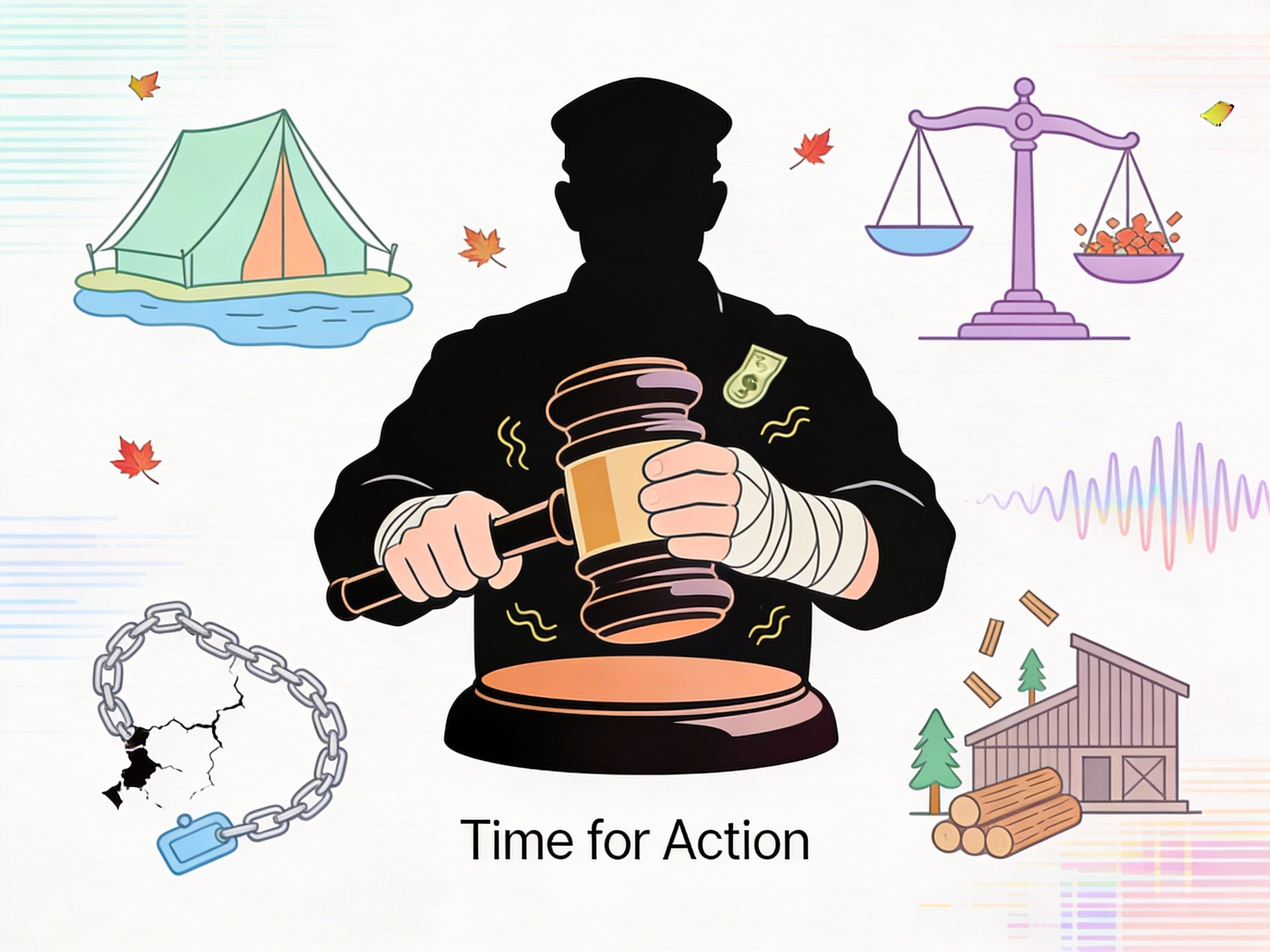
The silence in the committee room was heavy, broken only by the steady voice of a man describing the moment he decided to end his life. Gordon Hurley, a retired veteran and former special forces operator, told the Standing Committee on Veterans Affairs how he cut his wrists during a course in Alberta, only to smooth it over with his chain of command to protect his career. For the next five years, he used suicidal ideation as a coping mechanism. His testimony, part of a broad and often harrowing series of Parliamentary Committee Testimony sessions this session, peeled back the veneer of bureaucracy to reveal a system in crisis.
Across Parliament Hill, in rooms designated for Justice, National Defence, and Foreign Affairs, a similar scene played out repeatedly. Canadians—from grieving mothers to exhausted steelworkers, from persecuted refugees to frustrated police chiefs—came forward to testify that the systems designed to protect them are failing. The transcripts of these meetings paint a cinematic portrait of a nation grappling with a crisis of confidence, where the machinery of government appears increasingly disconnected from the visceral realities of its citizens.
The Cost of Service and The Price of Neglect
The testimony heard by the Veterans Affairs committee offered a stark indictment of how Canada treats those who serve. Witnesses described a labyrinthine bureaucracy that seems designed to wear down the very people it is meant to support. Mr. Hurley, now an advocate for psychedelic-assisted psychotherapy, described a system that prioritizes process over outcomes. He noted that while Veterans Affairs Canada will pay for ketamine as a drug, they refuse to fund the assisted psychotherapy necessary to make the treatment effective and safe.
The despair was palpable. Another witness, Mr. Bona, described catching veterans who were “living down by the river in a tent” because they could not access benefits. He spoke of the “sanctuary trauma” inflicted when the institution that a soldier fought for turns its back on them. The committee heard disturbing allegations that veterans seeking help for simple physical ailments or mental health struggles were being offered Medical Assistance in Dying (MAID) instead of treatment.
This theme of institutional betrayal echoed loudly in the Standing Committee on National Defence. Survivors of military sexual trauma described a system where reporting an assault often led to professional ruin rather than justice. Paula MacDonald, a former social worker in the Canadian Armed Forces, detailed how her chain of command weaponized medical labels against her, framing her reaction to harassment as a mental health problem rather than a disciplinary issue for her aggressors. The committee grappled with Bill C-11 and the transfer of sexual offence investigations to civilian police—a move supported by many survivors but complicated by police chiefs who testified that their civilian forces are already breaking under the strain of lack of resources.
Justice Denied: The Crisis in Bail and Sentencing
Perhaps the most emotionally charged testimony occurred within the Standing Committee on Justice and Human Rights, where the abstract concepts of legal theory collided with the brutal reality of violent crime. The committee heard from Jacqueline Beisel-Cobb, whose daughter Madison was gunned down by an ex-boyfriend. The offender had been released on bail multiple times despite facing criminal harassment charges and being known to possess a firearm.
Ms. Beisel-Cobb’s testimony was a direct challenge to legislators. She described a legal system filled with loopholes that criminals exploit, leaving victims unprotected. This sentiment was reinforced by Brett Broadfoot, whose 17-year-old daughter Breanna was murdered by a partner who had been released from custody the same day he was arrested for strangulation.
These personal tragedies played out against a backdrop of intense political maneuvering regarding a recent Supreme Court decision. The court had struck down mandatory minimum sentences for child sexual exploitation, ruling them cruel and unusual punishment. This sparked a fierce debate within the committee, with Conservative members moving motions to invoke the notwithstanding clause to reinstate the penalties. The Liberal members, while condemning the crimes, argued against overriding the Charter, proposing instead to table new legislation. The gridlock and procedural wrangling stood in stark contrast to the immediate, irreversible loss suffered by the families in the room.
The Axis of Authoritarians and Foreign Interference
While domestic safety dominated the Justice committee, the Procedure and House Affairs committee and the Subcommittee on International Human Rights turned their gaze outward to threats targeting Canada’s sovereignty and democratic institutions. The testimony revealed a country that has become a “playground” for foreign interference.
The Honourable Irwin Cotler, a former Minister of Justice, provided a chilling overview of the geopolitical landscape. He described a “collaborative axis of authoritarianism” comprising Russia, China, and Iran. He detailed how these regimes are engaging in transnational repression, targeting dissidents and diaspora communities within Canada’s borders. His testimony was corroborated by Charles Burton, who described the government’s failure to implement a foreign influence registry as “cynical stakeholder management.” Burton warned that delays in appointing a commissioner to oversee foreign influence suggest a fear within the political elite that transparency might expose compromising entanglements.
The scope of this interference was further illuminated by witnesses discussing the digital information environment. Aengus Bridgman of the Media Ecosystem Observatory described a crisis in platform governance, where social media giants provide little transparency regarding the spread of disinformation. He noted that during the recent election period, AI-generated content posing as Canadian news sources garnered hundreds of thousands of views, spreading narratives designed to delegitimize the democratic process.
The Economic War: Tariffs, Productivity, and Survival
The economic anxiety gripping the nation was laid bare in the meetings of the Industry and Natural Resources committees. The overarching theme was the vulnerability of the Canadian economy to external shocks, particularly trade disputes with the United States.
In the Natural Resources committee, representatives from the forestry sector described a slow-motion disaster. Scott Hughes of Hupaco Wood Products detailed how U.S. duties on softwood lumber have cost the industry billions, forcing mill closures and hollowing out rural towns. He warned that diversification to other markets is a long-term goal that cannot replace the immediate necessity of the U.S. market. The testimony painted a picture of an industry bleeding out while waiting for a trade deal that remains elusive.
Simultaneously, the Finance committee became a battleground over how to fix Canada’s lagging productivity. The government touted the “Productivity Super-Deduction” in Budget 2025—a measure allowing businesses to immediately write off capital investments—as a game-changer. Ryan Turnbull, a Liberal MP, argued passionately that these tax incentives are supported by chambers of commerce and municipal leaders across the political spectrum. However, opposition members remained skeptical, viewing the measures as insufficient to counter the broader uncertainty caused by the carbon tax and regulatory red tape.
The human cost of this economic instability was highlighted by the emergency debate in the Industry committee regarding layoffs at Algoma Steel. With 1,000 workers facing job losses just weeks before the holidays, the committee debated whether government loans to the company had failed to secure necessary job guarantees.
The Digital Shield: Cybersecurity and Civil Liberties
As the physical economy struggles, the digital infrastructure of the nation is under siege. The Public Safety and National Security committee examined Bill C-8, aimed at bolstering cybersecurity for critical infrastructure. Witnesses like John de Boer from BlackBerry described a threat landscape where nation-states and cybercriminals are actively pre-positioning themselves within Canada’s power grids and transportation networks.
However, the proposed legislation sparked a fierce debate over civil liberties. Kate Robertson from Citizen Lab warned that the bill grants the government broad powers to order telecommunications companies to act—or stop acting—without sufficient oversight. She raised alarms about the potential for these powers to be used to undermine encryption, essentially creating backdoors for surveillance under the guise of security. The tension between the urgent need to secure critical systems and the necessity of protecting privacy defined the hearings, with civil society groups urging amendments to ensure judicial review and transparency.
A Culture in Crisis: Language and Identity
The struggle to define and protect Canadian identity was fought on the airwaves in the Official Languages committee. Witnesses from the radio industry described a sector in freefall, battered by competition from unregulated foreign digital giants like Spotify and YouTube.
Commercial radio executives argued that the current quotas for French-language music are unrealistic in a digital age and are driving listeners away. They proposed lowering the quota to 40% to allow for more flexibility. This proposal was met with fierce resistance from artists and community radio representatives, who argued that reducing the quota would accelerate the decline of the French language and destroy the ecosystem that supports Francophone culture. The testimony highlighted a profound disconnect between twentieth-century regulations and twenty-first-century consumption habits, with the government seemingly paralyzed on how to regulate the digital giants effectively.
The Science of Governance
Finally, the Science and Research committee provided a window into the machinery of evidence-based decision-making—or the lack thereof. Dr. Mona Nemer, the Chief Science Advisor, faced intense scrutiny regarding the value of her office. Opposition members questioned the tangible deliverables of her $4 million budget, contrasting her high-level advisory role with the specific failures in government operations.
The committee also delved into the ethics of medical training. Dr. Patricia Houston from the University of Toronto testified about the “visa trainee” program, where foreign governments, including Saudi Arabia, pay significant sums to have their citizens trained in Canadian medical residency spots. While Dr. Houston insisted these trainees do not displace Canadian students and provide valuable service to hospitals, the reliance on foreign funding from regimes with poor human rights records raised uncomfortable ethical questions for the committee.
Conclusion
The thousands of pages of testimony from these committees reveal a nation at a crossroads. In every sector—from the military to the forests, from the courts to the digital sphere—witnesses described systems that are buckling under pressure. The government is attempting to respond with new legislation and funding programs, but the recurring message from witnesses is that these measures are often too slow, too bureaucratic, or misaligned with the reality on the ground.
Whether it is the veteran waiting for mental health support, the mother waiting for justice for her murdered daughter, or the forestry worker waiting for a mill to reopen, the plea is the same: accountability, transparency, and action. As Parliament debates bills and budgets, the testimony stands as a stark reminder that for many Canadians, the time for study is over, and the time for solutions is long overdue.
Source Documents
Standing Committee on Veterans Affairs. (2025, November 18). Evidence (No. 012).
Standing Committee on Veterans Affairs. (2025, November 25). Evidence (No. 014).
Standing Committee on Citizenship and Immigration. (2025, November 27). Evidence (No. 015).
Standing Committee on Environment and Sustainable Development. (2025, November 27). Evidence (No. 017).
Subcommittee on International Human Rights of the Standing Committee on Foreign Affairs and International Development. (2025, December 1). Evidence (No. 006).
Standing Committee on Foreign Affairs and International Development. (2025, November 27). Evidence (No. 016).
Standing Committee on Finance. (2025, December 8). Evidence (No. 017).
Standing Committee on Status of Women. (2025, November 24). Evidence (No. 016).
Standing Committee on Human Resources, Skills and Social Development and the Status of Persons with Disabilities. (2025, November 27). Evidence (No. 018).
Standing Committee on Industry and Technology. (2025, December 3). Evidence (No. 019).
Standing Committee on Justice and Human Rights. (2025, November 6). Evidence (No. 012).
Standing Committee on Justice and Human Rights. (2025, November 27). Evidence (No. 013).
Standing Committee on Official Languages. (2025, November 25). Evidence (No. 012).
Standing Committee on Official Languages. (2025, December 2). Evidence (No. 014).
Standing Committee on Official Languages. (2025, December 11). Evidence (No. 017).
Standing Committee on National Defence. (2025, November 20). Evidence (No. 014).
Standing Committee on Government Operations and Estimates. (2025, November 18). Evidence (No. 015).
Standing Committee on Procedure and House Affairs. (2025, November 27). Evidence (No. 015).
Standing Committee on Natural Resources. (2025, December 1). Evidence (No. 017).
Standing Committee on Public Safety and National Security. (2025, December 2). Evidence (No. 017).
Standing Committee on Public Safety and National Security. (2025, December 4). Evidence (No. 018).
Standing Committee on Science and Research. (2025, November 26). Evidence (No. 018).
Standing Committee on Indigenous and Northern Affairs. (2025, December 10). Evidence (No. 016).
Standing Committee on Health. (2025, November 27). Evidence (No. 014).