


When you think about Parliament, you might picture heated debates during Question Period. While that is an important part of our democracy, the deep, detailed work of scrutinizing government actions and shaping legislation happens elsewhere, in parliamentary committees. These small groups of Members of Parliament from all parties are the engines of the House of Commons.
They study complex issues, question experts, and travel the country to hear directly from citizens. This work generates a massive amount of activity and requires a significant budget. A recent report on committee activities provides a rare look into this essential function, detailing everything from the number of meetings held to how taxpayer dollars are spent.
This analysis breaks down the key findings from the 2024-2025 fiscal year, offering a clear picture of the scale of committee work, where the money goes, and which issues have demanded the most attention from your elected officials.
An Astonishing Volume of Work
The first major takeaway is the sheer volume of activity. Between April 2024 and March 2025, parliamentary committees were exceptionally busy. The numbers paint a clear picture of a system operating at a high tempo to address a wide range of national issues.
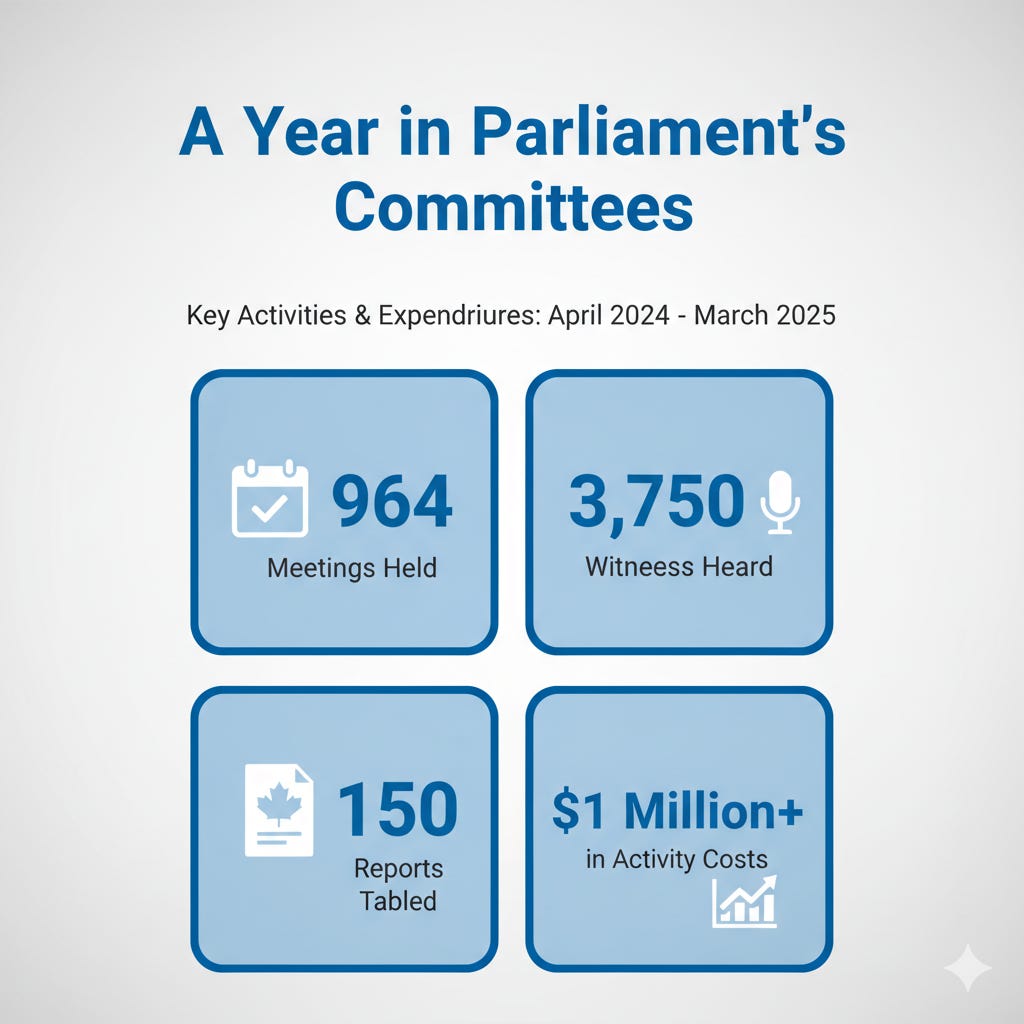
In just under a year, committees accomplished the following:
Held 964 meetings.
Heard testimony from 3,750 witnesses.
Received and analyzed 1,892 written briefs.
Presented 150 reports with recommendations to the House of Commons.
Witnesses are experts, officials, or citizens who provide testimony on a specific topic. Briefs are detailed written submissions from individuals and organizations offering evidence and recommendations. This intense pace of work shows a commitment to gathering diverse perspectives before making recommendations on laws and policies that affect all Canadians.
Following the Money: A Surprising Budget Breakdown
Committees require resources to function effectively, and for the 2024-2025 fiscal year, their activities were supported by a budget of over $1 million. The way these funds were spent offers insight into what committees prioritize.
The largest portion of expenditures was for witness expenses, accounting for 56% of the total. This category covers the costs associated with bringing experts and individuals from across the country to Ottawa to provide testimony. It ensures that Members of Parliament hear from a wide range of voices, not just those who are able to travel on their own dime.
Here is the breakdown of total committee spending:
Witness Expenses: $566,395
Working Meals: $210,424
Videoconferences: $114,587
Travel: $109,810
Hospitality: $8,192
Other: $1,376
The significant spending on working meals reflects the long hours and intense work schedules of these committees. Travel costs allowed members to conduct on-site visits and hold meetings outside of Ottawa, such as the Health Committee's travel to study the opioid crisis. Videoconferencing costs show the continued importance of virtual participation, allowing witnesses from remote locations to contribute without the expense of travel. In contrast, spending on hospitality was minimal, representing less than one percent of the total budget.
The Busiest Committees on Parliament Hill
While all committees are active, some carry a heavier workload due to the nature of their mandates. The data shows clear leaders in terms of spending, meeting frequency, and witness testimony.
The Standing Committee on Health (HESA) was the top spender, with expenditures of $122,337. A significant portion of this was for travel across four provinces to study the opioid and toxic drug crisis, demonstrating a commitment to understanding the issue from a local perspective.
The Standing Committee on Public Accounts (PACP), responsible for scrutinizing government spending, held the most meetings, convening 57 times with its subcommittee. Its work included detailed examinations of Auditor General reports on topics like the ArriveCAN application and housing in First Nations communities.
The Standing Committee on Finance (FINA) heard from the most people by far. It welcomed 387 witnesses and processed an incredible 840 written briefs. This high volume is driven by its annual pre-budget consultations, where it invites Canadians from all sectors to share their priorities for the national budget.
Tackling Canada’s Most Pressing Issues
The studies undertaken by committees reflect the most urgent and complex challenges facing the country. The list of topics provides a snapshot of the national conversation and the issues occupying the minds of policymakers.
For example, the Standing Committee on Public Safety and National Security (SECU) launched a study into the growing problem of car thefts in Canada and travelled to the Port of Montréal to see the issue firsthand. It also examined foreign interference from multiple state actors.
The Standing Committee on Government Operations and Estimates (OGGO) continued its extensive investigation into the ArriveCAN application and government contracting practices. It also studied postal service in rural and remote communities and the federal grants and contributions process.
Meanwhile, the Standing Committee on Canadian Heritage (CHPC) examined job cuts at CBC/Radio-Canada, the tactics used by tech giants to evade regulation, and the protection of freedom of expression. These studies show committees grappling with modern challenges to Canadian culture and information.
Parliament Adapts: The Permanent Role of Virtual Testimony
The pandemic changed how Parliament works, and virtual participation in committee meetings is now a permanent feature. The data shows this hybrid model is functioning well and has become an integral part of committee operations.
Even with the return to in-person meetings, a significant number of witnesses continue to appear remotely. In December 2024, 40% of all witnesses gave their testimony via videoconference. This practice saves on travel costs and allows a more diverse range of experts to participate.
The House of Commons has refined its technical processes to support this model. Nearly 90% of remote witnesses successfully complete a technical pre-test, and the vast majority now use a House of Commons-approved headset. This ensures high-quality audio, which is essential for simultaneous interpretation and allows meetings to run smoothly for all participants, whether they are in the room or joining from across the country.
Conclusion
The detailed work of parliamentary committees often happens without fanfare, yet it is a cornerstone of our democracy. The 2024-2025 report reveals a system operating with intensity, focused on accountability, and dedicated to hearing from a broad cross-section of Canadians. From scrutinizing every dollar of government spending to travelling the country to understand grassroots issues, committees perform the essential task of ensuring our government is responsive and our laws are well-considered.
The data shows a modern Parliament adapting to new realities while holding firm to its core mission of oversight and inquiry. This work, though complex, is fundamental to a healthy democracy. What national issue do you believe a parliamentary committee should investigate next?
Source:
House of Commons. (2025). Committee Activities and Expenditures April 1, 2024 – March 23, 2025: Report of the Liaison Committee. 45th Parliament, 1st Session.