


Is Canada’s government failing on implementation?
It’s easy to think of Parliament as just the theatre of Question Period. But the real, detailed work happens in standing committees, where Members of Parliament grill experts and officials to study the complex issues facing Canadians.
This week, 11 different committees met to discuss everything from cybersecurity and trade to intimate partner violence and the future of artificial intelligence. I’ve synthesized the testimony from these meetings to give you a clear, evidence-based picture of the critical challenges your elected officials are grappling with right now.
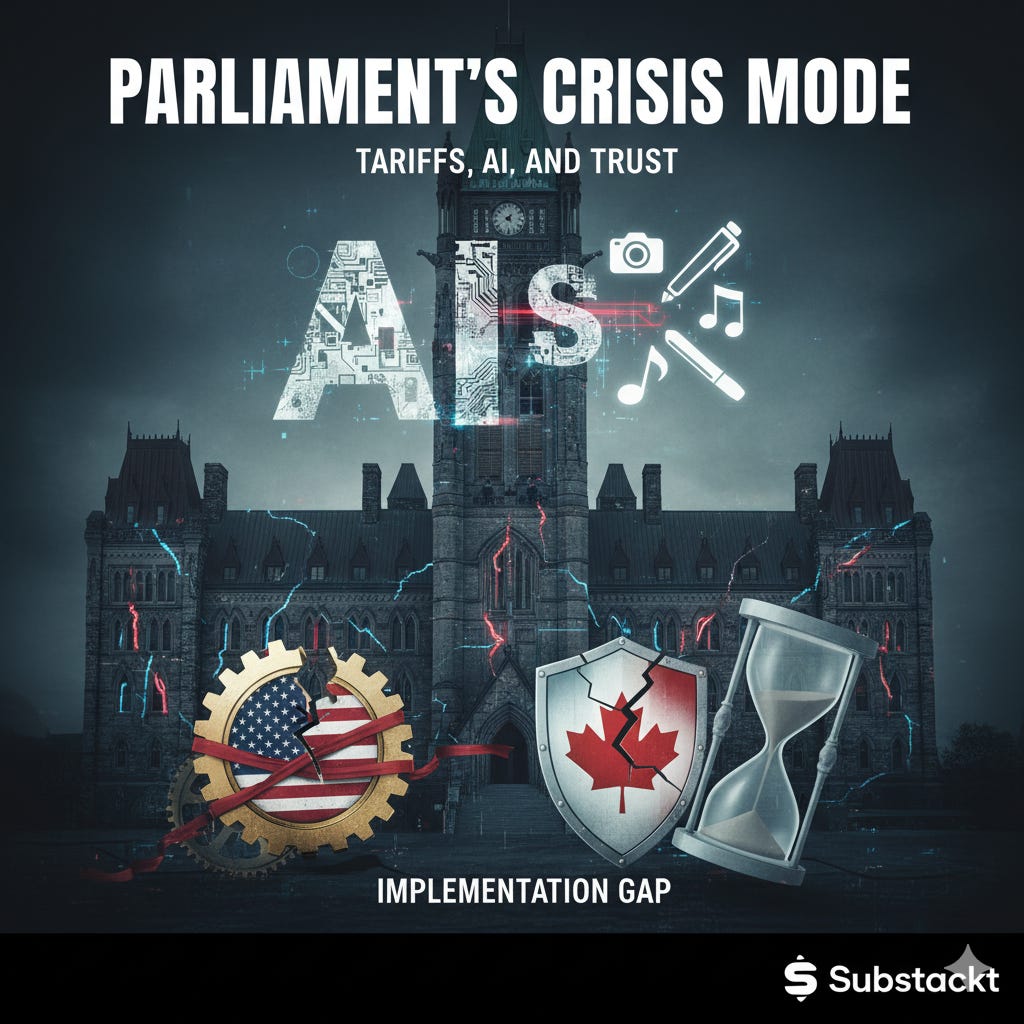
Three major themes emerged from this testimony: a deep crisis in economic competitiveness, a profound breakdown of trust in public safety institutions, and a massive, system-wide “implementation gap” where solutions exist but are never put into action.
The Competitiveness Crisis: “An Own Goal”
Across multiple committees, a single message rang clear: Canada’s economy is in a fragile state, and business leaders are deeply anxious about our ability to compete, especially with the United States.
The Auto Sector Sounds the Alarm
At the Industry committee, the message on U.S. tariffs was blunt. “There is no industry without U.S. access,” said Brian Kingston of the Canadian Vehicle Manufacturers’ Association.
Witnesses from all major auto associations (representing Ford, GM, Stellantis, Toyota, and Honda) are pleading with the federal government to repeal its own Electric Vehicle (EV) mandate. They argue the mandate is “punitive” and a “direct challenge to our competitiveness”. By levying high costs on companies that don’t meet sales targets, they say the regulation is an “own goal” that makes it harder for Canadian plants to compete with American counterparts at the worst possible time. The mandate, they warned, is “rapidly eroding” Canada’s competitiveness as a manufacturing jurisdiction.
Investment is Fleeing
This anxiety was echoed at the Natural Resources committee.
Helium: This is a critical mineral essential for semiconductors and MRIs. Witnesses warned that because helium is not treated like other critical minerals in Canada’s Income Tax Act, the sector is being “starved” of capital. While other critical minerals can be depreciated over six years, helium is treated as “goodwill,” depreciated over 40. That investment is now fleeing to the U.S..
Mining: Canada has the second-slowest approval times for new mines in the OECD. It takes 23% longer than in Australia and 38% longer than in the U.S.. As one witness put it, Canada is “one of the best places to operate a mine” but “one of the worst places to develop” one.
“We Feel Abandoned”
At the International Trade committee, the testimony was stark.
Softwood Lumber: David Hamel, a fifth-generation sawmill operator, explained his industry now faces a staggering 45% tariff on exports to the U.S.. He stated that his company is now selling at a loss, exporting only 5% of its product compared to 50% previously, and that sawmill closures have already begun. He said his sector feels “rather abandoned” by the federal government, which has been focused on steel and auto.
Small Business: 96% of manufacturers support extending CUSMA. But recent U.S. policy changes—like the removal of the de minimis rule (which allowed small-value shipments to cross the border tax-free)—are “crushing” small Canadian exporters who now face new costs and paperwork.
Why It Matters: A clear pattern has emerged. At the very moment U.S. protectionism is high, key Canadian industries feel our own domestic policies—from EV mandates to slow permitting and a perceived lack of support—are making us less competitive and driving investment south.
A Crisis of Trust in Public Safety
A second major theme was a deep breakdown of trust in the very institutions designed to keep Canadians safe.
A Peace Bond is “Just a Piece of Paper”
The most powerful testimony came at the Status of Women committee. Debbie Henderson told the story of her niece, Bailey McCourt, who was murdered by her former partner.
The tragedy is that Bailey did everything right. She reported her partner for assault and strangulation—an act experts identify as a key predictor of future homicide. He was convicted. But the system released him while he awaited sentencing. Three hours later, he found her at her workplace and murdered her.
Ms. Henderson’s message was that the system is reactive, not proactive. A peace bond, she said, is “a promise; GPS monitoring is protection”. She argued that a no-contact order is just a “piece of paper” that doesn’t actually stop a motivated abuser.
Indigenous Policing: “Set Up to Fail”
This crisis of trust is mirrored in Indigenous communities. At the Indigenous Affairs committee, Chief Leroy Denny of Eskasoni First Nation stated his community is “not happy” with the RCMP service, which has only two Mi’kmaq-speaking officers left.
He and Chief Keith Blake of Tsuut’ina Nation Police explained their communities had their own tribal police services, which were more effective and culturally aware. Chief Blake noted that independent First Nations police have “far fewer use of force incidents”.
The problem? They are “chronically underfunded”. Chief Denny said his community’s police service, which included Mi’kmaq-speaking dispatchers, was “set up to fail” by poor funding, and now they are forced to rely on an RCMP model that doesn’t work for them.
Fixing the Military and National Security
This theme of broken trust is the entire reason for two major new bills.
Bill C-11 (Military Justice): The National Defence committee is studying this bill, which permanently moves the investigation and prosecution of sexual offenses from the military to the civilian justice system. The Minister of National Defence stated the change is necessary to “enhance trust” and build confidence in the institution.
Bill C-8 (Cybersecurity): The Public Safety committee heard deep concerns from MPs about this bill, which grants the government new powers. MPs raised alarms about a lack of warrant requirements and new “secrecy provisions”. While government officials insisted the bill is about protecting critical infrastructure, not spying on Canadians, the debate showed a clear lack of trust.
Why It Matters: From partners in violent relationships to Indigenous communities and soldiers, the system is struggling. The debate in Parliament shows a deep divide: Is the solution new laws (like Bill C-8 and C-11) or is it properly funding and enforcing the systems we already have (like GPS monitoring for IPV and stable funding for Indigenous police)?
The Great Implementation Gap
Perhaps the most frustrating theme was the “implementation gap”—a pattern of good ideas and clear solutions being ignored for years until they become a crisis.
The “Spent Fowl” Fraud
The clearest example came from the Agriculture committee.
The Problem: For over a decade, Canada has faced massive fraud where importers mislabel regular broiler chicken as “spent fowl” (older, egg-laying hens) to avoid paying high tariffs. This costs Canadian farmers millions.
The Solution: A forensic DNA test that can instantly tell the difference between the two types of chicken was developed and scientifically validated by Trent University.
The Gap: That test was developed in 2014. Ten years later, the government (CFIA and CBSA) has still not implemented it. Witnesses for the Chicken Farmers of Canada testified that, despite $361 million in penalties being assessed, the rate of fraud is increasing. Imports of spent fowl now equal 115% of the entire U.S. production, a clear sign of massive fraud.
Canada Post and the CRA
This gap was visible in two other committees:
Canada Post (OGGO): The postal service is “not financially viable”. Witnesses testified that a 2016 parliamentary committee already provided the solutions (like diversifying revenue), but they were ignored. Now, municipalities are worried about post office closures and being stuck with the bill for community mailbox maintenance. The postal union (CUPW) alleges a serious conflict of interest, pointing out that Canada Post executives also sit on the board of its competitor, Purolator.
CRA Call Centres (PACP): The Auditor General (AG) delivered a damning report on the CRA’s call centres. The AG found that a key IT contract ballooned from an initial $50 million to $190 million. Worse, the AG reported that “neither Shared Services Canada nor the Canada Revenue Agency could confirm whether the invoiced levels of activity... were accurate”. In response, Shared Services Canada claimed the $190 million was the real expected cost all along, and the $50 million was just a “minimum revenue” guarantee for the vendor.
Why It Matters: These meetings show a pattern of government failing to act on known solutions, whether it’s a DNA test, a 2016 report, or an AG audit. This implementation gap leads directly to service failures, economic loss, and wasted tax dollars.
The Fight for the Future: AI vs. Creators
Finally, the Canadian Heritage committee meeting provided a perfect snapshot of Parliament’s struggle with new technology. The committee is studying the impact of Artificial Intelligence on creative industries, and the testimony revealed a deep divide.
The Creator Position: Associations for media producers and writers (CMPA and SARTEC) are terrified. They call AI training on their work “theft” and “misappropriation”. They are demanding a legal framework built on “authorization, remuneration, and transparency”.
The Tech Position: An AI agency focused on video game development argued that AI is a revolutionary new tool, not a replacement for creators. They warned that “blanket restrictions” will “constrain interactive mediums before they’re able to reach their maturity” and prevent Canadian artists from defining the next generation of entertainment.
Why It Matters: This is the debate in a nutshell: Is AI a tool for innovation or a machine for theft? How Parliament answers this question will shape the future of Canada’s entire creative economy.
These are complex, high-stakes issues that go far beyond a 30-second soundbite. What’s the one problem here you think Parliament needs to fix first?
Sources
Standing Committee on Public Safety and National Security. (2025, October 28). Evidence. 45th Parliament, 1st Session.
Standing Committee on Agriculture and Agri-Food. (2025, October 27). Evidence. 45th Parliament, 1st Session.
Standing Committee on Canadian Heritage. (2025, October 27). Evidence. 45th Parliament, 1st Session.
Standing Committee on Foreign Affairs and International Development. (2025, October 21 & 28). Evidence. 45th Parliament, 1st Session.
Standing Committee on Indigenous and Northern Affairs. (2025, October 27). Evidence. 45th Parliament, 1st Session.
Standing Committee on Industry and Technology. (2025, October 27). Evidence. 45th Parliament, 1st Session.
Standing Committee on National Defence. (2025, October 27). Evidence. 45th Parliament, 1st Session.
Standing Committee on Natural Resources. (2025, October 27). Evidence. 45th Parliament, 1st Session.
Standing Committee on the Status of Women. (2025, October 27). Evidence. 45th Parliament, 1st Session.
Standing Committee on International Trade. (2025, October 27). Evidence. 45th Parliament, 1st Session.
Standing Committee on Public Accounts. (2025, October 28). Evidence. 45th Parliament, 1st Session.
Standing Committee on Government Operations and Estimates. (2025, October 28). Evidence. 45th Parliament, 1st Session.
Standing Committee on Access to Information, Privacy and Ethics. (2025, October 27). Evidence. 45th Parliament, 1st Session.
Standing Committee on Fisheries and Oceans. (2025, October 28). Evidence. 45th Parliament, 1st Session.
Standing Committee on Human Resources, Skills and Social Development and the Status of Persons with Disabilities. (2025, October 28). Evidence. 45th Parliament, 1st Session.
Standing Committee on Health. (2025, October 28). Evidence. 45th Parliament, 1st Session.
Standing Committee on Official Languages. (2025, October 28). Evidence. 45th Parliament, 1st Session.
Wow, the massive system-wide 'implementation gap' really stood out, making me wonder how solutions exist but fail to become actual policcy.