


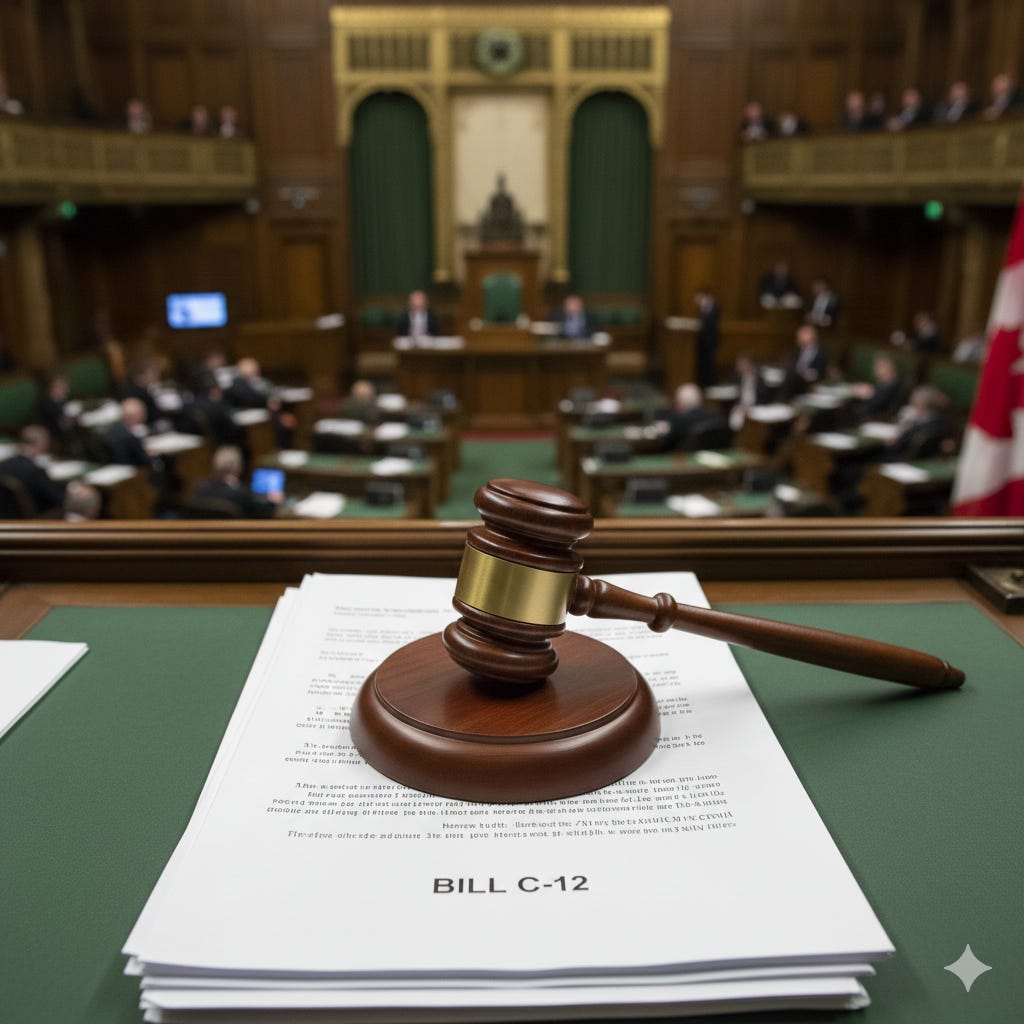
On Thursday, the House of Commons focused its attention on Bill C-12, the Strengthening Canada’s Immigration System and Borders Act. The bill is the government’s second attempt at a major security overhaul after its predecessor, Bill C-2, was widely condemned by civil liberties groups for granting sweeping surveillance powers. While the new bill is a step forward for some, it has become a flashpoint for competing visions of how Canada should manage its borders, treat refugees, and tackle crime. The debate reveals a government trying to appear tough on security, an official opposition claiming the measures don’t go far enough, and an NDP arguing the bill is a punitive attack on the vulnerable.
What is Bill C-12?
At its core, Bill C-12 is a large omnibus bill designed to amend several laws related to border security, immigration, and crime. It emerged from the ashes of Bill C-2, which the opposition successfully forced the government to abandon.
The original bill included highly contentious provisions that would have allowed Canada Post to open mail without a warrant, banned cash transactions over $10,000, and given security agencies warrantless access to Canadians’ personal information. Conservatives repeatedly took credit for forcing the Liberals to remove these “poison pills,” which the Privacy Commissioner confirmed were drafted without his consultation.
The new bill, C-12, retains measures aimed at addressing several pressing issues:
Export Security: It gives the Canada Border Services Agency (CBSA) more power to inspect goods being exported from Canada, a measure intended to crack down on the rampant export of stolen vehicles.
Fentanyl Crisis: It creates a faster process to ban the precursor chemicals used to manufacture fentanyl in Canada.
Immigration Integrity: It introduces new rules for asylum claims, including a one-year cap on filings and new procedures for handling “irregular” entries at the border.
The bill was passed on division and has now been referred to the Standing Committee on Public Safety and National Security for further study.
The Opposition’s Arguments
Conservative Stance: A Flawed Step Forward
Conservatives framed their support for sending the bill to committee as a pragmatic choice, not an endorsement. They argued that while Bill C-12 begins to address problems they have highlighted for years, it is a weak response to a crisis created by a decade of Liberal mismanagement.
Their main criticisms focused on what the bill fails to do. They pointed out that it does not include tougher bail laws for criminals who traffic in fentanyl and firearms. Kelly Block, the Conservative member for Carlton Trail-Eagle Creek, noted that while the bill bans fentanyl precursors, it ignores the criminals who manufacture and distribute the deadly drug. She argued that the government’s “catch-and-release” bail policies remain untouched, allowing violent offenders back onto the streets.
Other members raised specific failures they believe the bill overlooks. Kelly McCauley of Edmonton West highlighted the use of trafficked illegal labourers on federally funded construction projects, an issue he claims the government has ignored despite being provided with evidence.
NDP Opposition: Pandering and Punitive
In contrast, the NDP stood in firm opposition to the bill. Alexandre Boulerice, speaking for the party, argued that Bill C-12 is a shameful attempt to “pander to Donald Trump’s administration.” He claimed the bill sacrifices the fundamental rights of refugees and asylum seekers to appease the American president’s anti-migrant agenda.
The NDP’s analysis, supported by what Boulerice said are over 300 civil society organizations, is that the bill is fundamentally flawed. Key concerns include:
Arbitrary Deadlines: The bill introduces a one-year deadline for filing an asylum claim after entering Canada and a 14-day deadline for those who enter irregularly at a land border. Critics argue these deadlines are arbitrary and fail to account for the trauma and lack of legal support many migrants experience.
Increased Executive Power: The bill would allow the government to suspend or cancel immigration documents “en masse” in the name of “public interest,” a term the legislation does not define. The NDP warns this concentrates massive, arbitrary power in the hands of the executive.
Conflating Immigration and Security: Boulerice argued that by mixing immigration measures with the fight against organized crime, the bill reinforces a dangerous perception of migrants as a threat, justifying a “repressive rather than humanitarian approach.”
A Strange Debate Dynamic
A recurring theme throughout the day was the government’s apparent reluctance to defend its own legislation. Multiple opposition members, from both the Bloc Québécois and the Conservatives, pointed out the lack of Liberal speakers. “The Liberals do not rise to talk about their own piece of legislation because they do not want to talk about it,” Boulerice observed early in the day. This led to accusations that the government was disorganized or embarrassed by its own bill.
Instead of debating the bill’s merits, Liberal members in question periods and debates frequently pivoted to attacking the Conservative leader’s recent comments calling the RCMP leadership “despicable.” This strategy suggests the government is more interested in scoring political points than in engaging with substantive criticism of its legislation.
The day’s proceedings also saw the introduction of another major piece of legislation: Bill C-14, the Bail and Sentencing Reform Act. The timing is significant. As the government pushed forward its border security bill, which critics say is weak on crime, it simultaneously tabled a separate, long-awaited bill aimed directly at reforming Canada’s controversial bail system.
The Data Brief
Bill C-12 Passed Second Reading: The government’s new border security and immigration bill has been sent to committee for study. It is a revised version of the more controversial Bill C-2.
Key Provisions: The bill aims to combat stolen car exports, crack down on fentanyl precursor chemicals, and introduce new rules and deadlines for asylum claims.
Conservative Position: The bill is a weak, overdue response to problems the Liberals created. They support studying it but want tougher measures on bail for violent criminals and drug traffickers.
NDP Position: The bill is a punitive attack on refugee rights designed to appease the U.S. administration. They, along with over 300 civil society groups, oppose it.
New Bail Reform Bill: On the same day, the government introduced Bill C-14, a separate act focused on strengthening bail and sentencing laws for violent repeat offenders.
Source Documents
House of Commons of Canada. (2025, October 23). House of Commons Debates (Hansard), 152(042). 45th Parliament, 1st Session.