


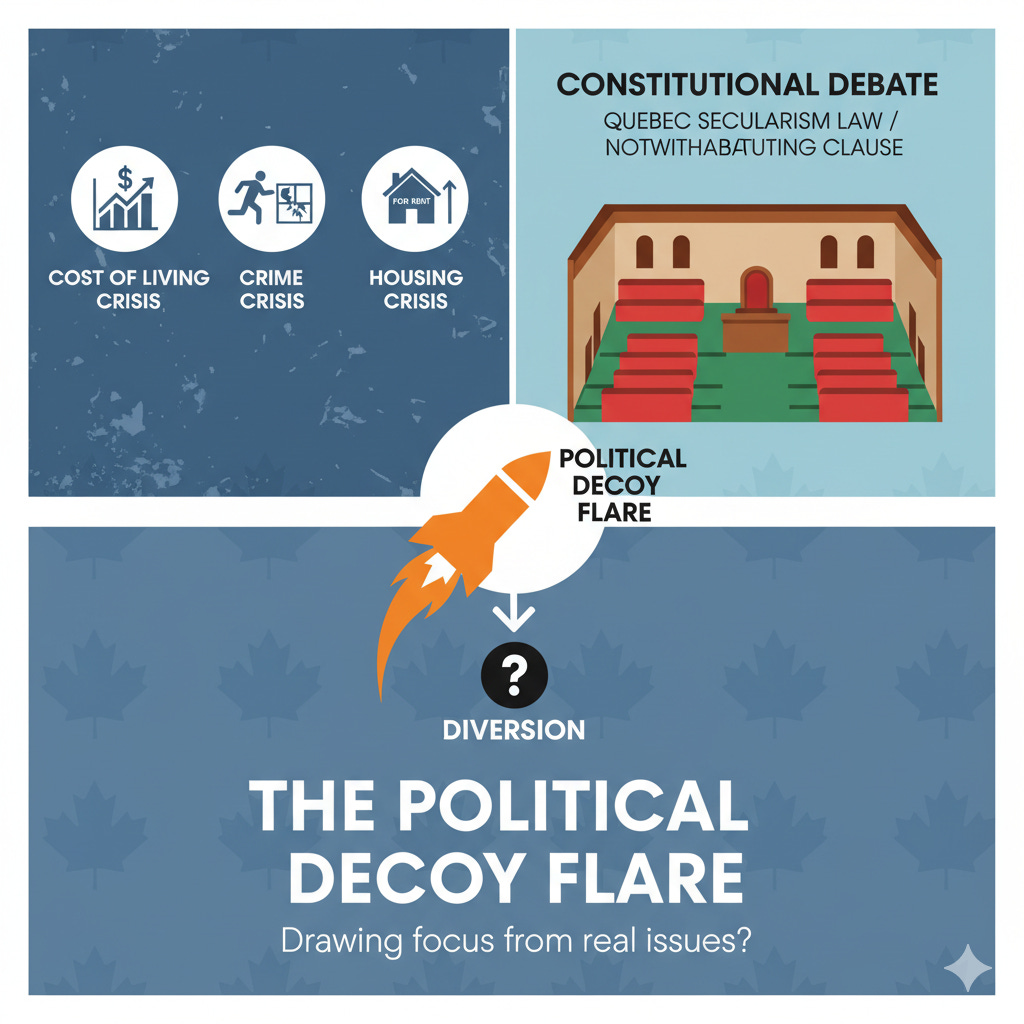
If you follow Canadian politics, you likely experience a form of civic whiplash. News alerts and social media feeds scream about a cost of living crisis, a crime crisis, and a housing crisis. Your personal experience confirms these pressures. You then turn your attention to the House of Commons, expecting to see these urgent problems debated with vigour. Instead, you find Parliament dedicating an entire opposition day to a seemingly abstract constitutional fight over Quebec’s secularism law and a legal provision known as the notwithstanding clause.
The disconnect is jarring. It feels like a deliberate diversion, a political sleight of hand designed to pull your focus from the issues hitting your wallet and your sense of security. This feeling is not an accident. It is the intended effect of a specific political strategy. Yet, a deeper look into the official record of the September 23rd, 2025, debate reveals something more significant. The day was not a distraction from the real issues. It was a raw and unfiltered demonstration of the real issues that define our country and the competing political projects attempting to shape its future.
The Political Decoy Flare
The first thing to understand about the debate is the Conservative Party’s explicit framing of it. Throughout the day, Conservative members labelled the proceedings a manufactured crisis and a distraction. This was not a subtle implication, it was their central message. Conservative member Andrew Scheer articulated this view clearly:
This is another engineered distraction on the part of the Prime Minister. He is trying to distract from his terrible record... Let me just go through a few of these crises so members can properly understand why the government is so desperate to have this debate instead of a conversation about the hardships that Canadians are facing.
This strategy introduces our central analogy for understanding these events: the Political Decoy Flare. In military tactics, a decoy flare is launched to confuse an opponent’s targeting system, drawing attention away from the real asset. The Conservative strategy was to frame the entire constitutional debate as a flare launched by the Liberal government to distract from its record. Member after member rose not to debate the motion, but to pivot to other topics. Luc Berthold, the member for Mégantic-L’Érable-Lotbinière, spent most of his speech on the cost of living and the debt crisis, stating this was a “constitutional crisis this time, to avoid talking about his results”.
This points to a critical question about modern political communication. When you label your opponent’s priority a “distraction,” you absolve yourself of the need to engage with its substance. It is a powerful tool. The Conservatives effectively told Canadians, “You are right to be confused and frustrated. This debate has nothing to do with you. Let’s talk about what really matters.” This tactic is designed to resonate with the widespread feeling that political debates are disconnected from everyday life.
The Motion at the Heart of the Matter
The Political Decoy Flare, however, successfully obscures the issue it is meant to mimic. To understand the day, you must look past the “distraction” frame and examine the actual motion put forward by the Bloc Québécois. Moved by Rhéal Éloi Fortin, the motion called on the House to do three things:
Demand the government fully withdraw from the legal challenge of Quebec’s Act respecting the laicity of the State (commonly known as Bill 21).
Demand the government withdraw its legal factum, filed September 17, 2025, which contests Quebec’s right to invoke the notwithstanding clause.
Denounce the government’s willingness to use the Supreme Court to take constitutional powers away from Quebec and the provinces.
This is not a minor procedural issue. It is a direct challenge to the federal government’s engagement in a legal battle over Quebec’s identity. Bloc members argued this intervention is an attack on the fundamental tools Quebec uses to protect its distinct character. Mr. Fortin provided the historical context, reminding the House of the clause’s contentious origins:
...the dreaded notwithstanding clause, which the government considers an atrocity...is actually the very thing that enabled the Liberal government of Pierre Elliott Trudeau to patriate the Constitution without Quebec’s consent in what was called the “night of the long knives”.
The Bloc’s argument is that the federal government’s legal challenge is not a neutral act. It is a political act intended to weaken Quebec. Christine Normandin of the Bloc argued the federal government’s factum uses extreme hypothetical examples, like a province using the clause to permit slavery or ban trade unions, to paint Quebec’s legitimate use of the clause as dangerous. She characterized the government’s legal arguments as insulting:
The Attorney General mentions places of worship to send the rather bizarre message that Quebeckers are so anti-religion that they might go so far as to ban churches, synagogues and mosques. That is practically what the Attorney General is telling us. That is the not-so-subtle subtext of this Liberal pamphlet.
This reveals a principle of federalism. The debate is a classic Canadian drama about the balance of power between the central government and the provinces, made more acute because it involves a law passed by the legislature of a national minority.
The Government’s Constitutional Tightrope
This leads to the government’s position, which is the most complex. The Conservatives are correct that the government’s official factum, as read into the record by Andrew Scheer, begins by stating the Attorney General “takes no position, on any basis whatsoever, on the constitutional validity of the provisions of the Act respecting the laicity of the State“.
So if the government is not fighting Bill 21, what is it fighting?
Liberal members argued their intervention is a principled defense of the Charter of Rights and Freedoms for all Canadians. Their argument is that the repeated, pre-emptive use of the notwithstanding clause threatens to make the Charter meaningless. Anthony Housefather, a Liberal member from Quebec, explained one of the government’s core legal arguments:
The first argument the government is making is that even if we use the notwithstanding clause, a court has the ability to declare that the law violates the charter... It is important for the residents of that province to know what their government has done.
This brings us to a fundamental principle of governance: the separation of powers. The Bloc argues this is a political matter for elected legislatures to decide. The Liberals argue it is the constitutional duty of the courts to interpret the law and its limits. The federal government is not necessarily attacking Bill 21 directly. It is using the Bill 21 case to ask the Supreme Court to place new limits on a constitutional tool it believes is being used too frequently by provincial governments, effectively rewriting the constitutional balance of power through the courts.
More Than a Distraction, It’s a Definition
The September 23rd debate was not a decoy flare designed to distract you. It was a perfect encapsulation of the three competing projects that define our national politics. The Conservative Party is running a permanent campaign, using every opportunity to focus public attention on economic pain and position itself as the sole voice addressing those concerns. The Bloc Québécois is relentlessly advancing its long-term project of Quebec sovereignty, using every constitutional friction point to demonstrate the incompatibility between Quebec’s aspirations and the Canadian federal structure. And the Liberal government is attempting to govern, which in this case means defending its interpretation of the constitutional order against challenges from the provinces. You are not witnessing a diversion from what matters, you are witnessing a raw exposure of what different political actors believe Canada is and ought to be.
Sources:
House of Commons. (2025, September 23). House of Commons Debates (Vol. 152, No. 027). 45th Parliament, 1st Session.