


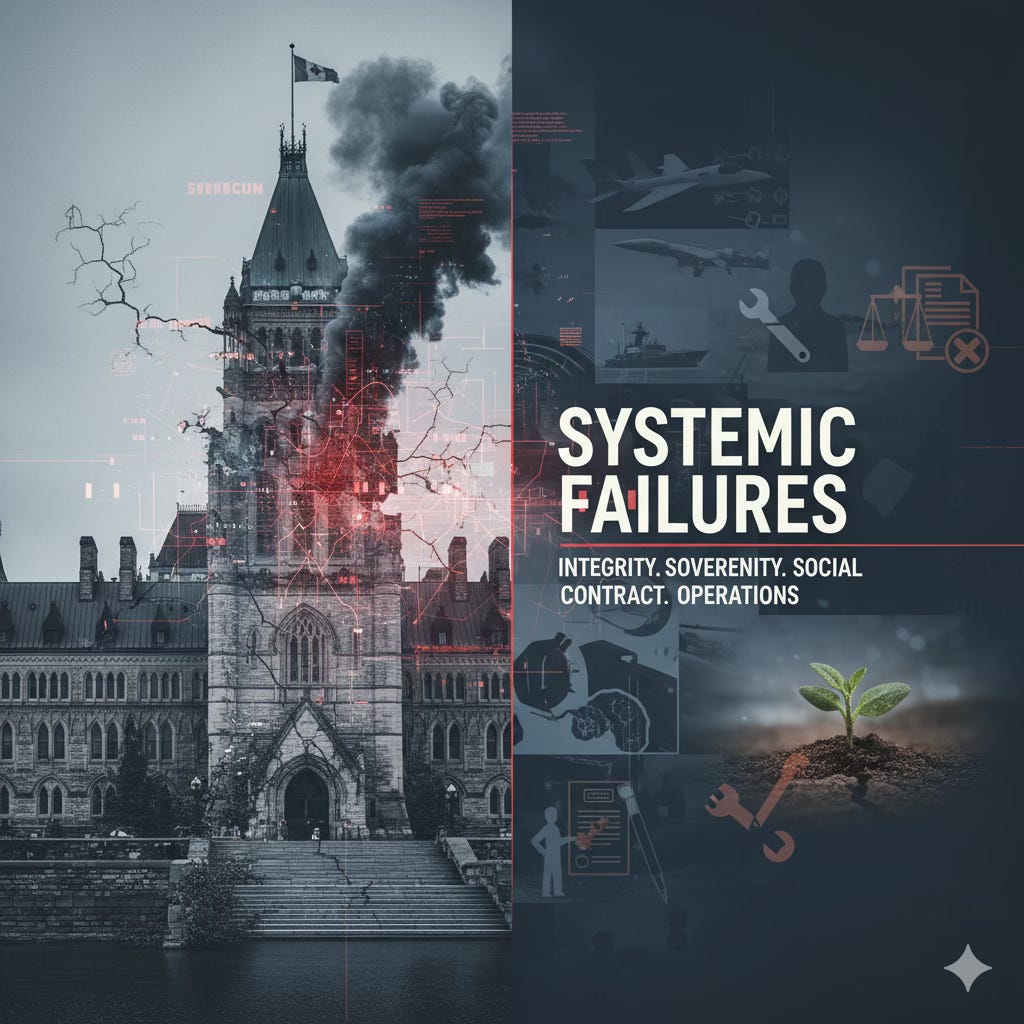
The fall sitting of Parliament is in full swing, and as standing committees resume their studies, a powerful, unifying theme is emerging from witness testimony.
Across more than a dozen different committees studying topics as diverse as Arctic sovereignty, healthcare, immigration, and trade, a narrative of systemic failure is taking shape. Witnesses, from Indigenous leaders and academics to business executives and auditors, are painting a picture of a federal apparatus under profound strain.
They describe a widening gap between Canada’s policy ambitions and its operational capacity to execute them. Whether discussing procurement, national defence, or economic productivity, the expert testimony repeatedly points to a system that is unprepared, under-resourced, or fundamentally misaligned with the problems it is meant to solve.
Today, we analyze the core findings from these committee hearings, organized into four key “gaps” identified by experts: Integrity, Sovereignty, Social Contract, and Operations.
The Integrity Gap: Procurement and Ethics
The most direct evidence of systemic breakdown came from the Auditor General (AG) and procurement experts.
‘Frequent Disregard’ for Rules
At the Public Accounts Committee (PACP), Auditor General Karen Hogan presented a damning overview of her recent audits. She described a culture of “frequent disregard” for basic procurement policies.
Her audit of McKinsey & Company contracts, which spanned 20 federal organizations, found that 10 of 28 competitive bids lacked enough information to even support selecting McKinsey as the winner. For non-competitive contracts, organizations “often issued these without documenting the required justification”.
This disregard for rules, she noted, was identical to the “many of the same weaknesses” found in the audit of GC Strategies and the ArriveCAN app.
The consequences of this poor management are not just procedural. Ms. Hogan’s audits revealed critical service failures:
Canada Revenue Agency (CRA): Call centre agents provided accurate answers to personal tax questions only 17% of the time.
Canadian Armed Forces (CAF): The CAF is failing to recruit and train enough members, falling short of its target by 4,700 recruits between 2022 and 2025. It also “did not manage living accommodations to meet... requirements,” with some members lacking “safe drinking water and working toilets”.
Indigenous Services Canada (ISC): The AG found “unsatisfactory progress” on more than half of her recommendations from the past six audits. This includes 35 long-term drinking water advisories that remain in effect, nine of which have been in place for over a decade.
Principles vs. Rules
At the Ethics Committee (ETHI), testimony suggested the problem may not just be that rules are being broken, but that the rules themselves are flawed.
Daniel Greenberg, the UK’s Parliamentary Commissioner for Standards, argued strongly for a “principles-based” ethics code over a rules-based one. He warned that overly technical definitions for things like “common-law partner” or “gift” encourage a “technical compliance mentality” rather than ethical behaviour.
He noted that rigid rules often “go wrong” and fail to capture what truly matters: apparent conflicts of interest. Mr. Greenberg’s testimony suggested that Canada’s focus on technical rules (which the AG’s report shows are being ignored anyway) may be failing to build a culture of integrity.
The Sovereignty Gap: Defence, Trade, and Digital
A second major theme was Canada’s declining ability to protect its sovereignty in a world defined by strategic competition.
An ‘Underdefended’ Arctic
At the Foreign Affairs Committee (FAAE), witnesses delivered a stark warning about the Arctic. Dr. Jessica Shadian of Arctic360 stated that while Russia and its allies modernize, Canada’s north remains “insecure and underdefended”.
Natan Obed, President of Inuit Tapiriit Kanatami (ITK), provided critical context. He noted that Inuit Nunangat, the Inuit homeland, is the “least-developed Arctic territory among the eight Arctic states”. He argued that true Arctic sovereignty is impossible without first addressing the profound infrastructure and social gaps, including the fact that Canada is the only Arctic state without a university in its Arctic territory.
‘Unprepared’ for a Trade War
This vulnerability extends to trade. At the International Trade Committee (CIIT), witnesses warned that Canada is dangerously “unprepared” for the upcoming CUSMA review.
Professor Barry Appleton explained that the U.S. never saw the deal as permanent. He cited Jared Kushner, who described CUSMA as a “16-year lease,” not a partnership, designed to give leverage to the “stronger party,” the United States.
Lana Payne, National President of Unifor, stated that Canada is in an “economic war” and must be willing to “play hardball”. A key problem, witnesses noted, is that Canada’s institutional capacity for this fight has been “dismantled.” The U.S. has 15 legislated Industry Trade Advisory Committees (ITACs) with security clearance. Canada’s equivalent, the Sectoral Advisory Groups on International Trade (SAGITs), was dissolved.
The Digital Sovereignty Fight
Vass Bednar of The Canadian SHIELD Institute argued the fight is also for “epistemic sovereignty”. She testified that CUSMA’s digital chapter, which prohibits data localization and bars access to source code, effectively prevents Canada from auditing the very algorithms that shape its markets and public sphere.
The consensus was clear: Canada is facing significant external threats but lacks the modern domestic infrastructure—military, diplomatic, and digital—to effectively respond.
The Social Contract Gap: Policing, Housing, and Students
Witnesses at several committees highlighted how uncoordinated policies are creating severe social strain, particularly for Indigenous peoples, renters, and students.
A ‘Glaring Double Standard’ in Policing
At the Indigenous and Northern Affairs Committee (INAN), witnesses described the First Nations and Inuit Policing Program (FNIPP) as a failed system. Ontario Regional Chief Abram Benedict cited a “glaring double standard” where First Nations face high crime rates with a fraction of the resources. He referenced the 2024 Auditor General’s report, which found Public Safety Canada had “poorly managed” the program and not treated First Nations as “true partners”.
Doris Bill, former chief of the Kwanlin Dün First Nation, explained that her community created its own “community safety officers” program because the mainstream system was failing them. The key demand from all witnesses was the recognition of Indigenous policing as an “essential service” and an affirmation of First Nations jurisdiction.
Colliding Crises: Students and Housing
The collision of federal immigration policy and provincial education funding has created a crisis, according to testimony at the Citizenship and Immigration (CIMM) and Finance (FINA) committees.
Dr. John Tibbits, President of Conestoga College, defended his institution’s massive growth in international students (84,000 in four years). He testified that this growth was encouraged by government to “help solve” labour shortages. He stated the federal government never asked his college to tie its requests for student permits to local housing availability or healthcare capacity.
Dr. Rob Kristofferson, representing university faculty, argued the root cause is chronic provincial underfunding, which forces institutions to use international students as “ATMs”.
Dr. Roopa Desai Trilokekar argued that the core problem is policy incoherence. She stated that international education and immigration must be “delinked”. By treating students as a solution to labour shortages, Canada has created a system that is ripe for exploitation and is straining public services.
This strain was the focus at the Finance Committee, where Housing Minister Gregor Robertson defended new measures like the first-time home buyer’s GST rebate. However, members questioned how this single measure could succeed when other federal policies—like the high intake of temporary residents—are simultaneously increasing demand.
The Operations Gap: How We Work
Finally, two committees held debates that questioned the very mechanics of Canada’s economy and its democracy.
The Productivity Paradox
The Industry Committee (INDU) heard two contradictory explanations for Canada’s poor productivity.
The ‘Private Sector is Failing’ View: Dawn Desjardins of Deloitte argued that Canada has “failed to keep up” with its peers due to a “relative lack of investment in machinery and equipment” by Canadian businesses.
The ‘Public Sector is Failing’ View: Linda Hasenfratz, Executive Chair of Linamar, offered a sharp rebuttal. She argued that Canada’s business productivity is actually growing strong, citing her own company’s 54% productivity growth over 10 years. The problem, she claimed, is that this growth is “diluted in the aggregate figure” by a bloated public sector, where GDP per worker has “not changed at all in the last 20 years”. She noted that from 2019 to 2023, government employment grew by 13.3%, while the private sector grew by only 3.6%.
The ‘Mockery’ of Democracy
At the Procedure and House Affairs Committee (PROC), witnesses raised alarms about the “Longest Ballot” initiative, which saw 214 candidates register in a single riding.
Former Chief Electoral Officer Jean-Pierre Kingsley stated this tactic is “exceedingly disruptive” and makes a “mockery” of the electoral system. Jean-François Blanchet, Quebec’s Chief Electoral Officer, agreed, testifying that it “complicate[s] the voting process” for seniors and persons with disabilities. Witnesses urged Parliament to implement simple fixes, such as requiring each candidate to have a unique official agent and unique signatories.
The Data Brief
Across all committees, the testimony points to a government at a crossroads, facing a crisis of implementation.
17%: The accuracy rate of CRA agents answering general personal tax questions, according to the Auditor General.
$209 Million: Value of McKinsey contracts reviewed by the AG, which found “frequent disregard” for procurement rules.
“Least-Developed”: How Inuit leadership describes Canada’s Arctic territory compared to other Arctic nations.
16-Year Lease: How the Trump administration’s architect for CUSMA described the trade agreement, which Canada’s “dismantled” advisory system is unprepared to renegotiate.
1 in 13: The ratio of CAF applicants who actually started basic training between 2022 and 2025, a period where recruitment fell 4,700 short of its target.
84,000: The number of international students admitted to Conestoga College in four years, a policy one witness argued must be “delinked” from immigration and labour-market goals.
214: The number of candidates in a single riding, a tactic former electoral officers called “disruptive” and a “mockery” of the system.
Source Documents
Standing Committee on Natural Resources, Evidence, No. 006, Thursday, October 9, 2025
Standing Committee on Industry and Technology, Evidence, No. 008, Monday, October 20, 2025
Standing Committee on Indigenous and Northern Affairs, Evidence, No. 005, Monday, October 20, 2025
Standing Committee on Environment and Sustainable Development, Evidence, No. 008, Monday, October 20, 2025
Standing Committee on Procedure and House Affairs, Evidence, No. 007, Tuesday, October 21, 2025
Standing Committee on Human Resources, Skills and Social Development and the Status of Persons with Disabilities, Evidence, No. 007, Tuesday, October 7, 2025
Standing Committee on Human Resources, Skills and Social Development and the Status of Persons with Disabilities, Evidence, No. 008, Thursday, October 9, 2025
Standing Committee on Access to Information, Privacy and Ethics, Evidence, No. 009, Monday, October 20, 2025
Standing Committee on International Trade, Evidence, No. 006, Thursday, October 9, 2025
Standing Committee on International Trade, Evidence, No. 007, Monday, October 20, 2025
Standing Committee on Public Accounts, Evidence, No. 009, Thursday, October 9, 2025
Standing Committee on Public Accounts, Evidence, No. 010, Tuesday, October 21, 2025
Standing Committee on Foreign Affairs and International Development, Evidence, No. 006, Thursday, October 9, 2025
Subcommittee on International Human Rights of the Standing Committee on Foreign Affairs and International Development, Evidence, No. 001, Monday, October 20, 2025
Standing Committee on Canadian Heritage, Evidence, No. 007, Monday, October 20, 2025
Standing Committee on Finance, Evidence, No. 007, Monday, October 20, 2025
Standing Committee on Finance, Evidence, No. 008, Wednesday, October 22, 2025
Standing Committee on Citizenship and Immigration, Evidence, No. 007, Thursday, October 9, 2025
Standing Committee on Agriculture and Agri-Food, Evidence, No. 007, Thursday, October 9, 2025
Standing Committee on Agriculture and Agri-Food, Evidence, No. 008, Monday, October 20, 2025
Standing Committee on Government Operations and Estimates, Evidence, No. 007, Thursday, October 9, 2025
Standing Committee on Government Operations and Estimates, Evidence, No. 009, Tuesday, October 21, 2025