


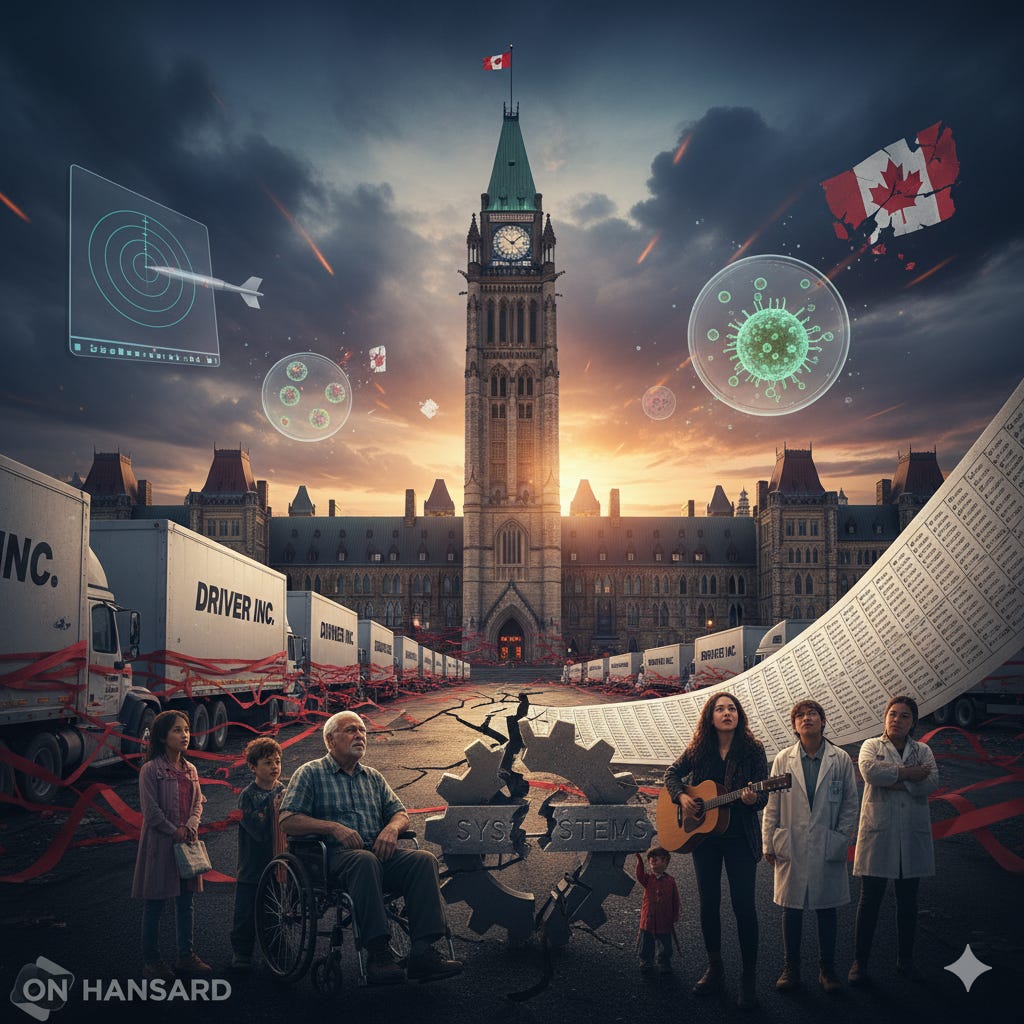
In Ottawa, parliamentary committees painted a picture of a nation under strain. Across multiple fronts, from the integrity of our elections and the security of our supply chains to our national defence and the trust in our public officials, the message was consistent. Systems designed for a different era are buckling under the pressure of new threats and bad actors exploiting old loopholes.
The testimony from experts, officials, and citizens reveals a common thread: a crisis of enforcement and a lack of urgency in adapting to a rapidly changing world. Whether it’s truckers skirting labour laws, protest groups weaponizing election rules, or foreign adversaries developing threats that bypass our defences, the core challenge remains the same. How does Canada update its rules, and its resolve, to meet the moment?
A System on Overload
Two committees this week examined how motivated groups are exploiting legal loopholes to disrupt fundamental systems: trucking and elections. In both cases, witnesses argued that the problem isn’t a lack of rules, but a failure to enforce them.
The ‘Driver Inc.’ Crisis
At the Transport Committee, trucking associations described a scheme called “Driver Inc.,” where companies misclassify employee drivers as independent contractors to avoid paying payroll taxes, overtime, and workers’ compensation. Mark Bylsma, Chair of the Ontario Trucking Association, called it “payroll fraud, tax fraud and labour fraud” that allows non-compliant carriers to undercut legitimate businesses by as much as 25% to 30%.
What does this mean in practice? It means honest, family-run trucking companies are losing contracts and going out of business because they follow the law. “If you follow the law, you lose; if you cheat, you win,” said Chris McKee of the Atlantic Provinces Trucking Association. Witnesses were united in their proposed solution: enforce existing laws. Specifically, they called on the federal government to lift the moratorium on T4A reporting to create a paper trail and provide the Canada Revenue Agency (CRA) with resources to conduct audits.
The Longest Ballot
A similar theme of systemic exploitation emerged at the Procedure and House Affairs Committee, which is studying the Longest Ballot Committee (LBC). This group runs dozens of “protest candidates” in by-elections to advocate for electoral reform. While some witnesses defended this as a legitimate, if annoying, form of protest, others presented evidence of potential illegality.
Ryan Davies of Northern Perspective testified that a whistle-blower provided internal LBC communications suggesting the group was collecting nomination signatures for candidates who hadn’t even agreed to run yet. Davies argued this violates the Canada Elections Act and that the LBC operates like an unregistered political party by running multiple candidates under a single, centrally-directed platform. The result, witnesses noted, is a system that creates significant accessibility barriers for voters with disabilities and risks eroding public trust in elections.
Threats, Seen and Unseen
From hypersonic missiles to drug-resistant superbugs, committees on National Defence and Science and Research heard that Canada is dangerously unprepared for critical threats. Experts described a decade of inaction that has left the country vulnerable.
‘We Are Blind’
At the National Defence Committee, experts delivered a stark warning about the state of North American defence. The current system, they argued, is built for a Cold War reality that no longer exists. Adversaries like China and Russia are developing advanced cruise missiles, hypersonic weapons, and hybrid threats that can strike North America.
Our ability to even see these threats is compromised. Dr. James Fergusson, a defence expert from the University of Manitoba, stated bluntly that against long-range cruise missiles in the Arctic, “We are blind. We are in the dark right now not tomorrow, but right now”. Experts urged the government to accelerate NORAD modernization and commit to participating in the American “golden dome” missile defence initiative to avoid being marginalized in the defence of our own continent.
The Silent Pandemic
Meanwhile, the Science and Research Committee heard that antimicrobial resistance (AMR) has become a “silent pandemic”. One in four infections in Canada is now resistant to first-line antibiotics, and projections suggest AMR could cause nearly 14,000 deaths annually by 2050.
Experts like Dr. Allison McGeer compared the situation to climate change, warning that we are at risk of doing “too little, too late”. The solution, they argued, isn’t just new drugs. It requires a “One Health” approach that integrates human, animal, and environmental health. This means investing in prevention through vaccines, better stewardship of existing antibiotics in both medicine and agriculture, and creating a unified surveillance system. As Dr. Simon Otto put it, “We cannot manage what we do not measure”.
A Breakdown in Trust
This week also highlighted a growing trust deficit between Canadians and their institutions. At committees on Veterans Affairs and Ethics, witnesses described systems that feel broken, opaque, and unaccountable.
‘Institutional Betrayal’
The Veterans Affairs Committee heard heartbreaking testimony from families of veterans who died by suicide. Sherri Elms, whose husband Brad served for 34 years, described a military health system that failed to diagnose his operational stress injury and a Veterans Affairs Canada (VAC) system that left her family without mental health support after his death. She, along with other witnesses, argued that when a soldier serves, their family serves too, and VAC owes them a duty of care that is currently not being met. Ashley Thompson, a serving member whose veteran husband also died by suicide, has been waiting over three years for VAC to recognize his death as service-related so her children can receive support. This sense of abandonment was described by retired captain Hélène Le Scelleur as “moral injury and institutional betrayal”.
A ‘Toothless’ Ethics Act
At the Ethics Committee, experts debated the effectiveness of the Conflict of Interest Act. Guy Giorno, former chief of staff to a prime minister and now an integrity commissioner, argued the act is “toothless”. Of its 55 rules, he said, 40 have no penalties, including the most important prohibitions against using public office to further private interests. This makes the law largely symbolic and does little to build public confidence. The debate also touched on controversial mechanisms like blind trusts and ethics screens, which critics argue create an “appearance of a conflict” and mask, rather than prevent, potential ethical breaches.
The Fight for Sovereignty
Finally, three different committees explored the fight for Canadian sovereignty in the digital age, touching on culture, language, and industrial capacity.
Artificial Intelligence vs. Creators: At the Canadian Heritage Committee, representatives from the music industry described generative AI as “Napster 2.0”. They argued that AI models are being trained by illegally scraping vast catalogues of copyrighted music without permission, credit, or compensation. They are not asking for a ban on AI, but for the enforcement of existing copyright law. “Respect for copyright does not stifle innovation,” said Jennifer Brown, CEO of SOCAN.
Minority Language Education: The Official Languages Committee heard about the precarious state of French-language education outside Quebec. Witnesses spoke of chronic underfunding, a lack of infrastructure, and a severe shortage of early childhood education spaces, with only 450 spots in B.C. for an estimated 4,000 eligible preschool-aged children. They called for stable, predictable federal funding to build a complete education continuum, from daycare to university, to prevent assimilation.
A Defence Industrial Strategy: The Industry Committee examined how to build a sovereign defence industrial base. Witnesses stressed the need to bridge the gap between Canada’s world-class university research and its industrial capacity. Robert Asselin of U15 Canada argued for a Canadian version of DARPA, the U.S. defence research agency, to translate discovery into deployable technology and use strategic public procurement to help Canadian companies scale up.
The Data Brief
Systemic Loopholes: The “Driver Inc.” scheme in trucking and the “Longest Ballot” in elections show how outdated or poorly enforced regulations are being exploited, causing significant disruption.
Critical Threats: Canada is unprepared for modern military threats and the growing crisis of antimicrobial resistance, with experts warning of a lack of urgency, investment, and coordinated strategy.
Eroding Trust: Testimony from veterans’ families and ethics experts highlights a growing disconnect and lack of accountability in key public institutions, from VAC to the federal ethics regime.
Sovereignty Under Pressure: The creative industries, minority language communities, and the defence sector are all fighting to maintain Canadian sovereignty against powerful global forces, calling for strategic investment and clear, enforceable rules.
Source Documents
Standing Committee on Veterans Affairs. (2025). Evidence, Number 006, 45th Parliament, 1st Session. House of Commons.
Standing Committee on Transport, Infrastructure and Communities. (2025). Evidence, Number 010, 45th Parliament, 1st Session. House of Commons.
Standing Committee on Official Languages. (2025). Evidence, Number 004, 45th Parliament, 1st Session. House of Commons.
Standing Committee on National Defence. (2025). Evidence, Number 007, 45th Parliament, 1st Session. House of Commons.
Standing Committee on Access to Information, Privacy and Ethics. (2025). Evidence, Number 008, 45th Parliament, 1st Session. House of Commons.
Standing Committee on Science and Research. (2025). Evidence, Number 008, 45th Parliament, 1st Session. House of Commons.
Standing Committee on Industry and Technology. (2025). Evidence, Number 007, 45th Parliament, 1st Session. House of Commons.
Standing Committee on Procedure and House Affairs. (2025). Evidence, Number 006, 45th Parliament, 1st Session. House of Commons.
Standing Committee on Public Safety and National Security. (2025). Evidence, Number 006, 45th Parliament, 1st Session. House of Commons.
Standing Committee on Canadian Heritage. (2025). Evidence, Number 006, 45th Parliament, 1st Session. House of Commons.