


The fall session is well underway, and the procedural games have officially begun. One committee spent most of a meeting filibustering its own motion, only to have it amended and passed unanimously moments later. This points to the kind of political theatre that often obscures the real work happening in Parliament.
Estimated reading time: 6 minutes
HOUSE BUSINESS
Finance Committee Stalls, Then Studies Tax Havens
Driving the news: The Standing Committee on Finance spent most of its September 22 meeting in a prolonged debate over a motion demanding the Minister of Finance appear by September 24, only to later pass a separate, comprehensive motion to study Bill C-4 and the use of offshore tax havens.
Catch-up: The initial motion, moved by Bloc Québécois MP Jean-Denis Garon, sought to compel the minister to appear on short notice to clarify the government’s budget cycle. Liberal members argued the timeline was unreasonable, citing the minister’s schedule and international duties, and attempted to amend the motion by removing the date.
The Big Picture: This procedural back-and-forth, which MP Garon noted involved Liberal members filibustering their own amendment for nearly half an hour, ended when the amendment failed. A subsequent amendment changing the minister’s appearance date to “no later than October 6” passed unanimously, resolving the impasse.
Why it matters: The episode reveals the tactical maneuvering that can dominate committee business. While the initial debate appeared to be a partisan stalemate, it quickly pivoted once a compromise was found. The committee then passed a substantive motion from Conservative MP Jasraj Hallan to begin a study of Bill C-4, an act to make life more affordable, and to launch a six-meeting investigation into offshore tax havens, which the Conference Board of Canada estimates cost the federal government between $8.9 billion and $47.8 billion annually.
What’s next: The committee will concurrently study Bill C-4, hearing from three ministers, and begin its investigation into tax havens, calling on officials from the Department of Finance, the Canada Revenue Agency, and the Parliamentary Budget Officer.
GOVERNANCE
Military Justice Reform Bill Sparks Debate Over Past Failures
Driving the news: The House of Commons began its second reading debate on Bill C-11, the Military Justice System Modernization Act, on October 6.
Catch-up: The bill aims to reform the military justice system by transferring jurisdiction over Criminal Code sexual offences committed in Canada from the Canadian Armed Forces (CAF) to civilian authorities. This measure directly responds to Recommendation 5 of the 2022 Arbour report, which investigated sexual misconduct in the military.
The Big Picture: The legislation also strengthens the independence of key military justice officials, such as the director of military prosecutions and the provost marshal, by making them Governor in Council appointees with fixed terms, separating them from the direct chain of command.
Why it matters: The debate quickly became a flashpoint for accusations of past government inaction. Conservative members argued that the Liberal government cannot be trusted, citing the decade-long delay since the 2015 Deschamps report made similar recommendations and pointing to the cover-up of the Jonathan Vance scandal by the Prime Minister’s Office and then-Defence Minister Harjit Sajjan. The government contends the bill is a critical step, fulfilling the only Arbour recommendation that requires legislative change, and is part of a broader effort that has already seen 36 of 48 recommendations implemented. Here’s the detail I find most revealing: despite the partisan accusations, all parties, including the Conservatives and Bloc Québécois, have signalled they will support the bill’s passage to committee for further study.
RESEARCH
Merit vs. Mandate: Committee Clashes Over EDI in Science Funding
Driving the news: The Standing Committee on Science and Research heard sharply conflicting testimony on September 22 regarding the impact of Equity, Diversity, and Inclusion (EDI) criteria on federal research funding.
Catch-up: Federal granting councils now require researchers to submit EDI plans with their applications. Critics argue this politicizes science, while proponents say it ensures research is more rigorous and relevant to Canada’s diverse population.
The Big Picture: Several witnesses, including professors Geoff Horsman and Patanjali Kambhampati, argued that EDI requirements compel “political speech,” force researchers to lie to get funding, and substitute social engineering for merit. Professor Kambhampati’s application was rejected purely on EDI grounds before its scientific merit was even reviewed. Conversely, professors Wendy Cukier and Mahadeo Sukhai argued that an EDI lens is essential for research excellence, preventing biased outcomes like car safety systems designed only for male bodies or public health strategies that fail to reach racialized communities.
Why it matters: This debate highlights a fundamental tension over the purpose of public research funding. Is its sole mission to fund the “best” science based on traditional metrics, or should it also pursue social goals? Professor Christopher Dummitt presented survey data showing 88% of Canadian professors identify as left-leaning, with only 7.6% voting Conservative, arguing the most significant diversity problem in academia, viewpoint diversity, is being ignored. The core question this leaves you with is whether current EDI policies are a necessary corrective for systemic bias or an ideological filter that compromises scientific integrity.
ON THE DOCKET
Productivity Crisis: William Robson, CEO of the C.D. Howe Institute, told the Industry committee that Canadian business investment in machinery and equipment has fallen to just 32 cents for every dollar invested by U.S. businesses, warning of a “productivity emergency”.
Online News Act: The CRTC informed the Industry committee that since the implementation of the Online News Act (Bill C-18), approximately $100 million is now flowing into the news system, although some local outlets have seen their audiences “disappear overnight” after Meta withdrew its services.
Trade Diversification: Officials told the Agriculture committee that despite ongoing tariff disputes, Canada has successfully increased its non-U.S. exports by 50% between 2018 and 2024, achieving its 2025 goal a year early.
Internal Trade Barriers: Witnesses at the Agriculture committee highlighted that it remains easier for many companies to export to the U.S. than to trade between Canadian provinces, calling for infrastructure investment to strengthen interprovincial supply chains.
IN THEIR OWN WORDS
Professor Patanjali Kambhampati on the purpose of scientific funding
“Science is not a social program; it is humanity’s greatest engine of progress.”
Why it matters: This quote, delivered to the Standing Committee on Science and Research on September 22, captures the core argument of critics of current EDI policies in federal research. Professor Kambhampati, a scientist at McGill University, contends that the goal of science funding should be to enable discovery and innovation by rewarding merit, not to achieve social engineering or “identity-based rewards”. His perspective frames the debate not as being for or against diversity, but as a fundamental disagreement over whether the primary mission of science is to advance knowledge or to correct societal inequities.
ALSO NOTEWORTHY
The House of Commons voted to defeat a Conservative motion to fast-track Bill C-242, the “Jail not Bail” act.
Liberal members on the Finance Committee spent over an hour conducting pre-budget consultations during a meeting on September 22, hearing from over 940 briefing submissions.
The CRTC reports that prices for cellphone services in Canada fell by 16.7% between 2023 and 2024.
The Standing Committee on Finance approved the appearance of the Governor of the Bank of Canada on November 5 to discuss his annual monetary policy report.
The Canadian Pork Council told MPs that a 25% tariff from China is eroding processor margins by an average of $8.80 per hog, amounting to nearly $177 million in annual losses.
The Canadian government has created an Indo-Pacific Agriculture and Agri-Food Office in Manila to help exporters navigate complex markets in the region.
The Prime Minister is scheduled to meet with the U.S. President in Washington to discuss ongoing trade disputes and tariffs.
The review of the Canada-United States-Mexico Agreement (CUSMA) is scheduled for 2026.
Bill C-11 would allow non-commissioned members of the CAF to become military judges for the first time.
THE DATA BRIEF
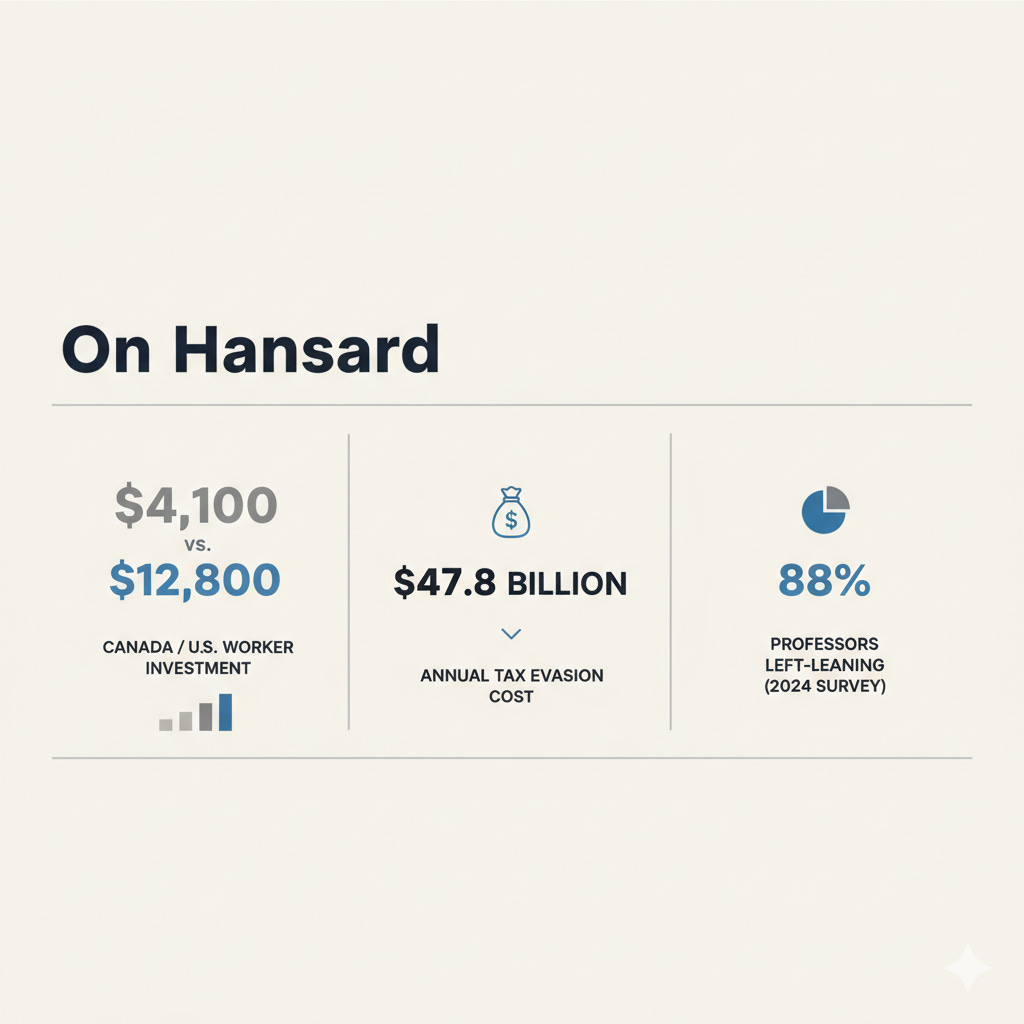
$4,100: The annual rate of investment in machinery and equipment per Canadian worker in Q2 2025, compared to nearly $12,800 in the U.S.
$47.8 Billion: The high-end estimate of what tax evasion and avoidance costs the Canadian federal government each year, according to the Conference Board of Canada.
88%: The percentage of Canadian university professors who self-identify as being on the political left, according to a 2024 survey.
-43%: The drop in the price of yellow peas since China imposed a 100% retaliatory tariff, resulting in an estimated net loss at the farm gate of $637 million.
$100 Billion: The value of Canada’s agri-food and seafood exports in 2024, with more than half of all agricultural production being exported.
Sources:
Standing Committee on Finance, Evidence, No. 003, 45th Parliament, 1st Session (Sept. 22, 2025).
Standing Committee on Industry and Technology, Evidence, No. 004, 45th Parliament, 1st Session (Sept. 24, 2025).
Standing Committee on International Trade, Evidence, No. 003, 45th Parliament, 1st Session (Sept. 22, 2025).
Standing Committee on Science and Research, Evidence, No. 004, 45th Parliament, 1st Session (Sept. 22, 2025).
Standing Committee on Agriculture and Agri-Food, Evidence, No. 003, 45th Parliament, 1st Session (Sept. 22, 2025).
House of Commons Debates, Official Report (Hansard), Vol. 152, No. 034, 45th Parliament, 1st Session (Oct. 6, 2025).