


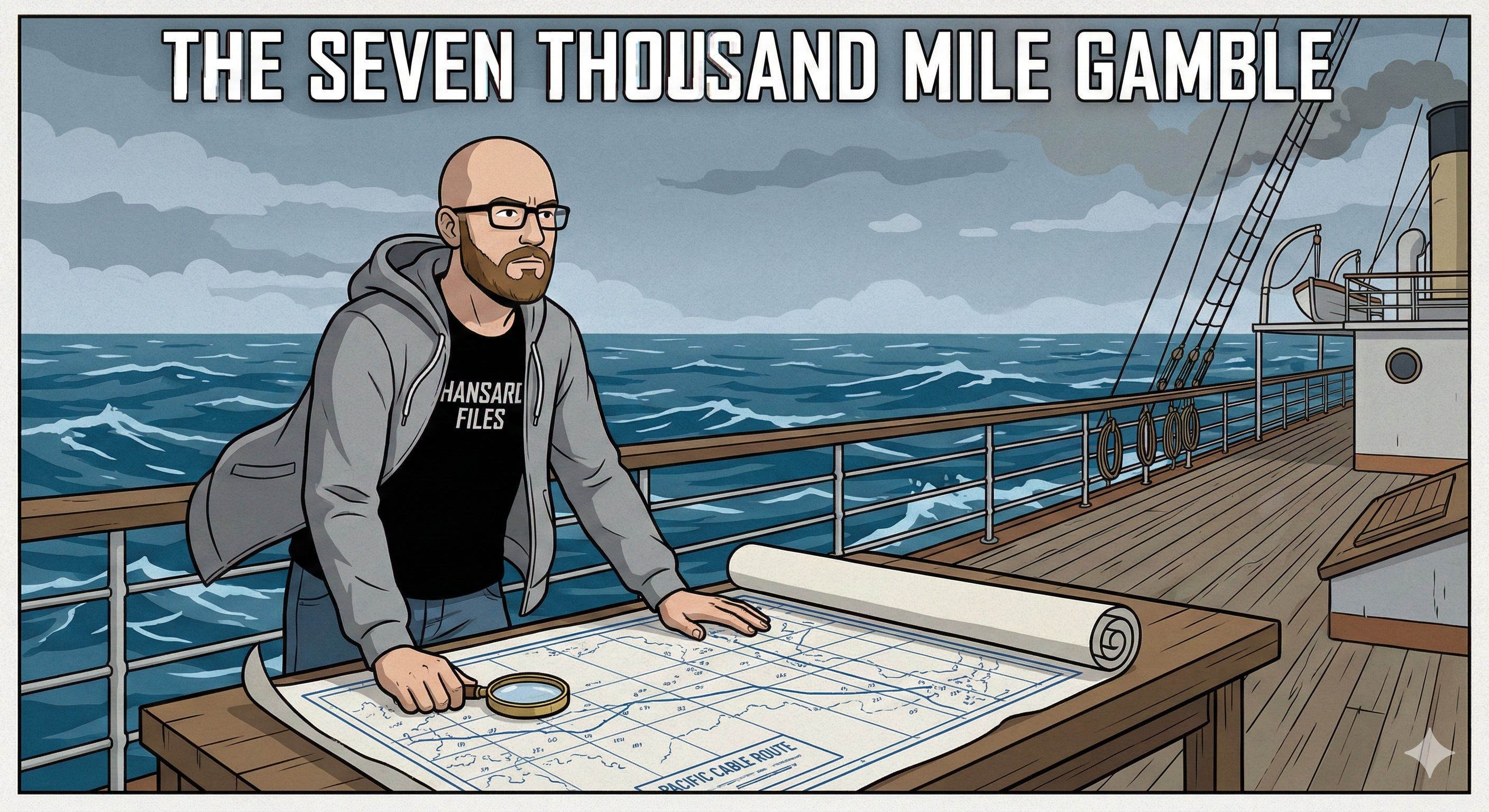
On the morning of September 24, 1893, the steamship Warrimoo cut its engines and drifted into the harbour of Honolulu. On the bridge, or perhaps leaning against the rail, stood Mackenzie Bowell, Canada’s Minister of Trade and Commerce. He was 69 years old, a Orangeman with a beard like a breaking wave, and he was nominally on a trade mission to sell Canadian timber and salmon to the Australian colonies.
But in his briefcase were the blueprints for a different kind of commerce: the “Pacific Cable.”
For decades, the British Empire had been the undisputed master of the world’s oceans, yet its communication network contained a fatal, structural vulnerability. To send a message from London to Australia, the signal had to travel through the Mediterranean, down the Red Sea, and across the Indian Ocean—a route cluttered with foreign landing stations and shallow waters where a French or Russian cutter could grapple and sever the line in an afternoon.
Bowell, accompanied by the legendary Canadian Pacific Railway engineer Sandford Fleming, had come to inspect the potential landing sites for an “All-Red Line”—a telegraph cable that would touch only British soil, spanning the terrifying 7,000-mile void between Vancouver and Australia.
As the Warrimoo’s anchor chain rattled down, Bowell looked out at a paradise that had already been lost.
The Hawaiian Poison Pill
Bowell’s report on his arrival in Honolulu reads less like a trade manifest and more like a geopolitical autopsy. He had expected to find a neutral kingdom, perhaps a friendly coaling station for the proposed cable. Instead, he found a nation in the final throes of digestion by the United States.
Only months before, the Hawaiian monarchy had been overthrown by a coup d’état led by American sugar planters. A “Provisional Government,” headed by Sanford Dole, now ruled the islands. Bowell noted the atmosphere of suspended animation; the islands were waiting for the inevitable annexation by Washington.
But the true revelation—and the death knell for any hope of landing a British cable in Hawaii—lay in the fine print of a document Bowell meticulously transcribed in his report: the Reciprocity Treaty of 1875.
On the surface, it was a trade deal. It allowed Hawaiian sugar to enter the United States duty-free. In exchange, the U.S. flooded Hawaii with manufactured goods, controlling a staggering 71.16% of the islands’ imports compared to Britain’s meager 16%. But buried in Article 4 was a clause that acted as a poison pill for any other nation with Pacific ambitions:
“It is agreed... that, so long as this treaty shall remain in force, he [the King] will not lease or otherwise dispose of or create any lien upon any port, harbour, or other territory in his domains, or grant any special privileges... to any other power.”
The trap was shut. If Canada landed a cable in Honolulu, they would be placing the Empire’s strategic nervous system within the legal and physical grasp of a foreign power. Bowell realized immediately that the map had to be redrawn. The cable could not hop comfortably from island to island. It would have to bypass Hawaii entirely, necessitating a single, unbroken leap from Vancouver to Fanning Island—a span of ocean so vast and so deep that many experts declared it physically impossible.
The Corporate Blockade
If the Americans controlled the geography, a British monopoly controlled the bureaucracy.
The villain of Bowell’s narrative, lurking in the appendices and correspondence of the 1894 report, is Sir John Pender. Pender was the chairman of the Eastern Extension Telegraph Company, the conglomerate that owned the existing lines to Australia via India. His monopoly was absolute, and his rates were predatory. A single word telegraphed from London to Sydney cost over 9 shillings—a price so high it strangled commerce and left the colonies culturally isolated.
Pender viewed the proposed Pacific Cable not as an engineering marvel, but as a theft of his dividends. A state-owned cable, run for the public good rather than private profit, threatened to destroy his business model.
Bowell and Fleming found that Pender’s reach extended into the highest levels of the British Admiralty. When Fleming had previously requested a survey of the Pacific ocean floor to prove the route was viable, the Admiralty—parroting Pender’s arguments—refused.
The refusal, signed by Evan MacGregor of the Admiralty in May 1887, was a masterpiece of obstruction. It stated that “unless the Secretary of State has reason to believe that a submarine cable is likely to be laid... their Lordships would not propose to despatch a surveying vessel.”
It was a Catch-22: the cable couldn’t be financed without a survey, and the Admiralty wouldn’t survey without the cable being financed. The Royal Navy, the supposed protector of trade, was effectively blockading the project to protect a private monopoly.
Fleming fought back with memoranda that crackled with indignation. He argued that the logic of private enterprise was fundamentally incompatible with imperial security. “The policy of companies is to obtain from the public as large profits as possible,” Fleming wrote, “while that of Governments is to accommodate and benefit the public.” He calculated that a state-owned line could lower the rate to 2 shillings a word and still cover its interest payments.
The Australian Patchwork
Leaving the American-controlled waters of Hawaii, the Warrimoo steamed south to Australia, where Bowell faced a different kind of chaos. In 1893, “Australia” was a geographical expression, not a political reality. The continent was divided into rival colonies—New South Wales, Victoria, Queensland—each manning its borders with what Bowell diplomatically termed “intercolonial discrimination.”
To get the cable built, Bowell had to convince these squabbling governments to unite in a joint financial venture with Canada. It was a diplomatic high-wire act.
In Sydney, he found the colony of New South Wales paralyzed by the “hostile tariffs” of its neighbors. In Brisbane, he found the Queensland government flirting with a dangerous alternative: a French cable. Queensland had already agreed to subsidize a line to New Caledonia, a French penal colony. Bowell and Fleming were horrified. They warned the Queenslanders that a cable touching French soil was useless in wartime.
“It is not the case,” Fleming argued, countering the naive belief that cables were neutral under international law. He cited the Paris Convention of 1884, proving that belligerents had every right to cut cables that touched their territory. A line through New Caledonia would be the first casualty of a European war.
Bowell’s pitch to the colonial premiers was a mix of imperial patriotism and hard-nosed commerce. He spoke to the Chambers of Commerce in Sydney and Melbourne, dazzling them with the prospect of Canadian timber, which they lacked, and the opening of a market for their wool and fruit in British Columbia. He used the cable as the bait to lure them into a broader trade alliance, arguing that the “All-Red Line” was the necessary spine for a new trans-Pacific economy.
The Engineer’s Vindication
While Bowell managed the politics, Fleming dismantled the technical objections. Critics, fueled by Pender’s disinformation, claimed the Pacific was too deep, that the pressure would crush the cable, or that the coral reefs of the uncharted islands would sever it.
Fleming, the man who had pushed a railway through the Canadian Rockies, was undeterred. He produced calculations showing that a heavy copper core, protected by new gutta-percha insulation, could span the Vancouver-Fanning distance. He estimated the cost at £1,800,000 —a fraction of what Pender’s monopoly claimed it would cost.
He framed the project not just as a wire, but as the completion of a global circuit. Canada had already built the railway and the telegraph across North America. The Pacific Cable was the final arc. “If we are to build up a great British commercial union,” Fleming told the colonial delegates, “the first essential step is to bring every British community... into direct telegraphic connection.”
The Ottawa Conference
The culmination of the mission was not a signed contract, but a summons. Bowell returned to Ottawa and convinced the Canadian government to host a “Colonial Conference” in 1894. It was a radical move: the colonies meeting on their own terms, on their own soil, to plan their own infrastructure.
The report Bowell submitted in March 1894 became the foundational text for this conference. It laid bare the American threat in Hawaii, exposed the Admiralty’s obstruction, and provided the financial blueprint for the state-owned cable.
It took another eight years of fighting against Pender’s successors and the inertia of London, but in 1902, the Pacific Cable was finally completed. The first message circled the globe on the “All-Red Line,” safe from American spies and French cutters.
Mackenzie Bowell’s mission is often forgotten, overshadowed by the railway that preceded it and the wars that followed. But his 1893 voyage on the Warrimoo was a pivot point in history. It was the moment Canada stepped out of the role of a passive colony and acted as a global power, diagnosing a strategic threat that London was too complacent to see, and engineering a solution that wired the modern world.
The Hansard Files explores the archives to find the forgotten origins of our connected world. Subscribe to uncover the history they didn’t teach you.
Source Documents
Bowell, M. (1894). Report on the Mission to Australia. S.E. Dawson, Printer to the Queen’s Most Excellent Majesty.
Excellent article! Forward thinking in 1894!
Fascinating history I suspect that you had Mr. Maroun and the Ambassador bridge in mind as you wrote. So many parallels!