


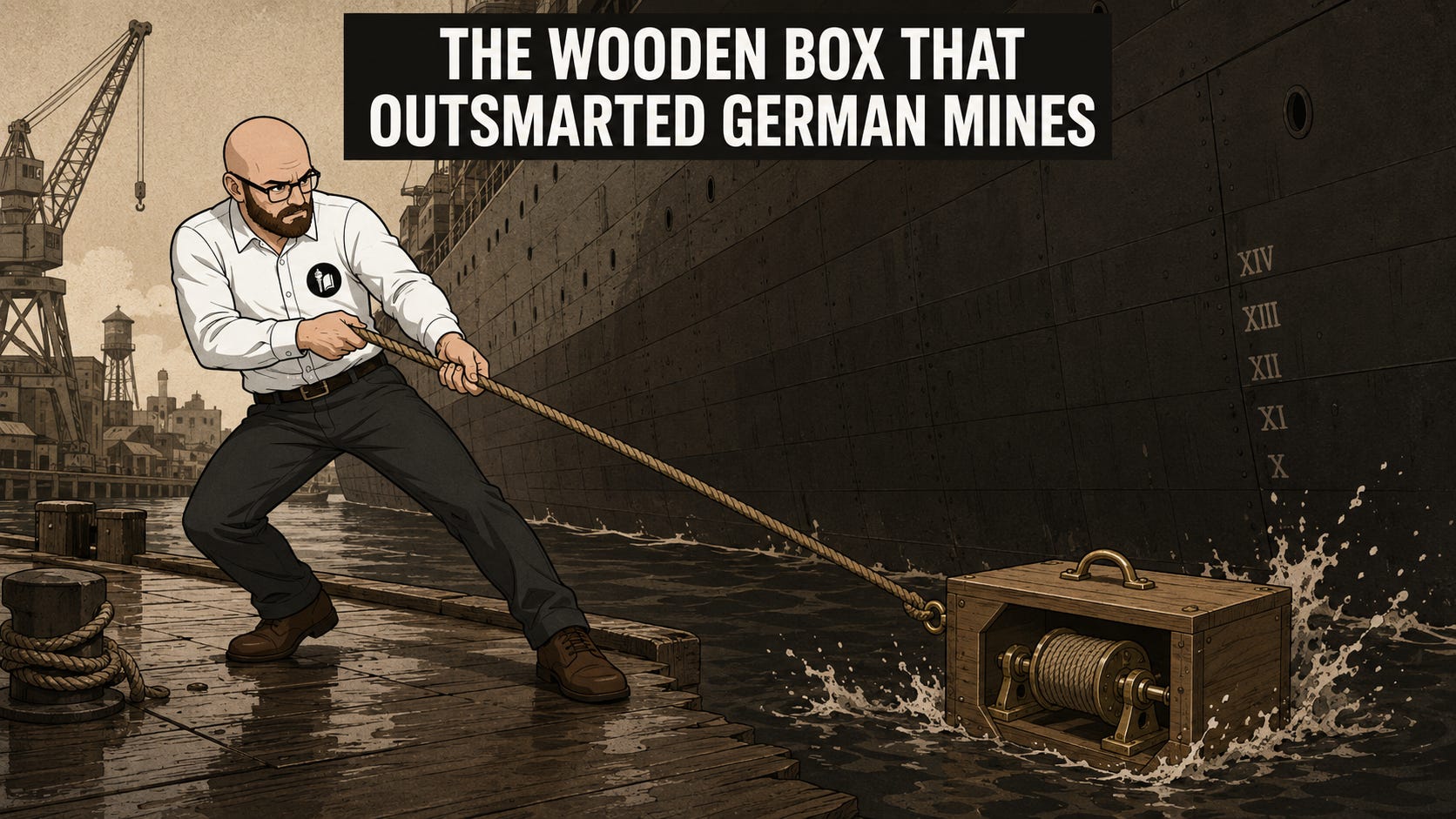
In the freezing waters of Halifax Harbour, an experiment was underway beneath the ship’s hull. The Battle of the Atlantic was escalating, and the Royal Canadian Navy faced German magnetic mines. Ships needed to be “degaussed,” fitted with electrical coils that neutralized their magnetic fields. But the Navy had no instruments to tell whether the coils worked.
Two Dalhousie University physics professors, J.H.L. Johnstone and G.H. Henderson, built their own detector: a rotating coil inside a watertight wooden box. They “keelhauled” the box under Fleur de Lys, dragging it back and forth to map the ship’s magnetic signature.
It worked. The ship was successfully degaussed, the first of many protected by Canadian science.
The experiment also marked the beginning of Operational Research in Canada. The discipline would move from Halifax Harbour to the high seas, using mathematics and physics against German U-boats.
The Physics of Survival
Operational Research did not begin in Canada as a formal military doctrine. It began with a practical problem.
In the early years of the Second World War, the RCN expanded rapidly, often using converted civilian vessels and inexperienced crews. The German Kriegsmarine was deploying magnetic mines and advanced U-boats that threatened the supply line between North America and Britain.
After the degaussing experiments, the National Research Council formalized its arrangement with Dalhousie University. By mid-1942, the scientific staff in Halifax had grown to thirty, mostly young physicists and engineers fresh from Canadian universities.
Their work soon extended beyond defensive coils. The team studied magnetic minesweeping, ship calibration and “noisemakers” designed to distract acoustic torpedoes.
In July 1943, Johnstone became the RCN’s first Director of Operational Research. His task was to apply scientific analysis to naval warfare.
The Mathematics of the Hunt
The RCN’s main wartime objective was convoy protection. Operational Research gave the Navy a way to test tactics against the evidence.
One of the directorate’s first major reports examined 49 anti-submarine hunts conducted by RCN ships in 1942. By studying those engagements, the scientists assessed which tactics worked best for finding and destroying submerged submarines.
They studied how weather affected North Atlantic convoys, how well radar screens worked and where middle-ocean escorts should be placed to protect merchant ships.
The scientists calculated the probability of a kill under different attack patterns. They assessed new weapons such as the Squid mortar and efforts to stabilize Hedgehog anti-submarine projectors. They also analyzed the factors that shaped success in anti-U-boat operations from 1940 to 1944.
The figures became doctrine.
Countering the Acoustic Torpedo
When Germany introduced a torpedo that followed the noise of a ship’s propellers, the RCN needed a countermeasure. The Operational Research team worked with the Naval Research Establishment in Dartmouth, Nova Scotia, to develop one.
The scientists worked closely with operational staff. A liaison officer at the Admiralty in the United Kingdom sent intelligence about German technology back to Ottawa and Halifax.
When the war ended, the team helped interrogate prisoners from the surrendered U-889 and conducted a technical examination of the submarine.
It also studied threats that never fully materialized. The German Type XXI U-boat, with its high underwater speed, posed what the scientists called a “grave threat.” They began developing countermeasures before Germany could deploy the submarine in significant numbers.
The Cold War Transition
The wartime organization did not survive the return to peace.
In October 1945, the RCN disbanded its operational research unit. Most of its scientists returned to universities coping with an influx of veterans.
In his final report, Johnstone wrote, “Even in peacetime one or more operational research scientists would be found very useful to the Navy”.
The military took two years to agree. The Defence Research Board was created in 1947 to coordinate defence research. A dedicated scientist, Dr. J.A.H. Duffie, was assigned to the Navy in 1949.
The postwar Navy brought different questions. Scientists evaluated anti-submarine weapons by studying hit probabilities and the lethality of systems such as the Mark 32 and Mark 35 torpedoes. They compared 3-inch and 4-inch guns, helicopters and hydrofoils, and studied the threat that mines posed to Canadian ports.
By the 1950s, the Operational Research Group had become a permanent part of the Navy. Scientists such as E.L. Leese and P.B. Wilson brought experience from the British Admiralty. They attended naval staff meetings, examined weapons procurement plans and tested decisions against evidence.
It began with a rotating coil sealed inside a wooden box and dragged beneath a ship in Halifax Harbour.
From there, Operational Research became part of how the Royal Canadian Navy went to war.
If you enjoyed this deep dive into the archives, subscribe to Hansard Files. We read the thousands of pages of history so you don’t have to, unearthing the forgotten stories that shaped our world.
Source Documents
Mayne, J.W. (1974, March). History of Operational Research in the Royal Canadian Navy (DRAE Report No. 41). Defence Research Analysis Establishment.
Interesting article, Mike. Thanks!