


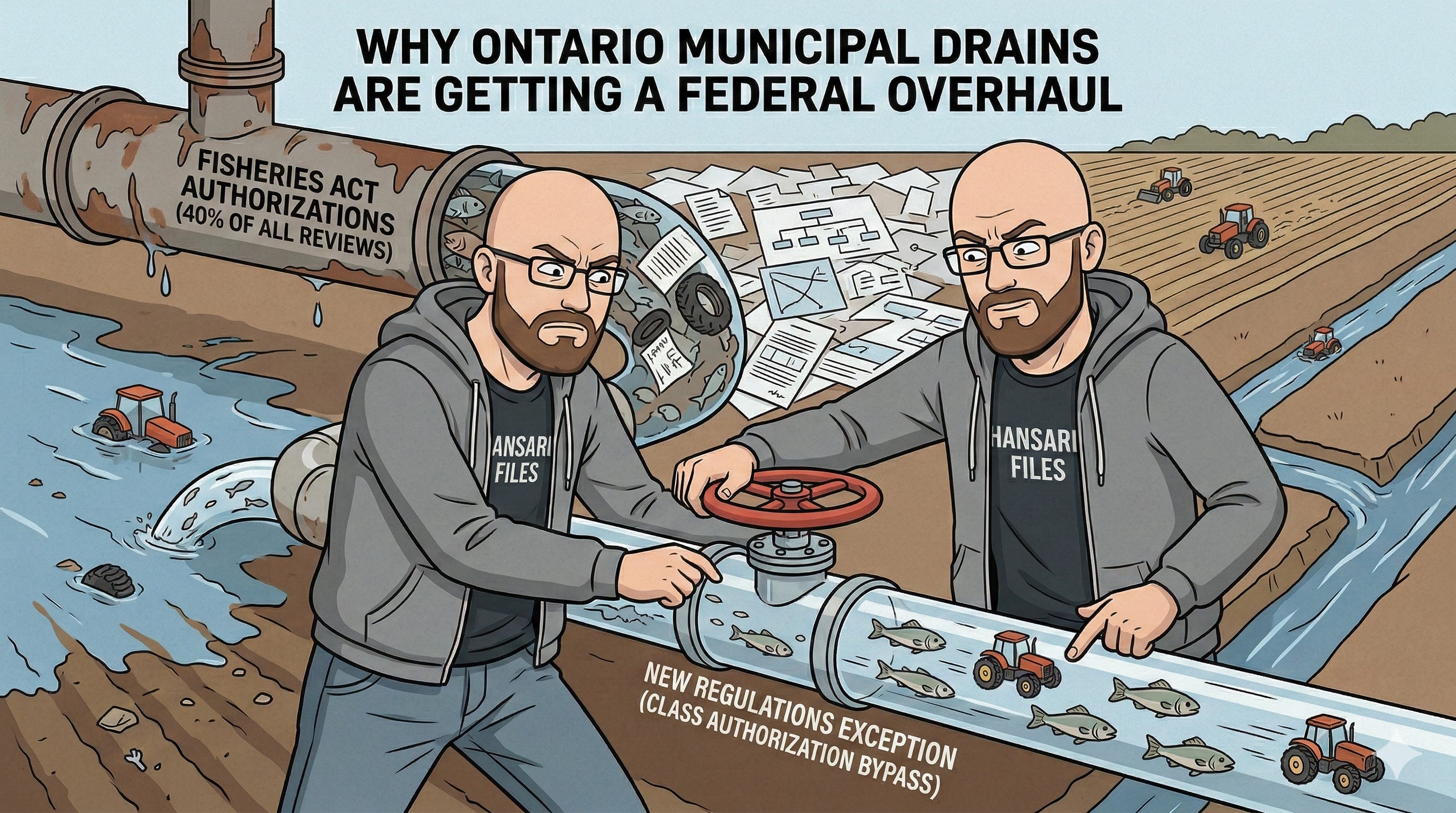
Beneath the quiet, frost-thawed fields of rural Canada, an invisible war of jurisdiction has been raging for decades. Here, the lifeblood of agricultural productivity flows through Ontario municipal drains. These constructed or altered natural watercourses were originally established by municipal by-laws pursuant to the Ontario Drainage Act. Their primary function is strictly utilitarian. They are designed to remove excess water from agricultural and nearby lands to improve crop productivity and control seasonal flooding. However, nature rarely respects municipal zoning. Over time, these agricultural arteries have become vital, living ecosystems that provide habitat for numerous species of fish.
For years, the friction between routine agricultural maintenance and federal environmental protection has created a staggering bureaucratic bottleneck. Every time a municipality needed to clear out a choked waterway, they collided with the Fisheries Act. Now, the federal government is intervening. Through the newly published Maintenance and Repair of Ontario Municipal Drains Regulations, Ottawa is attempting to broker a permanent peace between the tractors and the trout.
The Bureaucratic Bottleneck
The legal stakes in drain maintenance are remarkably high. The federal Fisheries Act strictly prohibits any activities that result in the death of fish, governed under subsection 34.4(1), or the harmful alteration, disruption, or destruction of fish habitat, governed under subsection 35(1). Unless a formal exception is granted under the Act, a municipality clearing sediment from a local ditch could technically be committing a federal environmental offense.
In the year 2000, Fisheries and Oceans Canada (DFO) sought to simplify this legal minefield. They created a class authorization process to streamline the review and approval of repair and maintenance activities in classified drains across the province. While well-intentioned, this system slowly transformed into an administrative quagmire. Approximately 130 of these class authorizations are issued every single year. Remarkably, routine drain maintenance in Ontario represents roughly forty percent of all ministerial authorizations issued across the entire country under the fish and fish habitat protection provisions of the Fisheries Act.
For each of these routine maintenance projects, federal staff have been required to manually review the application, obtain internal approvals for authorization, and physically input the data into a federal database. While this was less burdensome than a full project-specific review, it still required considerable effort and introduced potential delays for municipalities trying to keep their fields from flooding.
The new regulations seek to eliminate this bottleneck entirely. By invoking paragraphs 34.4(2)(a) and 35(2)(a) of the Fisheries Act, the federal government is creating a blanket exception for this prescribed class of routine works. Project-specific reviews will no longer be required, provided that the municipal proponents comply meticulously with the conditions prescribed in the new law.
Classifying the Arteries of Ontario Agriculture
Not all ditches are created equal. To manage the environmental risks, the federal government relies on a rigorous classification system for Ontario municipal drains. This framework evaluates drains based on their water flow, the specific species of fish present, habitat sensitivity, fish spawning times, the permanency of the flow, and the presence of critical or exceptional fish habitat.
The new regulations apply exclusively to routine cleanouts in three specific classes of drains where the ecological impacts are well understood. Cleanouts in any other unlisted classes of drains will continue to be subjected to the old, project-specific approval processes.
For Class C drain segments, the regulatory leash is the loosest. These specific waterways contain no species that are sensitive to drain cleanouts. Consequently, drainage superintendents are permitted to perform full bottom cleanouts to remove accumulated sediment and aquatic vegetation directly from the bottom of the drain channel. They are also authorized to remove riparian vegetation along one or both bank slopes, combined with the brushing of the top of the banks.
The rules tighten considerably for Class E1 drain segments. These environments harbor sensitive species that explicitly require a gravel substrate and healthy riparian vegetation to survive. While bottom cleanouts are permitted, the removal of riparian vegetation is strictly confined to one bank slope. Furthermore, workers must retain the riparian vegetation on the specific bank slope that provides crucial shade to the drain segment whenever possible. Most importantly, it is strictly prohibited to remove gravel substrates from the bottom of the drain channel during any work on a Class E1 segment.
For Class E2 drains, the stakes reach their peak. These highly sensitive environments contain species that require an intricate balance of gravel substrate, riparian vegetation, and active in-stream vegetation. To preserve this fragile in-stream flora, the federal rules mandate that only one half of the aquatic vegetation may be removed during a cleanout. To achieve this, municipalities must perform a staged bottom cleanout. Under this highly controlled method, the altered and unaltered sections of the drain must be of exactly equal length, they must alternate along the length of the drain segment, and no single cleared section can exceed one kilometer in length. Furthermore, once a staged bottom cleanout is completed on a Class E2 segment, the municipality is legally prohibited from carrying out any further cleanout of that specific segment for a full calendar year.
The Strict Rules of Engagement
While the federal government is stepping back from manual approvals, they are replacing the old system with a rigorous, legally enforceable notification protocol. The responsibility now falls squarely on the shoulders of the municipal drainage superintendents.
Ten days before a single piece of heavy machinery pierces the soil, the municipality must formally notify the federal Minister. This pre-project notice is a comprehensive dossier. It must contain the name, address, and telephone number of the municipal Drainage Superintendent overseeing the project. It requires precise geographical coordinates, explicitly demanding the latitude and longitude of every location where work will occur. The notification must state the exact name of the drain and the classification of each segment being altered.
Crucially, the superintendent must submit date-stamped photographs along with the pre-project notice. These images must be taken in completely ice-free and snow-free conditions, capturing sections of the work zone that clearly demonstrate why the proposed maintenance is necessary.
The bureaucratic oversight does not end when the digging stops. Within sixty days of the project’s completion, a mandatory post-project notice must be filed with the Minister. This final documentation must describe exactly what was completed, detailing any deviations from the original pre-project notice alongside a formal rationale for those changes. The municipality must also submit a new set of date-stamped, snow-free photographs taken from the exact same vantage points as the initial submission, visually proving that the work was completed according to federal standards. If a municipality files a pre-project notice but fails to complete the work within two years, the entire authorization expires, and a completely new pre-project notice must be submitted.
Seasonal Sanctuaries and Erosion Control
Timing is a critical vulnerability in the lifecycle of aquatic ecosystems. To protect vulnerable fish populations during their spawning seasons, the federal government has mapped out strict geographic and temporal boundaries across the province. A complete blackout on all municipal drain maintenance is legally enforced based on geographic zoning determined by the Regulations Plans of Fisheries Management Zones.
For all provincial waters located north of Zone 15, absolutely no maintenance work, undertaking, or activity may be carried out during the period beginning on April 1 and ending on July 15 of each year. For the waterways situated entirely within or south of Zone 15, the prohibited period is even more expansive, legally freezing all maintenance operations from March 15 through to July 15.
When the seasonal blackouts finally lift and work commences, municipalities must adhere to aggressive site management protocols to prevent ecological degradation. The law requires the formal development and implementation of a comprehensive sediment and erosion control plan for every project. All sediment and erosion control measures and structures must remain securely in place until all potential sediment sources are permanently stabilized.
The regulations take a hard line on contamination. Any excavated material pulled from the drains must be disposed of and fully stabilized above the ordinary high water mark, ensuring that muddy, sediment-heavy runoff does not bleed back into the active watercourse. Furthermore, the legislation explicitly mandates the creation of safe harbors for the fish. Municipalities must physically install at least two refugia pools for every single kilometer of drain cleanout. These deep-water havens provide essential refuge for fish during periods of exceptionally low flow.
Once a site is fully secured, all non-biodegradable erosion control measures must be physically removed from the environment. Finally, the exposed soils on the top and slopes of the drain banks must be actively revegetated using deep-rooted native plant species, securing the earth and restoring the natural balance.
A Quiet Consensus
The path to this regulatory overhaul was paved with extensive quiet diplomacy. Throughout 2022, the Department of Fisheries and Oceans engaged in targeted consultations to test the waters for this new framework. Fifty-five key stakeholders participated in these sessions, including representatives from various Ontario municipalities, the Ontario Conservation Authorities responsible for provincial flood protection, and the Ontario Ministry of Agriculture, Food and Agribusiness. The Ministry of Agriculture was a critical voice at the table, as they bear the ultimate responsibility for the Ontario Drainage Act and manage the public distribution of drain maps through the provincial open data website known as GeoHub.
The consultations revealed a rare moment of bureaucratic consensus. Given that the new regulations replicate the functionality of the existing class authorization process with minimal changes to municipal operations, there was widespread general support for the initiative. Separate engagements with Indigenous Peoples confirmed a complete lack of opposition, and no concerns regarding potential impacts on Indigenous rights were identified. An official assessment of modern treaty implications concluded that the regulations were highly unlikely to impact the rights or self-government provisions of modern treaty partners, primarily because the municipal drains in question are restricted to the southern half of Ontario, an area where no modern treaties are currently in effect.
An independent Climate, Nature and Economy Lens analysis further supported the regulatory shift, concluding that the new framework would yield no negative impacts on the broader economy or natural environment. This aligns seamlessly with a cited 2017 scientific study which determined that fish assemblages in agricultural drains are remarkably resilient to habitat changes caused by routine drain maintenance, and any negative ecological shifts are inherently short-lived.
By trading manual federal approvals for strict, automated legal standards, Ottawa is betting that farmers can keep their fields dry without destroying the hidden ecosystems thriving just below the surface. Set to come into force on April 30, 2026, the Maintenance and Repair of Ontario Municipal Drains Regulations represent a rare victory for regulatory efficiency, proving that sometimes the best way to protect the environment is to simply get the paperwork out of the way.
At Hansard Files, we read the fine print so you do not have to. Uncovering the hidden regulatory shifts that reshape Canadian life takes relentless digging. Subscribe today to support independent investigative journalism and never miss a deep dive.
Source Documents
Canada Gazette. (2026, February 28). Canada Gazette Part I, Vol. 160, No. 9.
My goodness, how things have changed. Contrast this heavy handed version of environmental protection to the gubbermint who contemplated creating a canal to allow ships to pass from the Northumberland Strait to the Bay of Fundy per your previous article.