


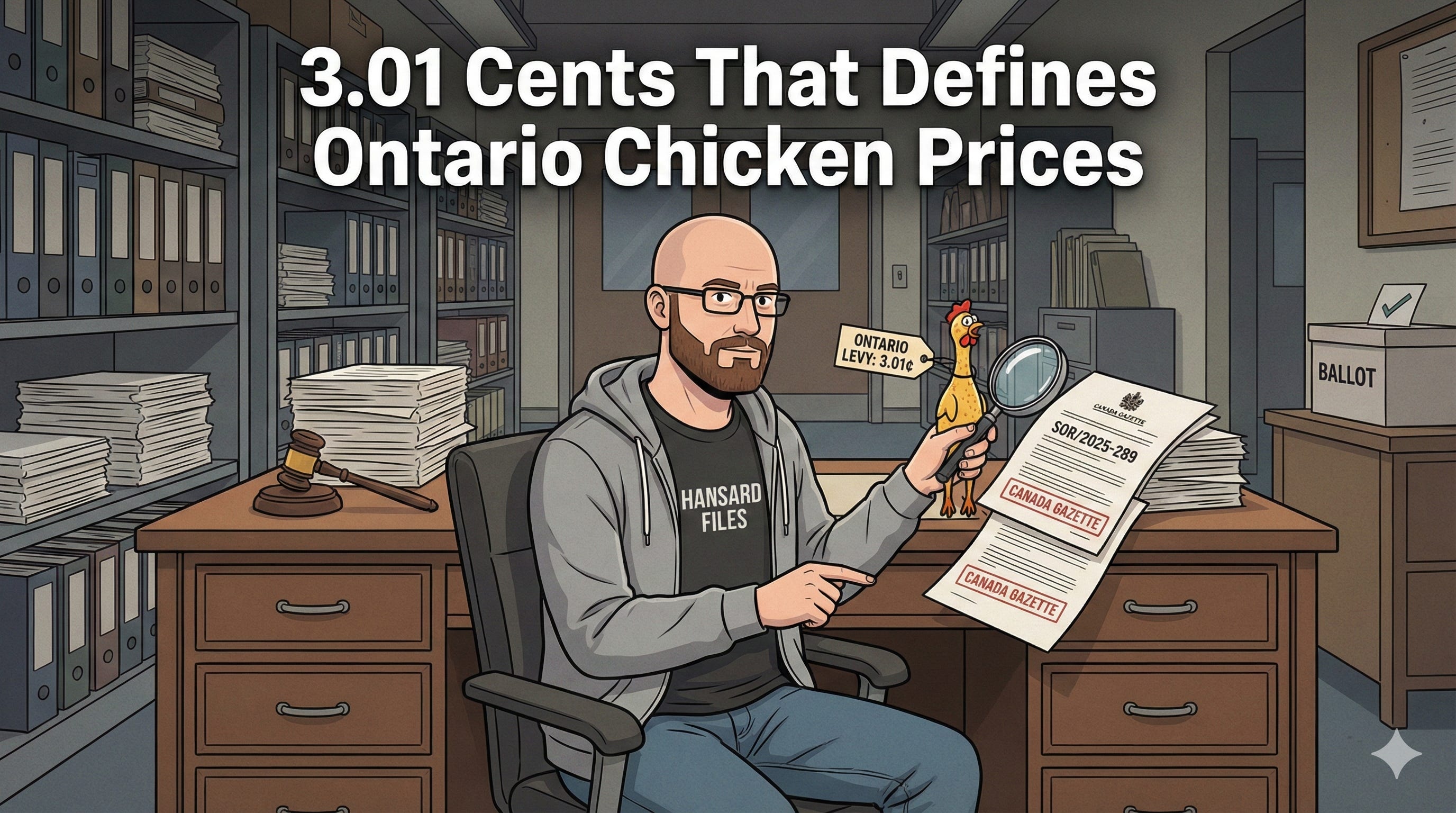
The machinery of the Canadian state often operates in silence. It moves not through televised debates or scandalous headlines but through the quiet, rhythmic release of statutory instruments. On Wednesday, January 14, 2026, the Canada Gazette released Part II of its 160th volume. Buried within the technical indexes and standard bureaucratic notices was a specific directive that alters the financial landscape for agricultural producers in the nation’s most populous province. This directive, registered as SOR/2025-289, specifically targets the Ontario chicken marketing levy, a critical component of the supply management system that governs how poultry moves from the farm to the grocery store.
The document itself is a study in administrative precision. It represents the final step in a long chain of command that begins with the Farm Products Agencies Act and ends with the specific amount a farmer must pay per unit of product. While the rest of the country was winding down for the holiday season in late 2025, the regulatory apparatus was finalizing the numbers that would define the first quarter of the new year. The order outlines a precise financial adjustment: the levy rate for producers in the province of Ontario is now set at exactly 3.01 cents.
This figure is not arbitrary. It is the result of a negotiated balance between the Chicken Farmers of Canada (CFC) and the oversight bodies that regulate them. The text reveals that the order applies specifically to producers engaged in the marketing of chicken in interprovincial or export trade. It is a reminder that in the world of Canadian agriculture, even the movement of a single commodity across a provincial border requires federal authorization and financial compliance.
The December Protocol
The timeline reveals the relentless nature of regulatory governance. The order was not drafted in the new year but was finalized in the waning days of 2025. On December 22, just days before Christmas, the Chicken Farmers of Canada formally made the annexed order. They acted under the authority granted by the Chicken Farmers of Canada Proclamation, utilizing specific paragraphs of the Farm Products Agencies Act. This action was not unilateral. It required the satisfaction of the National Farm Products Council, which had to review the proposal and verify that the levy was necessary for the implementation of the marketing plan.
One week later, on December 29, 2025, the order was officially registered. This date is significant. It marks the moment the regulation transitioned from a proposal to a legal reality, assigned the registration number SOR/2025-289. The bureaucratic process continued through the holiday lull, ensuring that the legal framework would be in place before the mid-January publication date. The text notes that the Governor in Council had previously established the CFC, empowering them to implement these marketing plans. This highlights the deep legal roots of the levy system, tracing authority back to the highest levels of the executive branch.
The Canada Gazette serves as the official record, but the legal force of the document often predates the ink on the page. According to the “Coming into Force” section of the order, the new levy rate became effective on January 11, 2026. This creates a retroactive window between the legal activation of the levy and its public dissemination in the Gazette on January 14. For the producers on the ground, the financial reality shifted three days before the public notice was distributed.
The Economics of Three Cents
The heart of the regulation is found in the amendment to the Canadian Chicken Marketing Levies Order. The text dictates that Paragraph 3(1)(a) is replaced entirely. The new language is stark and devoid of ambiguity: “in the province of Ontario, 3.01 cents.” This replaces the previous rate, adjusting the cost of business for every kilogram of chicken marketed within the specified trade corridors.
The explanatory note accompanying the order clarifies the scope. The amendment is designed to set the levy rate specifically for Ontario producers. It links the payment directly to the marketing of chicken in interprovincial and export trade. This distinction is crucial. It separates local, intra-provincial commerce from the federally regulated movements that trigger the involvement of national agencies. The levy is the fuel that powers the Chicken Farmers of Canada, allowing the agency to maintain the marketing plan that stabilizes supply and prices across the country.
This small fraction of a dollar—3.01 cents—multiplied across millions of kilograms of product represents a significant capital flow. It funds the inspections, the marketing campaigns, and the administrative oversight that defines the Canadian poultry industry. The precision of the number suggests a calculation based on rigorous forecasting and budgetary requirements for the 2026 fiscal year.
The Regulatory Ecosystem
The publication of this order also sheds light on the broader ecosystem of Canadian statutory instruments. The Canada Gazette is published under the authority of the Statutory Instruments Act. It is the permanent record of the rules that bind citizens and corporations. The document explains that while the electronic versions are free, the official record remains a pillar of government transparency.
The involvement of the National Farm Products Council acts as a check on the power of the commodity agencies. The text explicitly states that the Council approved the proposed order only after being satisfied that it was “necessary for the implementation of the marketing plan.” This phrase is the legal key. A levy cannot be raised simply for revenue; it must be tied to the operational necessities of the marketing scheme authorized by the Proclamation.
As the order settles into the archives of 2026, it stands as a testament to the complexity of modern food production. The chicken on a dinner plate in Montreal or Vancouver, originating from an Ontario farm, carries with it the invisible cost of that 3.01 cents. It is a cost ratified by councils, signed by agencies, and printed in the official ledger of the state, ensuring that the system continues to function with predictable, regulated precision.
Source Documents
Chicken Farmers of Canada. (2026, January 14). Order Amending the Canadian Chicken Marketing Levies Order (SOR/2025-289). Canada Gazette, Part II, Vol. 160, No. 1.