


A Mother’s Fifth Appearance
Carol Todd has lost count of how many committee rooms she has sat in. She knows the number is five.
“I have probably met some of you in other standing committees that I’ve spoken to, and each time I say, ‘Please create action,’ and we’re not creating action,” she told the House of Commons Standing Committee on Canadian Heritage. “We’re creating words.”
Her daughter Amanda Todd died by suicide after enduring online exploitation and relentless bullying that began on a screen. Todd, founder of the Amanda Todd Legacy Society, described herself to the committee as “a mother who buried her child because of what began on a screen,” speaking not only for her own loss but for other parents whose children “are no longer with us” and others “working through their trauma.”
She was one of 33 witnesses who appeared before the committee between November 2025 and February 2026, part of a study that produced a report tabled in June 2026: The Effects of Influencers and Social Media Content on Children and Adolescents. Thirteen recommendations came out of it. None of them carry the force of law yet.
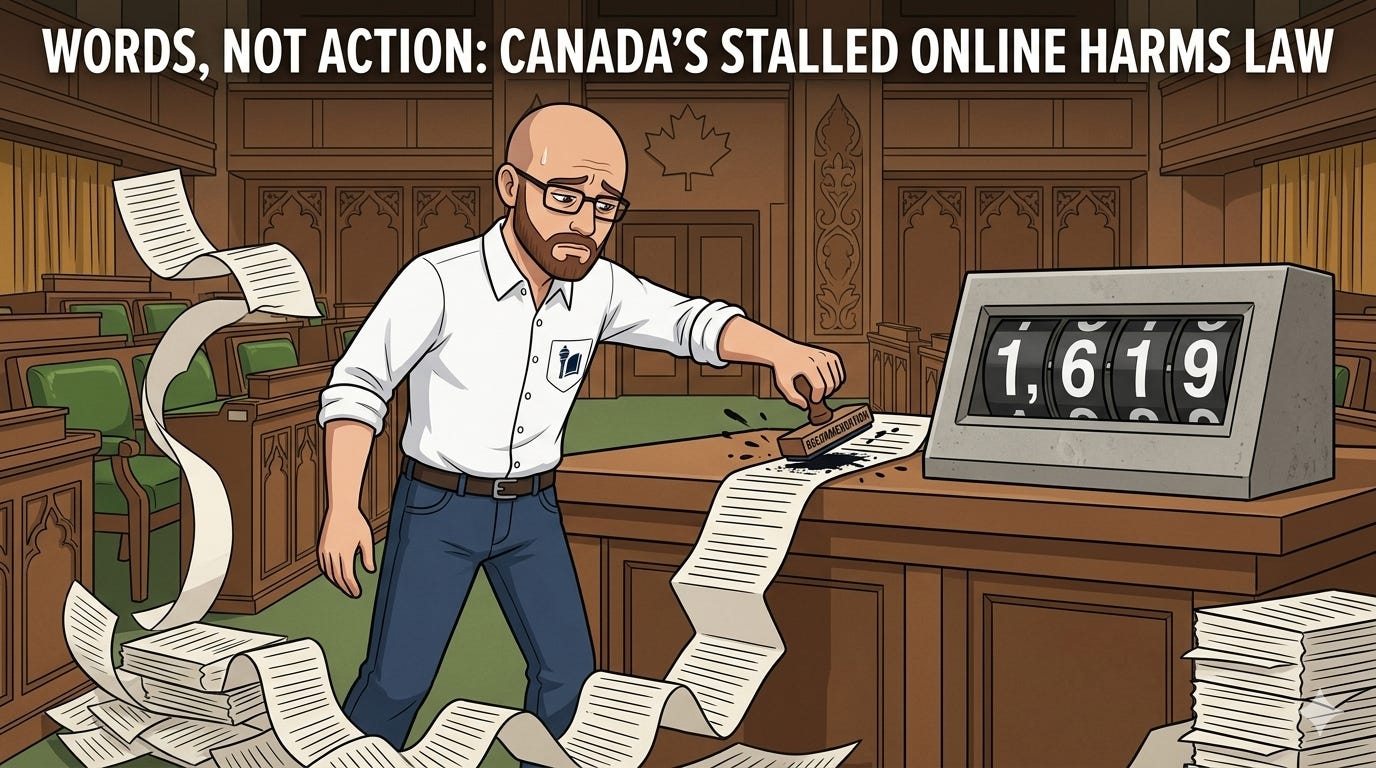
The 1,619-Day Number
Sara Austin, founder and CEO of Children First Canada, gave the committee a different kind of count. By her tally, 1,619 days had passed since the federal government first committed to introducing an online safety act.
“While Parliament studies, platforms profit,” Austin said. “And while committees debate, kids pay the price. Every day of delay costs children something they cannot get back, a day of their childhood.”
In a written brief, she called the situation “a rapidly escalating public health crisis.”
Witnesses repeatedly framed Canada as behind. Jocelyn Monsma Selby of Connecting to Protect, along with a brief from Children First Canada, noted that the United States, United Kingdom, European Union and Brazil have already moved to regulate the harms children face online.
André Côté of the Dais at Toronto Metropolitan University put it bluntly: “I really think we need to get on with it, and I don’t think we need to go back to square one.”
What the Numbers Behind the Scroll Look Like
The committee heard a flood of statistics meant to establish just how saturated children’s lives have become. According to figures Todd submitted in writing, half of Canadian children aged 7 to 11 already have access to a smartphone or tablet, and 83 percent of kids in grades 4 through 12 have a mobile device of their own. Nearly all Canadian youth aged 15 and older go online daily, spending an average of three to nearly five hours a day on recreational screen time.
Ève Tessier-Bouchard, editor of the children’s news platform Les As de l’info, told the committee that a quarter of 8-year-olds report having an account on at least one social media platform, usually YouTube or TikTok. Michael Cooper of Mental Health Research Canada said young people aged 16 to 24 are the group most likely to spend over six hours a day in front of a screen.
Aengus Bridgman of the Media Ecosystem Observatory offered a number with its own kind of weight: 81 percent of the youngest Canadians his organization surveyed now get their news primarily from influencers.
“They’re getting their news, their political information and their entertainment content. That is the source of their political and social life,” Bridgman said. “This has enormous repercussions for our political reality and for the training of youth in the political process.”
Grooming, Sextortion and a Border Crossing
Some of the testimony moved past statistics into specific harm. Monique St. Germain of the Canadian Centre for Child Protection, which runs the Cybertip.ca reporting line, told the committee that Cybertip processed over 29,000 reports in 2024 alone, most involving child sexual abuse material, with online luring and sextortion the next most common category.
Dr. Wanda Polzin Holman of Little Warriors described one case her organization treated: a 12-year-old girl whose parents were closely involved in her digital life and had set controls and monitoring at home. The breach came at school, where an online predator reached her through a platform the school’s safeguards hadn’t covered.
“They came to Edmonton, not once but twice, and met her at her school,” Polzin Holman testified. “At that point, they took her across the border in the United States and significantly sexually assaulted and raped her.”
St. Germain described how sextortion schemes often target boys specifically: predators posing as a female peer manipulate a victim into a sexual exchange of images, then threaten to release them to friends and family. Polzin Holman told the committee there had been an 80 percent increase in reported sextortion cases since 2020, and that Cybertip.ca logged a 150 percent jump in sextortion and online luring reports between June 2022 and August 2023.
Karen Orser of the Luna Child and Youth Advocacy Centre said her organization saw a 40 percent increase in cases of problematic sexual behaviour among children 12 and under in 2025 alone, behaviour she linked to exposure to harmful online content.
Built to Addict, Witnesses Say
Several witnesses described platform design itself as a driver of harm, not just a neutral conduit for it. Naomi Holland of Escalate the Conversation, drawing on neuroscience research into brain activity, described platforms as “built by design to addict,” telling the committee that companies pursue two things from young users: time on the app and scroll speed.
“They feed them something shocking, like a car accident. They look, and then they show them something sexy,” Holland said. “Then they show them something disturbing that makes them feel gross, so they scroll faster. They are being fed content that is truly like a dopamine drip.”
This is Holland’s characterization of platform design intent, presented to the committee as testimony rather than as an established finding.
Katie Paul of the Tech Transparency Project told the committee that internal research at major platforms had revealed companies’ own awareness of harms to children, alleging that “research was then buried by the companies so they could continue to profit from that harm.” Paul also told the committee that investigations by her organization had found Meta running ads for pill parties, alcohol, gambling, vaping and extreme weight loss aimed at users under 18, along with what she described as ads for illegal weapons including ghost guns and automatic firearms. These are characterizations offered in witness testimony rather than committee findings.
The Fight Over an Age Ban
No single proposal split witnesses more than the idea of an outright age restriction on social media use, the approach Australia has taken with its under-16 ban.
Tiana Sharifi of the Center for Exploitation Education argued plainly that “children under the age of 16 should [not] have access to social media platforms, because they’re not made for children.”
Daniel Clark of Western University said he’d “rather there be rules in place that are imperfect than to have nothing in place.”
Others warned a ban could backfire.
Holly Wood of Defend Dignity wrote that banning social media “doesn’t work and can actually make things worse by driving kids toward unregulated, dangerous spaces where the risks are higher,” noting that in places that have tried bans, young people moved to VPNs and burner accounts.
Matthew Johnson of MediaSmarts agreed that “excessive restriction can backfire” by pushing youth toward more risk.
Perhaps the most direct verdict came from a 12-year-old.
Zachary Fathally, a member of Children First Canada’s Youth Advisory Council, told the committee: “I don’t think a ban would really work, because kids can find workarounds.”
Thirteen Recommendations, No Bill
The report’s 13 recommendations call for a legally enforceable duty of care on platforms, an independent regulator with administrative monetary penalty powers, safety-by-design requirements, a ban on targeted ads and data collection aimed at minors, and explicit recognition in future legislation that youth suicide is a foreseeable outcome of sustained online harassment and sextortion. Several echo provisions from the previous Parliament’s Bill C-63, the Online Harms Act, which died without passing and which witnesses said faced criticism over fragmented departmental leadership, free expression concerns and amendments to the Criminal Code seen as overreaching.
In a supplementary report, Conservative committee members argued the previous bill’s approach was itself flawed, citing testimony from Defend Dignity that combining online safety measures with Criminal Code and human rights changes made the legislation “confusing and overly broad.” The Conservatives called instead for a narrower framework built around duty of care, monetary penalties and stronger sentencing for offenders, pointing to their own private member’s bill, Bill C-216, as a model.
What both sides of the committee room agreed on, in the end, was the testimony of the witnesses themselves. Perry Mason, a restorative justice consultant who submitted a brief to the committee, described the task ahead as regulating “a reality that moves faster than the law.” Carol Todd, for her part, made clear she has said this before, in other rooms, in other years. The report does not say what happens if Parliament fails to act before her sixth appearance.
Hansard Files spends weeks in the archives so you don’t have to. If stories like this matter to you, The archive stays free. A paid membership funds the hours to work the next file.
Source Documents
House of Commons, Standing Committee on Canadian Heritage. (2026, June). The Effects of Influencers and Social Media Content on Children and Adolescents (Eighth Report, 45th Parliament, 1st Session).
Unpopular truth: the government is not a substitute for parenting; full stop. Building a massive nanny state isn't turning out well. Adding layers more of legislation won't help.