


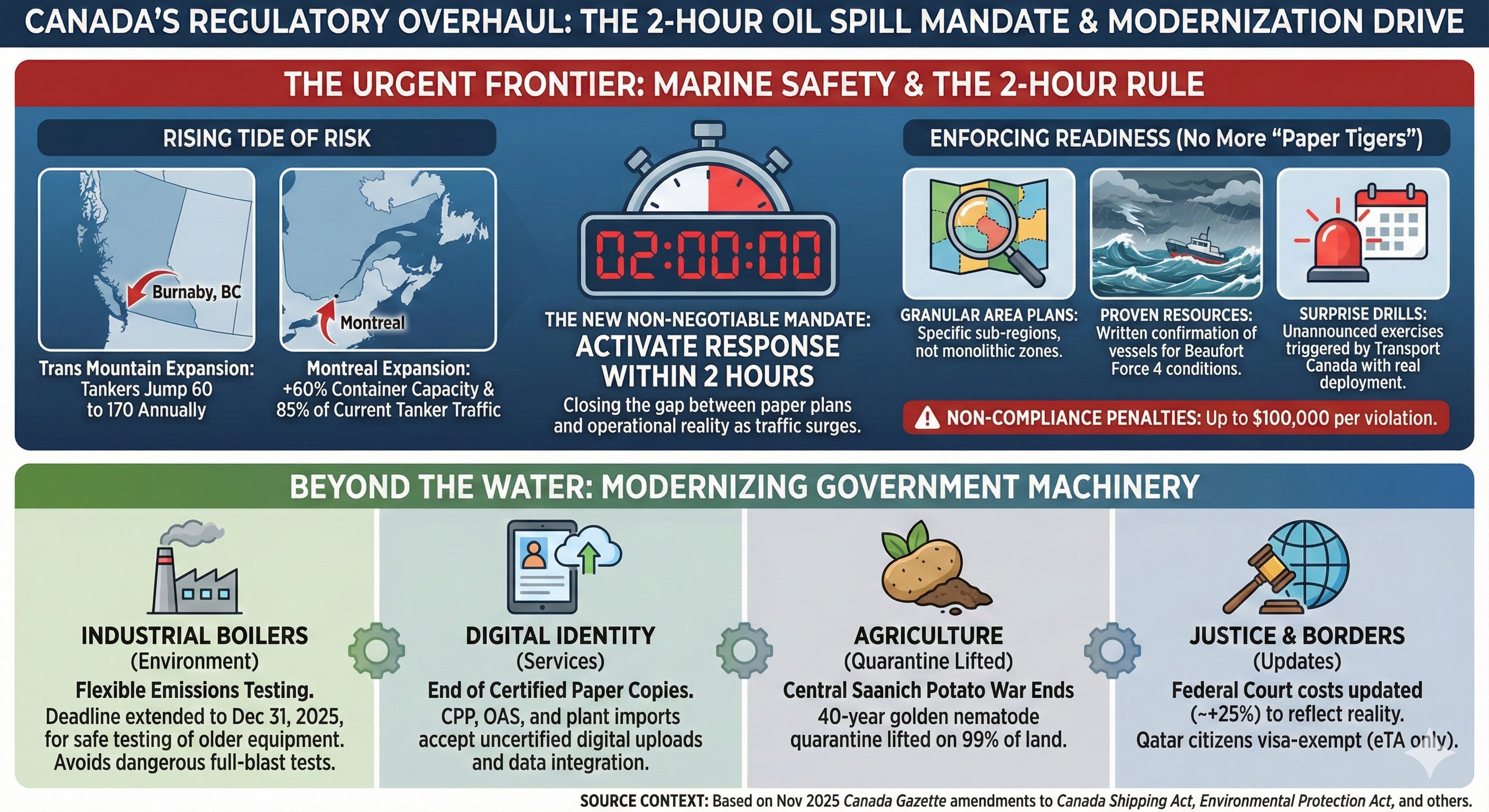
The clock begins the moment the alarm sounds. Out on the water, where the weather dictates survival and the margin for error is nonexistent, a hull breach can turn a pristine coastline into an environmental graveyard in hours. For decades, the safety net protecting Canadian waters relied on a regulatory framework established in 1995, a time before the Trans Mountain expansion and before the modern surge in Atlantic cargo traffic. Now, the government has pulled the trigger on a massive overhaul of its marine safety regime. At the heart of these changes is a singular, non negotiable demand: oil spill response organizations must be capable of activating their emergency protocols within two hours.
This new mandate is not a suggestion. It is part of a sweeping package of regulatory amendments registered under the Canada Shipping Act, 2001, designed to close the gap between theoretical planning and operational reality. As tanker traffic climbs toward twenty thousand movements annually off Canadian coasts, the federal government is enforcing a regime where readiness is measured in minutes rather than days.
This legislative update goes beyond the water. It touches the industrial heartland where boilers burn natural gas, the courtrooms where federal litigation costs are calculated, and the service counters where citizens apply for pensions. Yet, the through line is clear. The government is attempting to modernize its machinery, removing the friction of paper based bureaucracy while tightening the screws on environmental compliance.
The Rising Tide of Risk
The volume of oil moving through Canadian waters as cargo and fuel is rising. This is the driving force behind the Regulations Amending and Repealing Certain Regulations Made Under the Canada Shipping Act, 2001. The government’s own analysis points to a stark reality: cargo and container traffic has increased by over ten percent in the last decade. The Trans Mountain Expansion project alone is forecast to nearly triple the number of oil tankers served annually at the Westridge Marine Terminal in Burnaby, British Columbia, jumping from sixty to one hundred and seventy.
On the Atlantic coast, the Contrecœur Terminal Expansion Project in Montreal is expected to boost container capacity by sixty percent, increasing traffic along the St. Lawrence River. With eighty five percent of tanker traffic currently concentrated on the East Coast, the stakes for a catastrophic failure are distributed across thousands of kilometers of shoreline.
Under the previous regime, Response Organizations—private entities certified by Transport Canada to clean up spills—operated under planning standards that did not always account for the specific, localized conditions of the geography they protected. They relied on voluntary best practices to fill the gaps in regulations that had not been updated in nearly thirty years. The new regulations erase the ambiguity.
The headline requirement is the establishment of a strict activation time standard. Response Organizations must now demonstrate that they have the planning and procedures in place to activate their response plans within two hours of a request. This covers the critical initial phase of mobilizing personnel and equipment before they even reach the spill site.
The Geography of Disaster
A spill in the busy port of Vancouver presents a fundamentally different challenge than a spill in a remote inlet on the northern coast of British Columbia or the rocky shores of Newfoundland. The old regulations often treated vast geographic areas as monolithic entities. The new rules dismantle this approach.
Response Organizations must now subdivide their massive geographical areas of responsibility into smaller, more manageable sub regions. For each of these sub regions, they must develop specific Area Response Plans. These plans cannot be generic templates. They must describe the specific types of vessel traffic operating in that zone, the types of oil being transported, and the unique environmental sensitivities of the local shoreline.
This granular approach forces planners to look at the map with fresh eyes. A response plan for the Cabot Strait must account for different variables than one for the Juan de Fuca Strait. The regulations require these organizations to list the specific contractors and third party vessels they rely on to execute these plans. It is no longer enough to assume resources will be available. The organizations must hold written confirmation from vessel owners that their ships are capable of performing the assigned tasks and can operate safely in unsheltered waters during Beaufort Force 4 conditions.
The Element of Surprise
Paper plans are useless if they fail in practice. To ensure these new protocols work in the real world, the government has formalized a rigorous exercise program. Response Organizations must now conduct at least four notification exercises per year for each Primary Area of Response to verify they can reach their personnel and contractors immediately.
More significantly, the regulations introduce the power for the Minister of Transport to demand unannounced exercises. In the past, drills were largely pre planned events where staff and contractors knew the date and the scenario well in advance. Under the new regime, Transport Canada inspectors can trigger a surprise drill to evaluate readiness without the benefit of preparation.
These exercises will not be hypothetical tabletops. They will involve the actual deployment of equipment. The regulations mandate that organizations must be prepared to handle spills of up to ten thousand tonnes within specific timeframes. For example, in a designated port, equipment for a one hundred and fifty tonne spill must be deployed within six hours. In a Primary Area of Response, equipment for a twenty five hundred tonne spill must be delivered within eighteen hours.
The regulations also close a loophole regarding transparency. Response Organizations must now publish their fees in the Canada Gazette, ensuring that the shipping industry and the public have clear visibility on the costs associated with this safety net. Failure to comply with these new reporting and planning requirements can result in administrative monetary penalties of up to one hundred thousand dollars per violation.
The Industrial Boiler Dilemma
While the maritime sector grapples with spill response, the industrial sector is facing its own reckoning under the Canadian Environmental Protection Act, 1999. The Regulations Amending the Multi Sector Air Pollutants Regulations address a critical technical failure in how the government regulates nitrogen oxide emissions from industrial boilers and heaters.
These massive pieces of equipment, used in sectors ranging from oil sands to pulp and paper, are major sources of air pollution. The 2016 regulations required operators to test their emissions and classify their equipment by the end of 2022. Equipment that could not be tested or failed to meet standards was deemed to be in the worst performing class, known as Class 80. This designation triggers a requirement to meet stringent emission limits by January 1, 2026.
The problem, however, was physical reality. The Department of the Environment found that for many pre existing boilers, the required testing procedures were dangerous or technically impossible to perform. Operators faced a choice between risking catastrophic equipment damage during testing or accepting a default classification that would force them to retrofit or decommission perfectly functional equipment at a cost of millions of dollars.
The new amendments provide a lifeline. They extend the testing deadline to December 31, 2025, and introduce flexibility in how tests are conducted. Operators can now run tests at lower capacities if running at full blast would risk an explosion or mechanical failure. They can also use alternative methodologies for measuring emissions when multiple boilers share a common smokestack.
This is not a rollback of environmental standards but a correction of a regulatory oversight. By allowing proper testing, the government expects most of these “deemed” dirty boilers to be reclassified as cleaner Class 40 units, avoiding unnecessary capital expenditures estimated at fourteen million dollars while maintaining air quality standards.
Digital Identity and the End of Paper
Far from the industrial zones, the machinery of government is undergoing a quiet digital revolution. For decades, the administration of the Canada Pension Plan and Old Age Security relied on a pre digital artifact: the certified true copy. Applicants were required to submit original birth certificates or certified copies to prove their age and identity.
The COVID 19 pandemic shattered this model. With service centers closed and municipal offices shuttered, citizens could not obtain the necessary paper documents. The government was forced to adopt temporary measures allowing for digital submissions. The Regulations Amending the Canada Pension Plan Regulations and the Old Age Security Regulations now codify these changes permanently.
The Minister of Employment and Social Development can now determine a person’s age and identity based on uncertified copies or digital uploads. The system can cross reference data with the Social Insurance Registry or information from the Canada Employment Insurance Commission. This shift acknowledges a fundamental reality of the twenty first century: data integration is often more reliable than a physical piece of paper.
This modernization extends to the Plant Protection Regulations. The Canadian Food Inspection Agency is removing the requirement for importers to submit original hard copies of import permits and phytosanitary certificates if they have already been submitted electronically. This aligns Canada with international efforts to create a paperless global trade system for plant products, reducing the administrative burden on businesses that move everything from lumber to grain across borders.
The Central Saanich Potato War
Buried within the regulatory repeals is the end of a decades long agricultural quarantine. In 1965, the golden nematode, a microscopic pest that attacks potato roots, was discovered in Central Saanich on Vancouver Island. To stop the spread, the federal government imposed strict prohibitions on the movement of soil and plants from the municipality.
For forty years, landowners in Central Saanich lived under a regulatory cloud. They could not grow potatoes, tomatoes, or eggplants for commercial sale. Moving farm equipment required federal certificates.
Extensive sampling between 2010 and 2014 revealed that the pest had been effectively eradicated from nearly ninety nine percent of the land. The Regulations Amending and Repealing Certain Regulations (Canadian Food Inspection Agency) finally lift these outdated restrictions. For the one point two five percent of land where risk remains, specific notices will replace the blanket regulation. For the rest of the municipality, the soil is finally considered free, closing a long chapter of agricultural containment.
The Cost of Justice
The modernization effort reaches into the federal court system as well. The Rules Amending the Federal Courts Rules update the “Tariff B” structure, which dictates how much a winning party can recover in legal costs from the losing party.
For years, the tariff rates lagged so far behind the actual cost of litigation that judges simply ignored them, awarding lump sums instead to ensure fairness. This created unpredictability for litigants. The amendments increase the tariff amounts by approximately twenty five percent and simplify the calculation tables. While this increases the financial risk for parties who lose in court, it brings the cost of justice closer to economic reality.
Simultaneously, the rules update the title of “prothonotary” to “associate judge,” a semantic shift that reflects the evolving role of these judicial officers in managing the court’s heavy caseload.
Opening the Door to Qatar
In a move with geopolitical implications, the Regulations Amending the Immigration and Refugee Protection Regulations lift the temporary resident visa requirement for citizens of Qatar. Following a comprehensive review of socio economic conditions, migration trends, and security risks, Canada has determined that Qatar meets the criteria for a visa exemption.
This change allows Qatari citizens to travel to Canada for short stays using only an Electronic Travel Authorization when arriving by air. The government anticipates this will increase travel volumes by approximately four hundred visitors annually, strengthening bilateral ties and facilitating business travel. It represents a calibration of border security, shifting low risk travelers away from the heavy scrutiny of the visa process to the streamlined automated screening of the eTA system.
The Conclusion
From the cold waters of the North Atlantic to the server rooms of Service Canada, these regulatory changes represent a government attempting to catch up with the speed of the modern world. The mandate for a two hour response time for oil spills acknowledges that environmental disasters do not wait for bureaucracy. The shift to digital documents for pensions and plant imports acknowledges that physical paper is a liability in a networked age.
Whether it is giving boiler operators a safe way to prove their compliance or lifting a forty year potato quarantine, the thread connecting these diverse files is the removal of friction. The government is betting that by modernizing the rules, it can maintain safety and security without strangling the economy in red tape. But as the tankers continue to ply the coastlines, the real test of these new regulations will not be in the drafting, but in the execution when the alarm finally rings.
Source Documents
Department of the Environment. (2025, November 21). Regulations Amending the Multi Sector Air Pollutants Regulations. Canada Gazette, Part II, 159(25).
Department of Employment and Social Development. (2025, November 21). Regulations Amending the Canada Pension Plan Regulations. Canada Gazette, Part II, 159(25).
Department of Employment and Social Development. (2025, November 21). Regulations Amending the Old Age Security Regulations. Canada Gazette, Part II, 159(25).
Department of Justice & Department of Citizenship and Immigration. (2025, November 21). Rules Amending the Federal Courts Rules and the Federal Courts Citizenship, Immigration and Refugee Protection Rules. Canada Gazette, Part II, 159(25).
Department of Transport. (2025, November 21). Regulations Amending and Repealing Certain Regulations Made Under the Canada Shipping Act, 2001 (Environmental Response). Canada Gazette, Part II, 159(25).
Department of Citizenship and Immigration. (2025, November 21). Regulations Amending the Immigration and Refugee Protection Regulations. Canada Gazette, Part II, 159(25).
Department of Agriculture and Agri Food. (2025, November 21). Regulations Amending and Repealing Certain Regulations (Canadian Food Inspection Agency). Canada Gazette, Part II, 159(25).
Department of Agriculture and Agri Food. (2025, November 21). Regulations Amending the Plant Protection Regulations. Canada Gazette, Part II, 159(25).
This is such an important shift, and you lay out the stakes beautifully. For coastal communities — and really for anyone who cares about Canada’s waters — two hours isn’t a bureaucratic detail, it’s the line between containment and catastrophe.
What stands out to me here is the mindset change: we’re finally regulating for the world we live in, not the one we had in the 1990s. Tanker traffic has surged, weather patterns are sharper, and the geography hasn’t gotten any more forgiving. Treating every coastline as unique, testing readiness without warning, and demanding real, not theoretical, capacity feels like the kind of grown-up governance people have been asking for.
It’s also heartening to see environmental protection framed as operational competence — not as an add-on, but as a core part of how we run a modern country. These are the kinds of decisions that quietly strengthen sovereignty: when we set high standards, enforce them, and make sure those who profit from our waters can respond when things go sideways.