


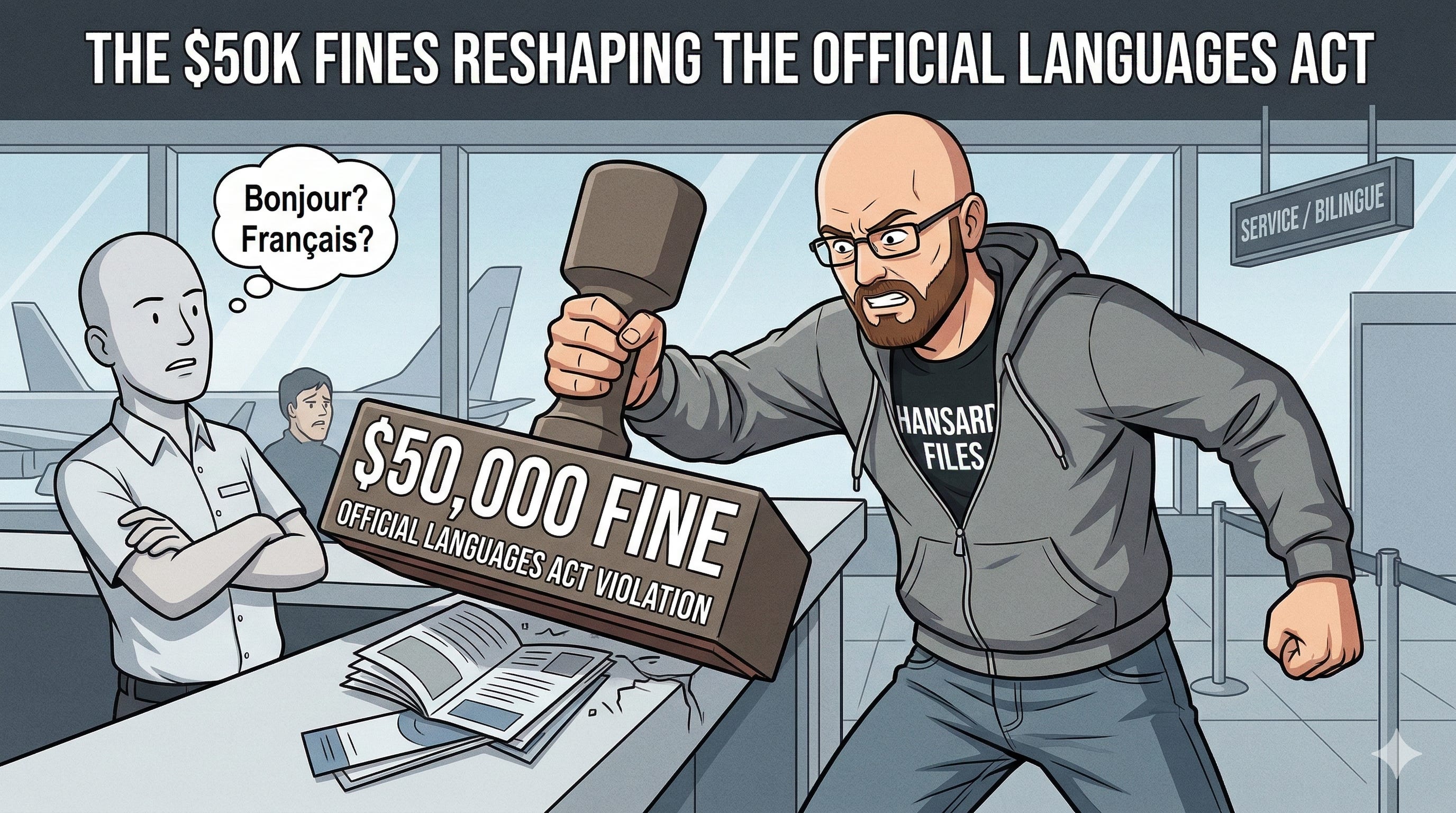
In 2021, the Chief Executive Officer of Air Canada stood before the Chamber of Commerce of Metropolitan Montreal and delivered a speech almost entirely in English, triggering an avalanche of complaints that exposed the glaring lack of enforcement within the Official Languages Act. The public fallout was immediate and explosive, generating more than 2,800 formal grievances and forcing the federal government to confront a decades-old policy failure. For decades, Canadian travellers have faced a persistent reality where demanding service in French on a national carrier or at a major transit hub often yielded blank stares or delayed assistance. The fundamental right to communicate in the official language of one’s choice, a cornerstone of Canadian identity enshrined in the Canadian Charter of Rights and Freedoms, had seemingly been reduced to a mere suggestion within the commercial transportation sector. Now, the federal government is moving to end the era of toothless reprimands. Through a sweeping new regulatory framework published in the Canada Gazette, Ottawa is utilizing targeted financial penalties to force compliance, putting the nation’s largest transit authorities on notice that ignoring linguistic rights will soon carry a heavy financial cost.
The 2,800 Complaints That Broke the System
The roots of this legislative battle stretch back to 1963, when the Royal Commission on Bilingualism and Biculturalism was established to address deep-seated Francophone concerns about inequalities within the federal administration. This commission laid the groundwork for the original statute in 1969, which officially recognized English and French at the federal level and guaranteed the right of citizens to communicate with federal institutions in their preferred language. The protections were further entrenched by the Canadian Charter of Rights and Freedoms in 1982, specifically under section 20, which mandates that federal institutions provide services to the public where there is significant demand. A subsequent reform in 1988 attempted to broaden these protections to better reflect the provisions of the Charter and advance the use of both languages in Canadian society.
Despite these historical milestones, the mechanisms for enforcing compliance remained severely limited. The Office of the Commissioner of Official Languages could investigate complaints, publish findings, and issue recommendations, but the office lacked the power to impose direct consequences for non-compliance. Over time, this dynamic created a culture of impunity, particularly among privatized or semi-privatized entities operating under federal jurisdiction. Between 2021 and 2024, a staggering proportion of complaints deemed admissible by the Commissioner involved communications with and services to the public, which are governed by Part IV of the legislation. In the 2023 to 2024 reporting period alone, 63 percent of complaints were related to this specific section.
The transportation sector emerged as a primary offender. Admissible complaints against airport authorities, Air Canada, and the Canadian Air Transport Security Authority climbed steadily. In the 2015 to 2016 period, 103 complaints were filed against entities serving the travelling public, but by the 2022 to 2023 period, that figure had quadrupled to 437. The data revealed a persistent, systemic failure in how these institutions interacted with the travelling public, demonstrating to lawmakers that administrative recommendations alone were no longer sufficient to guarantee linguistic equality in Canada.
The 55 Percent Failure Rate at Air Canada
To understand the scale of the enforcement challenge, one must look at the linguistic profile of the federal institutions providing services to the travelling public. As of September 2024, the Treasury Board Secretariat had identified 568 distinct points of service belonging to entities subject to the new enforcement regime. Of these, 340 locations (representing 59 percent) are designated as officially bilingual.
However, the compliance landscape is highly fractured. Air Canada, the nation’s flagship carrier, operates 454 of these service points, but only 248 of them (or 55 percent) are designated as bilingual. The breakdown within the airline’s operations reveals further disparities. While 122 of its international flights and 65 of its offices offer services in both English and French, only 61 of its domestic flights meet the bilingual designation. In stark contrast, VIA Rail Canada Inc. maintains a much higher threshold of compliance. Of the railway’s 79 service points, 62 are bilingual, with only two specific routes (the Jasper to Prince Rupert line and the Winnipeg to Churchill line) designated as unilingual English.
This fractured landscape was heavily scrutinized during a rigorous consultation process leading up to the new regulations. Between April and July 2024, the Department of Canadian Heritage conducted extensive meetings with minority language communities, provincial representatives, and the transit entities themselves. More than 1,300 Canadians participated in an online questionnaire, with half of the respondents completing the section specifically focused on monetary penalties. The feedback was polarizing. While a third of respondents demanded strict penalties for any violation of the statute, transit operators warned that escalating costs could compromise service viability and eventually be passed down to passengers. Despite the corporate pushback, the public consensus was clear: the unavailability of services in the official language of choice, coupled with the absence of active bilingual offers, required an aggressive regulatory intervention.
Designing the $50,000 Official Languages Act Fines
The legislative overhaul crystallized in 2023 with royal assent to An Act for the Substantive Equality of Canada’s Official Languages. This modernized framework granted the Commissioner an expanded continuum of powers, most notably the unprecedented authority to issue administrative monetary penalties. To operationalize this power, the government drafted the Official Languages Administrative Monetary Penalties Regulations, a meticulous framework designed to transform linguistic obligations from abstract concepts into strict financial liabilities.
The regime specifically targets entities operating in the transportation sector that provide services to the travelling public. This includes Air Canada, VIA Rail Canada Inc., Marine Atlantic Inc., and 21 designated airport authorities across the country. Under the new system, violations are categorized into three distinct tiers to ensure that penalties are proportionate to the severity of the infraction.
Type A violations involve services provided pursuant to a contract, such as third-party vendors operating within an airport. Recognizing the operational challenges and lower level of direct control the primary entity holds over these contractors, the penalties for Type A infractions are capped at $25,000. Type B violations encompass broader breaches of communications and service obligations, including services provided directly on behalf of federal institutions, and carry a maximum penalty of $50,000. The most severe infractions are classified as Type C violations, which involve breaches related to public health, safety, and security. For these critical failures, the fines are set between a minimum of $10,000 and a maximum of $50,000.
The Commissioner is granted significant discretion in determining the exact penalty amount within these ranges. This calculation is not arbitrary. The regulations mandate a thorough assessment of aggravating and mitigating factors. Aggravating factors include the duration and repetition of the violation, the number of passengers affected, and the impact on public safety. Conversely, mitigating factors account for the entity’s efforts to remedy the situation, its cooperation during the investigation, and its financial capacity to absorb the penalty. The size of the organization is also a defining metric, with smaller entities (those with fewer than 100 employees) facing comparatively lower fines than massive corporations.
The Federal Court Threat and the Cost of Doing Business
Issuing a penalty under this new regime is designed to be an action of last resort. Before a fine is levied, the Commissioner must exhaust other avenues, such as alternative dispute resolution and the proposal of formal compliance agreements. If an entity refuses to comply or fails to correct the systemic issue, the Commissioner will issue a detailed notice of violation.
The procedural requirements for these notices are deliberately stringent to ensure transparency and prevent arbitrary punishment. Each notice must explicitly outline the date the violation was observed, the specific provisions breached, and the precise methodology used to calculate the penalty amount. It must also include all relevant evidence gathered during the investigation, such as photographs or digital screenshots of non-compliant signage or communications. To streamline the bureaucratic process, the regulations permit service of these documents via registered mail, courier, or electronic transmission, provided an electronic acknowledgment of receipt is secured.
Once a notice is served, the offending entity faces a critical choice. The entity can pay the fine directly to the Receiver General for Canada, effectively admitting liability, or it can challenge the penalty. Entities are granted 30 business days to contest the decision before the Federal Court, where they can dispute the facts of the violation, the severity of the penalty amount, or both.
The financial implications for the government to oversee this robust system are not insignificant. The Department of Canadian Heritage estimates that the Office of the Commissioner will incur costs of $2.7 million over a 10-year period to administer the regime. These operational costs include the development of custom digital tracking tools, specialized staff training, and the inevitable legal expenses required to defend contested penalties in federal court. However, because the penalties themselves are classified as transfers rather than administrative burdens, the government insists the new regulations will not impose unfair compliance costs on businesses that are already following the law.
Modern Treaty Obligations and the Indigenous Language Intersection
Beyond the immediate financial penalties, the regulatory development process highlighted the complex intersection of official languages and Indigenous rights. In accordance with the United Nations Declaration on the Rights of Indigenous Peoples Act, federal planners initiated consultations with major Indigenous organizations, including the Inuit Tapiriit Kanatami, the Assembly of First Nations, and the Métis National Council. These discussions, launched in late 2024, focused on ensuring that the stringent new enforcement of English and French did not inadvertently marginalize Indigenous languages or conflict with modern treaty obligations.
While no direct conflicts were identified during the preliminary phases, the government committed to ongoing dialogue to harmonize the advancement of official languages with the preservation of Indigenous cultural heritage. Internally, the Office of the Commissioner of Official Languages is undergoing a significant operational transformation to handle its new judicial powers. Fueled by funding secured in Budget 2024, the office is adapting its digital complaint management systems to process the complex variables of the penalty regime. The system must seamlessly integrate the calculation of fines, the issuance of default certificates for non-payment, and the compilation of granular data for the Commissioner’s mandatory annual reports to Parliament. This transparency is intended to prove to the public that the era of ignored complaints is genuinely over.
The 10-Year Review for Substantive Equality
The rollout of the administrative monetary penalties represents a paradigm shift in how Canada protects its linguistic heritage. While penalties for Type A violations will be delayed for a one-year grace period after the regulations come into force, the broader system will be activated immediately upon registration. To ensure the system remains effective and relevant, the Minister of Canadian Heritage is legally bound to conduct a comprehensive review of the regulations and their enforcement every 10 years, with a subsequent report tabled before both Houses of Parliament.
For decades, the promise of bilingualism in Canadian travel has been a source of profound frustration for minority language speakers. The introduction of targeted, $50,000 fines signals that the federal government is finally willing to treat language rights as non-negotiable legal mandates rather than aspirational goals. The true test of these regulations will unfold in the terminals and cabins of Canada’s transit network, where corporations will have to decide whether ignoring the law is a risk they can still afford to take.
Hansard Files digs through dense government archives to uncover the legislative battles shaping our nation. Subscribe to support independent investigative journalism and never miss a deep dive into the policies impacting your fundamental rights.
Source Documents
Department of Canadian Heritage. (2026, March 7). Official Languages Administrative Monetary Penalties Regulations.
How does this play in the five provinces where it is difficult to find anyone who has even rudimentary French language skills?
Controversial take warning!!
Official bilingualism was studied by Pearson and implemented by Trudeau the Elder. It has had the effect of entrenching the Laurentian Elite throughout the bureaucracy in Ottawa. Due to the bilingual requirement, at this point almost all senior managers and deputy ministers are exclusively Quebecois who hire more on bloodlines than bilingualism. By which I mean if two bilingual candidates apply for a job; one of English descent and one of French descent, the French candidate will get the job, even if the English candidate is better qualified. Well qualified English Canadians hit "the Quebec ceiling" at the supervisor stage.
The only government branch which hasn't completely been consumed by this insanity is the Armed Forces where they've studied the impacts of requiring senior officers to be bilingual (as opposed to having translation available) and the impact on competence was measurably negative. Meritocracy won but barely. Other DEI measures have overwhelmed meritocracy. Hence the CAF struggle with recruiting and/or retention since no-one ambitious and competent wants to work where they know they'll end up hitting the Quebec ceiling.
IF those facts offend anyone, feel free to refute them... but good luck since I know I'm right...