


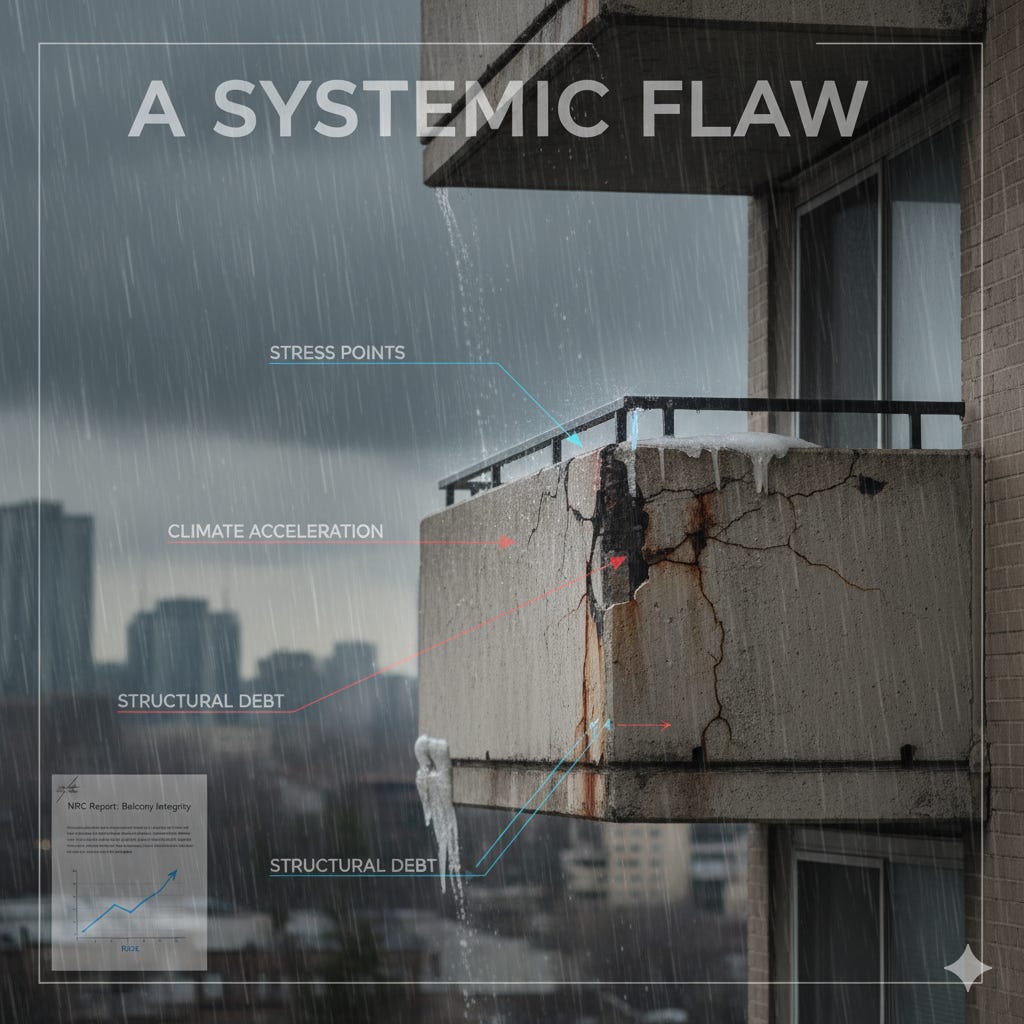
In April 2024, the National Research Council Canada (NRC), a federal agency, quietly published a report on a topic that affects millions of Canadians but rarely commands our attention: the structural integrity of residential balconies. The document, titled “State-of-practice, research gaps, and plan for safety and serviceability performance evaluation of residential building balconies in a changing climate,” is not the kind of publication that generates headlines. Yet, its findings point to a systemic vulnerability in our national housing stock.
The report’s core conclusion is unsettlingly clear. There are no distinct or specific methodologies in Canada to evaluate the performance of existing balconies. The standards we rely on for safety inspections are general, built for a stable climate that no longer exists. This gap between our official safety standards and the reality of our changing environment means we are underestimating a significant and growing risk. As the report states, balcony failures are “common occurrences and have often resulted in tragic human casualties”. This is not a theoretical problem. It is a failure of our regulatory systems to keep pace with reality.
A System Designed for a World That No Longer Exists
Here is the detail I find most revealing. When inspectors or engineers assess an existing balcony, they turn to major North American standards like the National Building Code of Canada (NBCC) or guidelines from the CSA Group. You would assume these documents contain precise, tailored instructions for evaluating a structure that is simultaneously load-bearing and completely exposed to the elements. You would be wrong.
The NRC report found a “notable absence of a dedicated methodology tailored explicitly for evaluating the performance of existing balconies”. Instead, the industry relies on general building evaluation methods that fail to account for the unique stresses balconies endure. These structures protrude from the building envelope, exposing them to a constant barrage of rain, snow, sun, and extreme temperature swings. The standards, however, lack provisions for assessing the “accelerated deterioration” that comes from this direct exposure. This points to a critical question: how can we ensure safety when our official rulebook does not fully address the specific problem?
The Accumulating Burden of Structural Debt
This regulatory gap has allowed our building stock to accumulate a form of Structural Debt. Similar to technical debt in software, where convenient shortcuts lead to future problems, Structural Debt is the accumulating risk we accept by failing to update our building standards to reflect new, well-understood realities. We defer the cost of proactive upgrades, and that debt grows with every season, compounded by interest in the form of environmental stressors.
The initial “loan” on this debt is often taken during construction. The NRC report identifies construction errors as the primary cause of balcony failures, a problem made worse by inadequate maintenance and irregular inspections. But climate change is the high-interest lender that dramatically accelerates the repayment schedule. The general evaluation methods currently in use “could underestimate the severity of the effects of climate change on residential balconies”. This is because the risks are not isolated, they compound. A small construction flaw that allows minor water ingress becomes a critical failure point when subjected to decades of more frequent freeze-thaw cycles and intense rainfall. The debt comes due when a balcony collapses.
Climate Change as a Silent Accelerant
The NRC report is specific about the mechanisms by which climate change is adding to our national Structural Debt. These are not future, abstract threats. They are active processes degrading our buildings right now.
Key Climate Stressors and Their Impacts on Balconies:
Freeze-Thaw Cycles: Rising average temperatures mean more frequent freeze-thaw cycles in many parts of Canada. Water seeps into concrete, freezes, and expands, causing internal stress and cracking. Over time, this “reduces concrete strength and increases the risk of chloride ingress, ultimately raising the likelihood of reinforcement corrosion”.
* Precipitation and Humidity: More intense and frequent precipitation, coupled with increased humidity, “heightens the risk of corrosion for steel components and creates conditions conducive to wood rot, a prominent cause of balcony failures”.
Atmospheric Carbon Dioxide: Heightened atmospheric CO₂ levels accelerate the carbonation of concrete. This chemical process lowers the concrete’s alkalinity, which in turn hastens the “corrosion of reinforcement bars and steel elements”.
Each of these factors attacks the primary materials used in balcony construction. What makes the situation so concerning is that our existing standards were not designed to account for the accelerated rate of this decay. The result is a system that provides a false sense of security, signing off on structures whose lifespans are being shortened by forces the rules do not fully recognize.
The Principle of Proactive Safety
This brings us to a foundational principle of governance. Public safety regulation must be dynamic and adaptive, proactively updating standards to address emerging risks rather than reactively legislating after a tragedy. The current approach to balcony safety in North America is almost entirely reactive. The report notes that more stringent inspection requirements in cities like Chicago and Berkeley, California were the “direct results of catastrophic collapses that resulted in the loss of life”.
We should not have to wait for the next disaster to act. The NRC report concludes by proposing a path forward: a collaboration with the CSA A500 technical committee to conduct new studies and ultimately integrate the findings into an updated national standard. This is the essence of proactive safety. It involves admitting our old assumptions are obsolete and doing the necessary work to build new ones that reflect the world as it is. It is a slow, unglamorous process, but it is how we pay down our collective Structural Debt before it comes due.
Concluding Insight
The integrity of our buildings is not just a matter of concrete and steel, but of the integrity of the standards we create to govern them. When those standards fall behind reality, they become sources of risk, not safety. A structure is only as strong as the assumptions upon which it was built.
Sources:
Bélec, G., & Almansour, H. (2024). State-of-practice, research gaps, and plan for safety and serviceability performance evaluation of residential building balconies in a changing climate (Report No. A1-023297). National Research Council Canada.