


In the shadowed corridors of power — where budgets are fought over and futures are forged — a single document slipped out almost unnoticed in November 2025: the National Research Council Canada’s 2024-25 Departmental Results Report.
It is not a press release.
It is a ledger of victories.
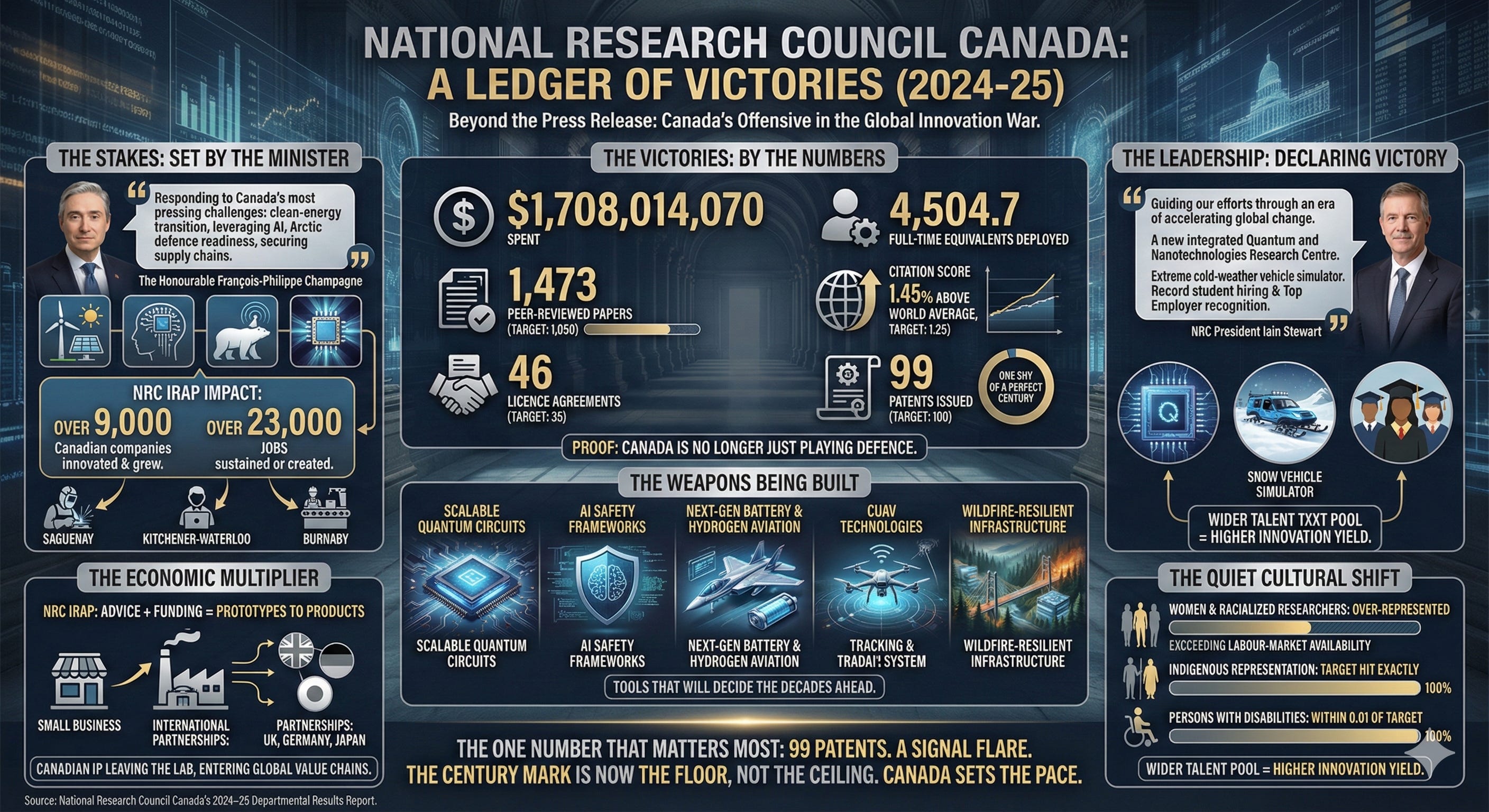
$1,708,014,070 spent.
4,504.7 full-time equivalents deployed.
1,473 peer-reviewed papers (target: 1,050).
Citation score 1.45 — 45 % above the world average (target: 1.25).
46 licence agreements (target: 35).
99 patents issued (target: 100 — one invention shy of a perfect century).
More than 9,000 Canadian companies touched by NRC IRAP.
More than 23,000 jobs sustained or created.
These are not footnotes.
These are proof that Canada is no longer just playing defence in the global innovation war.
The Minister Sets the Stakes
The Honourable François-Philippe Champagne does not mince words.
“Over the past year, the NRC … worked with government, academic and industry partners to support research and innovation that respond to Canada’s most pressing challenges,” he writes.
The challenges he lists are not abstract: accelerating the clean-energy transition, leveraging AI for productivity, strengthening defence readiness in the Arctic, securing semiconductor and photonics supply chains.
Then he drops the line that should make every Canadian sit up straighter:
“NRC IRAP helped more than 9,000 Canadian companies innovate and grow, and supported more than 23,000 jobs across the country.”
That is not a slogan.
That is a paycheck for a welder in Saguenay, a software revenue in Kitchener-Waterloo, a new production line in Burnaby.
The President Declares Victory
NRC President Iain Stewart is even blunter.
“Last year marked the launch of our new strategic plan … guiding our efforts through an era of accelerating global change.”
He then lists the deliverables, spoken like a general reporting to the nation:
A new integrated Quantum and Nanotechnologies Research Centre — the physical manifestation of Canada’s National Quantum Strategy.
A state-of-the-art vehicle simulator commissioned for extreme cold-weather testing — the kind of kit that keeps Canadian troops and researchers alive above the treeline.
Record student hiring and national recognition as one of Canada’s Top Employers.
Translation: the bench is deeper, the tools are sharper, the pipeline is full.
The Weapons Being Built
While diplomats talk, NRC researchers quietly shipped hardware and software that actually works.
Scalable quantum circuits — co-developed with partners — that can be manufactured at scale.
AI safety frameworks that industry is already adopting.
Next-generation battery systems and hydrogen-powered aviation concepts now moving to flight test.
Counter-unmanned aerial vehicle (CUAV) technologies now in the hands of the Canadian Armed Forces.
Predictive models for wildfire-resilient infrastructure and bridge design now embedded in national standards.
These are not PowerPoint slides.
These are tools that will decide whether Canada eats or gets eaten in the decades ahead.
The Economic Multiplier Nobody Talks About
NRC IRAP does not hand out grants and hope.
It hands out targeted technical and business advice plus funding that turns prototypes into product lines.
9,000+ firms received help.
23,000+ jobs linked directly to that help.
International partnerships with the UK, Germany, and Japan opened doors that Canadian SMEs could never have opened alone.
That is the sound of Canadian IP leaving the lab and entering global value chains — before foreign competitors even know the game has started.
The Quiet Cultural Shift
The equity ratios are not HR box-ticking.
They are a deliberate decision that the best ideas will come from the widest possible talent pool.
Women and racialized researchers are now over-represented relative to labour-market availability.
Indigenous representation hit its target exactly.
Persons with disabilities are within 0.01 of the target.
When the talent pool widens, the innovation yield rises.
The numbers prove it.
The One Number That Matters Most
99 patents.
One short of the century mark.
In any other year that would be a disappointment.
In 2024-25 it is a signal flare: the machine is running so hot that even the century mark is now the floor, not the ceiling.
Canada just showed the world it can set the pace — and almost did it perfectly.
Source Documents
National Research Council Canada. (2025). National Research Council Canada’s 2024–25 Departmental Results Report
This is one of the more useful breakdowns of the NRC numbers I’ve seen in a while. I’m glad you pulled this report out of the weeds — most Canadians never hear about it. If anything, it reminds me how much of Canada’s ‘innovation story’ happens out of view, especially in those small IRAP-supported firms that never make headlines but quietly anchor local economies. There’s a bigger conversation to have about how these wins translate into long-term domestic manufacturing and IP retention — but your post is a good doorway into it.